It is little over a year since Donald Trump stood in the White House Rose Garden and announced a raise in tariffs on foreign imports into the US for nearly every country in the world. ‘Liberation Day’ as he branded 2nd April 2025, and the fall-out from it, was the provocation that historian James Holland cited when discussing his latest book, The Visionaries: The Making of the Post World War II Order in the West, a noticeable pivot from his back catalogue of battlefield histories.
“I was really struck by what was going on with the current administration in the United States, the tariffs and the bullying tactics,” begins Holland in his interview with Phil Craig for Aspects of History. “It struck me that this was in such marked contrast to the very successful alternative approach taken by Franklin D. Roosevelt. You can moan and get cross about it, or you can actually do something about it.”
This is not simply history then, but an intervention, a blueprint for politicians today it seems. FDR appears on the cover of The Visionaries, the 32nd President of the United States entering office in 1933 amid the Great Depression and veering away from his predecessors’ protectionist tactics to international economic cooperation: “He is sworn in just six weeks after Hitler takes power in Berlin. Rather than bullying people and telling them what to do, he asks ‘Why don’t we have a Good Neighbor policy? We can help those countries, encourage them financially, and then we’ll do more trade with them. And guess what? We’ll get richer as a result.’ It’s a really, really interesting concept.” For Holland, Roosevelt’s masterstroke was identifying that generosity and self-interest were not mutually exclusive.
FDR’s leadership is most apparent in his rhetoric, maintains Holland who points to the force and relevance of his inauguration address, his ‘fireside chats’ broadcast on the radio and, later in 1941, his Four Freedoms speech: “Words really matter. You need to instill a sense of confidence, a sense of vision. Freedom of speech, freedom of religion, freedom from fear and freedom from want – it’s really, really heady stuff and it’s completely inspiring.”
Can economic history serve as an explicit warning to leaders today? Do governments the world over need to learn the lesson that economic nationalism fuels extremist political fires? “History constantly tells you that. Herbert Hoover’s Smoot-Hawley Tariff Act of 1930 led directly to the collapse of the Weimar Republic and the ushering in of Adolf Hitler. Yet here we are in the third decade of the 21st century with yet another trade war on our hands!”
The long-term fiscal intentions of Roosevelt’s first term were frustrated by the advent of the Second World War, but Holland explains that the seeds had been planted by the President ahead of time and subsequently upheld by his successor through ideals such as self-determination amid plans for peace: “The democracy that emerges after 1945 is envisioned by Roosevelt and Truman and it truly was progressive. Out of the Bretton Woods monetary treaty in 1944 emerges what becomes the IMF and the World Bank. It is completely revolutionary.
“I also think Truman is the most morally sound president that the United States has ever had. He is fundamentally a really, really good man. The Marshall Plan is actually his plan, and morally, it’s a good thing to do. But, again, in the long term, something that will also benefit the United States.”
For Holland, it is Roosevelt’s successor’s pragmatism and moral clarity, qualities working in combination, that marks out the Truman Doctrine and the first tranche of aid bestowed on Greece and Turkey in 1947. Rebuilding enemies like Germany and Japan and rejecting the prospect of a punishing the defeated too was revolutionary: “The victors should be financially bailing out the vanquished. Democracy is actually quite fragile. When you have economic chaos, political chaos follows; but when you have stable economics and economic growth, you have peace.” Prosperity as a form of peacekeeping is far cry from Versailles, a generation earlier, and the USA’s isolationist stance that followed.
This is where Holland’s urgent warning lies then, that the flipside of Truman’s approach, namely extremism and “wrecking-ball politics”, is the danger posed by today’s political fragmentation, populism and democratic complacency: “The alternative is a wrecking ball and they never ever work. We are no longer getting a consistent message from our leaders. That’s why it’s such a disaster.
“I’m a little troubled, but writing the book has given me greater respect for Roosevelt and Truman, two titanic figures. Not enough people today understand the benefits of their vision, that there’s another route, one that can help get us out of the mire.”
His admiration for the presidential pair is as palpable as his frustration at the economic and political amnesia that pervades the present. The post-war order and ideals forged a lifetime ago still underpin modern democratic life; the question is whether today’s leaders still choose to recognise that, let alone go about defending it.
And what of his other preoccupation this summer, namely a scenic history festival in the sloping downs of Wiltshire? The Chalke Festival is nigh approaching.
“It’s the last week of June, a gorgeous setting and everything you could possibly hope for from an English summer festival. Lots of food, plenty of camping, lots of things to do –every day is absolutely packed!
“At the absolute heart of it are our talks, a series of panels with amazing people – we’ve got Oscar winners, opposition leaders from Uganda and Venezuela whom you would never otherwise have the chance to see anywhere else in the UK other than at Chalke. Politicians, generals, eminent historians, much-loved celebrities and so much to do like workshops and living history displays. The spectacle is just fabulous.
“Everyone who comes absolutely loves it. So if history is your thing and you think history is important, then you can have a fantastic day, few days, week, however much time you want to spend there. It’s really a lot of fun.”

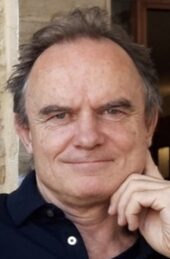
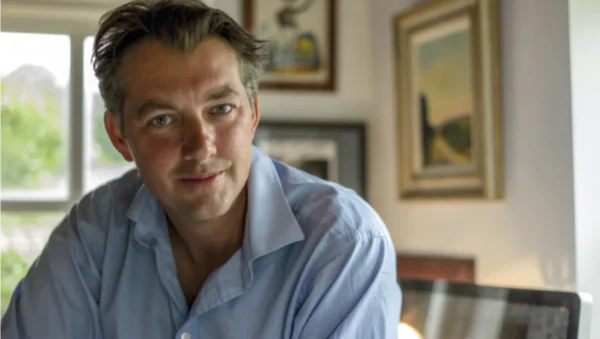
James Holland is a renowned military historian and broadcaster specialising in the Second World War, and the author of The Visionaries: The Making of the Post World War II Order in the West.
You can listen to the full conversation between James and Phil Craig on the Aspects of History podcast feed. And don’t miss James’ upcoming appearances at the Chalke Festival between 22nd and 28th June 2026!
Zeb Baker-Smith is a Classics teacher based in Malawi, a freelance journalist and Editor at Aspects of History.