

Welcome, Max, to Aspects of History. When the Editor contacted me to ask whether I wanted to review your new work on Domesday Book, I didn’t hesitate, having read and enjoyed a couple of your previous books. When I started reading, however, I soon realised this was something a bit different. In your own words, how would you describe Domesday: A Thousand Miles on Foot through the England of the Norman Conquest?
It’s a reflection on two Englands: the shattered, colonised and subjugated country of the Conquest and the England of today, linked by Domesday’s legacy as written in the landscape. Domesday is the book of the land; England is the land of the book. They speak to one another but they do so at a pace which is only discoverable at walking speed. On the way, I found out that the self-sustaining communities and landscapes of my great-grandparents’ generation in the late 19th century – with their lords of the manor, vicars, smiths, carpenters and ploughmen – took us nearly halfway back to the communities recorded in Domesday Book. We are closer to those times than we might think.
In the book, you describe a number of walks you have completed through several of the counties included in Domesday Book. How did you go about choosing which to include and which to leave out? And (from a selfish point of view), how on earth did Cheshire miss out?
I only made positive choices, knowing that I would miss much of interest in many other counties but not wanting the book to become a travelogue. I wanted to encounter new (to me) landscapes and a variety of them: fens, Weald, reclaimed coastlines and the massif of Dartmoor; the industrial conurbations of the West Midlands and the wasted hills of the North. A dozen counties out of 34 made for a good spread of regional diversity.
And then, with so many places to choose from in each county, how did you go about planning your routes?
I could have drawn almost any arbitrary route and found much that was of interest: Norman motte-and-bailey castles, churches and cathedrals; Domesday boroughs; barely-altered villages mentioned in the survey by the hundred. In the end, logistics played a big part: railways stations, campsites, cheap B&Bs and a few bucket list places that I wanted to visit: Deerhurst Anglo-Saxon church; Droitwich, the centre of the medieval salt industry; Castle Rising in Norfolk; Totnes approached from the River Dart; ferry crossings at Kings Lynn and Reedham.
Whilst your book is not (and does not try to be) an historical study of the survey incepted by King William I back in the 1080s, there is no doubting the document’s standing in the history of England. How would you sum up its importance at the time and from the perspective of today’s academics?
I would argue that Domesday Book should really form part of Britain’s constitution, it’s that important in defining the (then novel) imposition of a military autocracy on ancient customary relations between lord and tenant. It gave kings absolute power and shows how land ownership was concentrated in the hands of a few (about 200) Norman barons, almost all English lords having lost their estates. It legitimised and monumentalised conquest, and became a playbook for tyranny. Genocide, collective punishment and the attempted erasure of an ancient culture and heritage, all evident in the book, echo down the ages. Scholars of English Law and historical geography will still be trawling its deep, dark waters for generations to come.
It seemed to me that a rich seam of nostalgia ran through the book, almost as though it were an ode to a lost England or of a simpler time (but not necessarily that of the eleventh century).
I was deliberately trying not to be sentimental about ‘Old England’ – which suffered its share of brutalities and injustice, including slavery, blood feud and horrible legal punishments; but watching communities die before our eyes when they have survived such great historic upheaval is striking and unmissable to the traveller on foot. And, as an archaeologist, the sheer visible depth of our relations with the land is still thrilling – layer upon layer of road and hedge, field and farm – and not least the great treasure of our place names, formed in five languages across two millennia.
Just how many blisters did you have to cope with in the course of making this book?
The worst walks for blisters were those where I had to endure a lot of tarmac miles – Norfolk, Lincolnshire and Gloucestershire; but it’s an occupational hazard and sometimes led to charming encounters with strangers. Even the drudgery of relentless rain, and overnight frost on the tent has its narrative value. And I like to think that readers appreciate the authenticity of the lived experience.
Before we finish, I must just add that at the point I finished reading Domesday, my 90-year-old mother was staying with us. Born and bred in Sussex and a resident of Kent for many years as well, she devoured that chapter in one sitting. I’m not sure I can think of any higher praise.
I’m delighted to hear it. Kent into Sussex was a fascinating journey through many layers of deep time; and finishing with Battle, Pevensey and Hastings seemed like a perfect end point to a tour of the Domesday counties.
Finally, many people (me included) will be keen to know what’s in the pipeline. What are you working on next?
I have a project, deferred for a while, to write a history of the Early Medieval Kingdom of Dál Riata, with its Gaelic sea warriors and the greatest holy man of the Early Christian world, Saint Columba. Before that, I am going to write a book that taps into my archaeological roots, called simply Artefact. Watch this space.
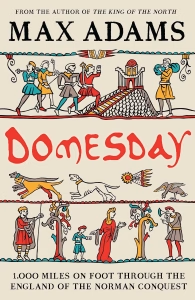
Max Adams is an archaeologist, historian and traveller and the author of Domesday: 1,000 Miles on Foot through the England of the Norman Conquest, published by Head of Zeus.
Paul Bernardi is the author of historical fiction set around the Norman Conquest. His forthcoming book, Wolf of Wessex, will be released in December 2026.