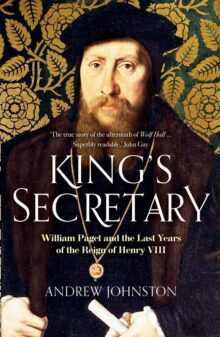
In the popular imagination, the role of Henry VIII’s most influential servant and politician is probably taken by either the scarlet-clad Cardinal Thomas Wolsey or the bulky, ruthlessly efficient, flint-faced Thomas Cromwell. These men certainly did dominate the king’s early and mid-reign. Yet, as heavily studied as Henry’s tenure as England and Ireland’s king is, those last few years – the years in which he reached the apotheosis of paranoid, terrifying tyrant – remain largely overlooked, at least in terms of his inner circle. As Andrew Johnston demonstrates in King’s Secretary, however, this is a critical period not just in understanding the Henrician or even the Tudor eras but in understanding English international relations, British politics, and the development of everything from intelligence services to religious identity to English – later British – bureaucracy.
The book’s subject is William Paget, 1st Baron Paget – a ‘stern and wintry’ looking figure who rose to prominence and power as one of the Tudors’ famous ‘new men’: one of those studious, well-educated politicians who benefitted from their education, entered into parliamentary politics, and climbed the rungs of local and national affairs until he found himself advising the government and sovereign. What results is a comprehensive study of the man’s political career under Henry VIII and, as the book looks ahead, under the ill-fated Protector Somerset (whose premiership, as is clearly laid out, Paget helped make a reality).
The focus, thus, is on Paget’s rise to power and his period at the top, and here Johnston shines. Drawing on a treasure trove of primary sources, both the intelligence of the man and the sheer complexity of the times are laid out in crisp, evocative prose. This granular focus allows for a really scholarly ‘deep dive’ into the late Henrician era: we see, for example, the careful intrigues Paget masterminded with French spies such as Giles Granado (who leaked secrets to England, via Paget, regarding French military support in Scotland at a time when the predatory Henry VIII was eagerly attempting to win influence in, and indeed control of, the northern kingdom). So too can we trace – with the usual caveat that it comes from John Foxe – the story of Robert Ockham, charged with carrying politically-explosive plans for destabilising the Privy Council on religious grounds (that is, expunging ‘heretics’) to the conservative Stephen Gardiner. Simply put, the laser focus on these years gives these micro-histories, which form part of the bigger picture of Henry’s reign, the attention they deserve, and Johnston carries them along with all the pace and skill of a novelist writing a spy thriller.
As the author notes, much is missing in the record when it comes to Paget – his private life and character are less immediate than those longer-lasting and sometimes ill-starred political heavyweights of the era. This means that, as a political biography (which King’s Secretary is), the book is a stunning achievement. It does not purport, however, to be a cradle-to-grave character study, and thus it does not cover the subject’s career once his star dimmed (Elizabeth I had little time for him and he died peacefully in bed, virtually in the political wilderness, in 1563, this after having managed to win over the Roman Catholic Mary I and thus retain power during her counter-Reformation). This does not, of course, detract from the quality of the book nor the sheer scholarship on display: it simply leaves one wanting even more.
Steven Veerapen is an academic specialising in the 16th and 17th centuries and the author of Overlord: The Life and Reign of Henry VIII, published by Yale University Press.