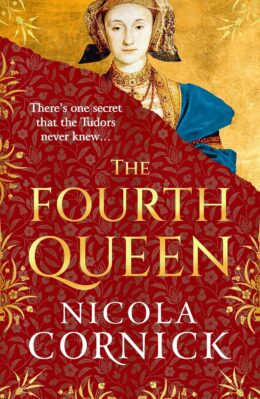
The Fourth Queen is Nicola Cornick’s latest Tudor historical fiction, set in the aftermath of the 1539 dissolution of the monasteries under King Henry VIII. Whilst Cornick is perhaps best known for her time-slip novels, The Fourth Queen takes a slightly different approach by exploring reincarnation through a dual timeline following Marris and her modern-day counterpart, Jenna. The result is a fresh perspective on Tudor history, and an imaginative and emotional story that explores memory, identity, the enduring bonds of sisterhood and the power of the past.
This novel follows Marris and her sisters, Bridget and Rose, as they are forced from Winterhill Priory following its seizure by the Crown. Stripped of their independence and the sanctuary the Priory once provided, Marris eventually finds herself at court as part of Anne of Cleves’ retinue. At the same time, she must reconcile her growing feelings for Sir William Sharington, the very man who has profited from Winterhill’s destruction. As Marris grows closer to Queen Anne, she becomes entangled in a dangerous secret that threatens them both. Meanwhile, in the present day, an archaeological dig at Winterhill leaves Jenna increasingly fearful that a 500 year old secret may soon be uncovered.
One of the novel’s greatest strengths is its portrayal of sibling relationships, with sisterhood in particular lying at its heart. Marris and Jenna both experience the complexities and tensions that arise from having personalities so different from their sisters. Jenna’s love interest, Owen, and his sister also offer an opportunity to explore the contrasting ways siblings can process grief. These sibling dynamics allow Cornick to explore the complexities of loyalty, loss and trauma.
Cornick’s love of history and historical sites shines throughout all of her novels, and The Fourth Queen is no exception. Her descriptions of the ruins of the Priory, gardens, and the natural landscape are utterly immersive and beautiful to read. Winterhill itself feels almost alive, becoming a quasi-character that embodies both permanence and fragility. The destruction of the Priory in Marris’ timeline and the later construction of Winterhill Hall vividly illustrate how landscapes evolve over time. By Jenna’s era, Winterhill has become a historic site, reminding readers how quickly traditions, identities and places can disappear if they are not preserved.
This novel also offers an imaginative interpretation of growing historical speculation surrounding Anne of Cleves. Rather than portraying her solely through the lens of her failed marriage to Henry VIII, Cornick presents her as a courageous, intelligent and emotionally complex figure. Through Marris’ perspective, readers witness a more intimate portrait of the Queen, revealing her loneliness, vulnerability and fear that her secret may be uncovered.
The Fourth Queen is a novel full of political intrigue, complex relationships, and a romance that spans the centuries. Effortlessly compelling and atmospheric, it explores belonging, memory, sisterhood, and the importance of honouring the past whilst learning to live fully in the present, making it a moving and imaginative addition to Nicola Cornick’s impressive body of work.

Ella Beales is a researcher, archivist and public historian.