
The latest Blandford Candy novel – A Visit to Bedlam – was born out of lockdown and a love of all things Alexandre Dumas. When COVID hit, my mum was severely immune-compromised due to COPD and dealing with a recurrence of breast cancer. I decided to take a break from teaching to look after her, planning on writing a lot whilst we were unable to go out. Mum’s condition didn’t really let it work out like that, and I found the only story I could actually focus on was the tale of a man falsely imprisoned and suffering in the medieval madhouse at Bedlam. As I said it was very much born during lockdown…
At first I planned on it being a short story, then a novella, then a couple of novellas, until it finally grew into a full novel. It is a digression from the main series, as the focus is on a side character rather than the usual protagonist, but the historical basis for characters and the background of France in the 1650s were a joy to research. The narrative voice is still Blandford Candy, he writes in the third person rather than his usual first person narrative, which is something I also enjoyed. I should emphasise for fans of the series, that the next book is a return to the old man’s narrative and a resolution to the cliff-hanger left dangling since The Emerald Cross.
Writing A Visit to Bedlam took me back to the historical three musketeers and D’Artagnan, the playwright Molière, and the work of Dumas. The falsely imprisoned man, escaping captivity to France, and hell bent on revenge is very much an homage to The Count of Monte Cristo and Alexandre Dumas more generally. However, it is very much an English reinterpretation of the idea. As a kid, Dumas’ books were some of my favourite novels to read, but my Hezekiah Hillier is not Edmond Dantès. Bedlam itself, England’s collective madness during the civil wars, and the question of the protagonist’s sanity loom large in the story.
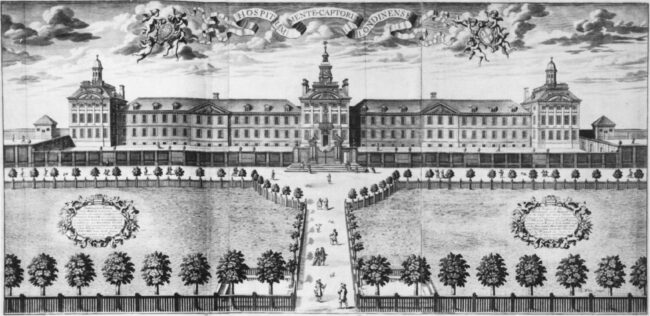
Bedlam had been established as a priory in 1247. By the 17th century, it had garnered a horrific reputation. The hospital was close to The Curtain and The Theatre playhouses, and the spectacles certainly influenced Elizabethan and Jacobean poets: Dekker and Middleton’s The Honest Whore was partially set in the hospital; The Duchess of Malfi, Bartholomew Fair and The Changeling all portrayed the asylum’s dark reputation for the early modern audience. Lady Eleanor Davies, committed to Bedlam in 1636 for ‘insufferable profanations’ said that Bedlam was: ‘to exchange the grave for hell, such were the blasphemies and the noisome scents’. Davies had caused a scene in Lichfield Cathedral and claimed to have visions (hardly an uncommon experience in 17th-century England).The playwright Nathaniel Lee commented on his imprisonment.
‘They called me mad, and I called them mad, and damn them, they outvoted me.’
Lee, one of the Earl of Rochester’s circle of delinquents, would spend five years interned in Bedlam, his mind completely broken, and would die in a drunken fit two years after his release in 1691.
Molière’s appearance in Dumas’ The Vicomte de Bragleonne, inspired his appearance in Bedlam, and his interactions with my interpretation of the musketeers. The playwright is a titan of world literature, and perhaps second only to Shakespeare in terms of influence and reputation when it comes to the 17th century. Born to a Royal upholsterer, Molière was enthused by the theatre from a very early age – despite his family’s disapproval. Aged 21, Molière founded the Theatre Illustre in Paris, but the venture went bankrupt two years later in 1645. After a short time in prison, he became an itinerant player, taking the company around the provinces to perform. The enforced exile from Paris would last until 1658, and there are scant details on Molière’s life and the Company’s travels during this period – absolute manna for a writer of historical fiction. During the 1660s, he was the toast of Paris achieving spectacular success and writing some of the most brilliant comedies ever produced.
Many years ago, when I was studying for my MA in Bristol, I was taken to the theatre in Bath for a performance of Tartuffe on a date. I had actually studied some Molière for my first degree, under the irrepressible Derek Alsop, but it was my first experience of Molière’s plays actually being performed. I think it is fair to say I was fascinated, amused, and enthralled by the show. Setting a book in France during the 1650s, and with such scant information on the playwright’s life at the time, just invited his appearances in my novel. I do hope that I have done the maestro justice.

Jemahl Evans is a historical novelist based in Wales and the author of A Visit to Bedlam, the latest in the Sir Blandford Candy Adventure series.