
‘English-grown saffron’ sounds like the subject of a contemporary, climate-change news story, akin to reports of olive groves thriving on the Lincolnshire fens, or award-winning Kentish vineyards. To learn, therefore, that the saffron in question had been cultivated in the past – between the 14th and 18th centuries, overlapping the Little Ice Age – came as something of a surprise. And then to find out that it was not just small amounts of English saffron, but a vast and highly profitable industry, provoked nothing less than astonishment.
My English saffron revelation issued from an unexpected source. An old university friend – known as ‘Dangerous Dave’ thanks to his propensity for wild student antics – surprised everyone by becoming the first of us to get married and settle down. One aspect of Dave’s domestication saw him move out of London into the commuter belt. The place where he ended up living was Saffron Walden in Essex.
Finding myself chatting to Dave at a party, I let slip my assumption that Saffron Walden must be some kind of new town – a postwar development like Welwyn Garden City or Thamesmead, given a bucolic name in order to lure in the City commuters. But Dave soon put me right. Saffron Walden was ancient, and far from the name having been chosen by some committee of utopian planners, it derived from the Tudor period, when the town had been the hub of the English saffron industry.
English saffron? How could that be? Saffron is an exotic spice, perhaps the most exotic in the world. How could it have been grown at scale in Essex – and at a time when the weather was much colder than it is today?
That faint, fluttering feeling you get – like a hummingbird beating its wings in your chest –when you hear something fascinating that you knew nothing about before is a precious thing. It first struck me many years ago, when I learnt that the majority of people in Gibraltar were of Italian rather than Spanish or British heritage. A series of legal thrillers about a Gibraltarian lawyer named Spike Sanguinetti ensued. It happened more recently when I stumbled upon a Victorian map of Chelsea and saw that the King’s Road had once been lined with exotic plant nurseries – The Plant Hunter (2022) was the result. And I felt sure that there was literary potential in this discovery, too.
Back home, I flicked through some history books, searching for mentions of Saffron Walden. According to Hakluyt in Principal Navigations (1598), the source of the town’s saffron dates back to 1339, when ‘It is reported at Saffron Walden that a pilgrim… stole a head of saffron and hid the same in his Palmer’s staff, which he had made hollow before of purpose, and so he brought this root into this realme, with venture of his life; for if he had been taken, by the law of the country from whence it came, he had died for the fact.’
So a thieving pilgrim had risked his life to smuggle back a single saffron crocus from the Holy Lands… It sounded a bit far-fetched. For a start, Hakluyt was writing more than two centuries after the alleged saffron theft. And I learnt that similar origin stories existed regarding the introduction of saffron to Switzerland (by a soldier) and Italy (by a monk).
I decided to make a trip to Saffron Walden. The town’s church is so prominent – the largest non-cathedral church in Essex – that it seemed the logical place to start my tour. Entering the cavernous nave, the source of the prosperity that had helped build the church was immediately apparent, with crocus emblems visible on the spandrels, and depicted on the stained-glass windows and kneelers. But also forming part of the decoration was a number of scallop shells – the traditional symbol of pilgrimage. One of these shells had been carved onto a part of the church that dated from the 14th century. Might Hakluyt have been right in his tale about the saffron’s arrival?
I set off through the well-preserved, timber-framed streets towards the Saffron Walden Museum. There I learnt that – after its introduction in the 1300s – the quantity of saffron being grown in the town had increased dramatically, so that, by 1514, Henry VIII had granted a charter changing its name from Chipping (or ‘Market’) Walden to the one we know today. I scoured the museum displays for more information. Writing in Holinshed’s Chronicles in 1587, a local clergyman named William Harrison explained why the crop had fared so well.
The saffron crocus – crocus sativus – was thought to have originated in Crete, before being cultivated more widely in the Middle East. The chalky, free-draining soil of North Essex had proven surprisingly similar to the dry crumbly earth of the Holy Lands, with the result that the ‘crokers’ (as the town’s saffron growers became known) ‘do carefulie observe’ that the plant ‘will prosper best in a lighter soile’. Such was their success, indeed, that the Reverend Harrison tells of one croker blasphemously remarking of his latest harvest, ‘God did now shite Saffron’.
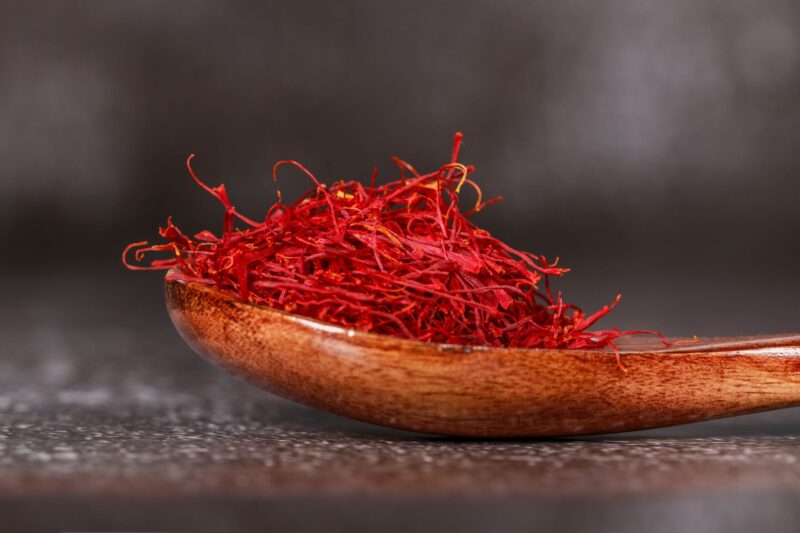
But however much saffron the crokers produced, it seemed the market was ready to absorb it. Why the insatiable demand? Tagine and bouillabaisse are rare enough on English menus nowadays, let alone hundreds of years ago. I continued my tour of the museum. Whilst the spice – which is formed by drying the bright red stigmas that protrude from the crocus flowers – did find some use in medieval cooking, and in clothes-dyeing, it was as a medicine that it was most prized.
‘Take 1 pound green walnuts, ½ ounce of saffron, ½ ounce London Treacle,’ urged Elizabeth Grey, Countess of Kent, in a 1653 treatise. ‘Beat them together in a mortar with a little cordial or some such water. Keep this in a pot… and it is good to cure the plague.’
The Black Death had struck England in the mid-14th century, I recalled. No doubt that was why the country had started to produce its own saffron around that time. It would save having to import it as a cure.
My next stop was the Saffron Walden Library, where I came across list of saffron prices over the years. Scanning through, I saw that the greatest spike in price had occurred in 1665, when the spice had sold for a whopping £4, 1d per pound. 1665 – the year of the Great Plague of London.
As I sipped a coffee outside the library in the town’s beautiful Market Square, a memory came rushing back to me. The year was 1999, and I was working as a sous-chef in a tourist restaurant in Venice, hoping to improve my spoken Italian as part of a Modern Languages degree. One of the first dishes I was shown how to cook was risotto milanese. ‘Use this sparingly, eh?’ the Head Chef had warned, holding up the restaurant’s tiny jar of saffron. ‘It is worth its weight in gold…’
If saffron was worth its weight in gold in modern times, how much more precious must in have been 1665, when it was considered a life-saving remedy? Suddenly, I realised the true potential of my English saffron discovery. There was a heist story to be told here – an English heist story, set in the 17th century.
Armed with the collection of pamphlets, books and leaflets I had accumulated in Saffron Walden, I returned to London and started researching whether any historical saffron heists had taken place. One had! In 1374, just outside Basel, a group of thieves had hijacked an 800lb shipment of Rhodes-grown saffron as it was transported through the woods towards the town. They took their spoils to a nearby castle and barricaded themselves inside. The Basle townspeople were in uproar, and a 14-week stand-off known as ‘The Saffron War’ had erupted, only to be settled once Leopold of Austria became involved, striking a deal with the Bishop of Basel to ensure the saffron’s safe return.
Basle had experienced a saffron heist – now I just had to work out how one could take place in Essex. Essex was close to London, I thought, and 1665 was close to 1666… Perhaps, if I set my saffron heist in 1666, I could incorporate the Great Fire of London as well? My hero could lose his fortune thanks to the fire, then make the short trip to Saffron Walden in order to try and regain it.
Excitement mounting, I set about plotting The Saffron Thief. As I did so, I learnt that the English saffron industry had started to decline in the years following 1666, so that by the end of the 1720s, there were no saffron crocuses being grown in Saffron Walden at all.
Some historians put this down to competition caused by an influx of cheaper Spanish saffron, others to the advent of a disease affecting the crocuses known as ‘The Rot’. But no one seemed certain why an industry at one point was considered the largest in the world – exporting saffron from Essex to the Continent – had mysteriously fizzled out. Perhaps I could link my fictional saffron heist to the demise of the industry. Now that would be a tale…
Finally, The Saffron Thief was finished. Now all I had to do was remember to send ‘Dangerous Dave’ a proof.
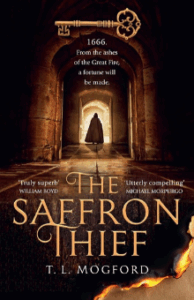
T.L. Mogford is the pen name of Thomas Mogford, a British crime novelist and the author of The Saffron Thief.


