My novel, Beyond the Edge of Light, is a love story set in the late 1930s and the first year of the Second World War. It tells the tale of two young people, one English, one German. Julia Ormesby, known as ‘Missie’, was brought up on the wild North-West Frontier of British India and is sent to finishing school in Europe. In Munich, she meets and falls in love with Conrad von Echlau, a down-at-heel member of the military aristocracy of East Prussia. Conrad is stridently anti-Nazi, but in common with many Germans of the time, circumstance forces him to become an unwilling recruit to Hitler’s war machine.
I attempt wherever possible to anchor my story with historical figures and events. Churchill and Reichsmarschall Hermann Göring both make appearances, as do Generals Kurt Student, the father of German airborne forces, and Hastings ‘Pug’ Ismay, Churchill’s formidable chief staff officer. Oberleutnant Witzig, the German parachute – or Fallschirmjäger – officer is there to lead the audacious dawn raid on the Belgian Fortress of Ében-Émael that first day of Blitzkrieg in the West. Hugh Dalton, Minister of Economic Warfare and member of the coalition war cabinet features at a key moment in the narrative, as does Colonel Colin Gubbins – appropriately, under fictitious pseudonym in my book – a past master of ‘Ungentlemanly Warfare’ and leader of Military Intelligence (Research) in Dalton’s secretive ministry. Then there is the great SIS officer Biffy Dunderdale, who from the ‘Passport Control Office’ in the pre-war British embassy in Paris masterminded an intelligence network that stretched across France and beyond. Perhaps Dunderdale’s greatest contribution to the war effort was the smuggling of a Polish-acquired German Enigma machine back to Bletchley Park in 1939.
The two prisoner-of-war camps in the northwest of England prominent in 1940, Glen Mill at Oldham and Grizedale Hall in the shadow of the Old Man of Coniston, also provide settings for the later stages of the story. Finally, I veer into local mythology with the persistent legend that a German raid took place on the Suffolk coast during the Battle of Britain, its reputed aim to snatch secrets from the Home Chain RADAR station at Bawdsey Manor… while providing me with vicarious means to enable my lovers to reconnect.
But, first of all, to the lovers…
***
Missie Ormesby
My mother, Sue, who died a couple of years ago in her hundredth year, lends her character and backstory to Missie. Both were children of the Frontier, the daughters of British Indian Army generals, veterans of Punjab regiments. Both were sent back alone to school in England at a punishingly young age, as was then the custom. Both were free spirits… both rebelled. Each of them ended up in secret service, my mother as an intelligence officer in MI5 during the Cold War, Missie as a translator at Bletchley Park.
The nickname, ‘Missie’, pays respectful homage to the White Russian princess Missie Vassiltchikov: another free spirit and courageous companion of the 20th July Plotters. She is a heroine of mine and her Berlin Diaries are the finest personal account of life in wartime Germany that I have read.
Conrad von Echlau
Conrad is more of an amalgam. His backstory, though, reflects that of a friend from my days serving in Germany during the Cold War. Like Conrad’s, his family was from East Prussia, and he too became swept along before and during the war by the contradictions of his loathing of Nazism, his loyalty to his men and duty to his country. The inspiration for Haus Echlau, Conrad’s home, came from Max Egremont’s wonderful book, Forgotten Land: Journeys Among the Ghosts of East Prussia, which drove me to explore the region for myself. Egremont’s title is well-chosen. Today north-eastern Poland, the former East Prussia, is a bewitching and peaceful place. But scratch the surface and the horrors of the 20th century are laid bare. I found ‘Haus Echlau’ at the end of an avenue of weary limes which lead nowhere beyond a set of grand but overgrown gates.
Nearby are the ruins of the palace of Schlobitten, once the seat of the zu Dohna family. It is mentioned in Beyond the Edge of Light and will feature more fully in a sequel. Prince Alexander, the last of his line to live at Schlobitten, fought on the Eastern Front. So, he knew what was coming when he returned home in late 1944, cashiered from the army for refusing to sign the execution order for a party of US paratroopers. An epic odyssey saw him spirit away from the advancing Soviets the entire German-speaking tenantry of his estates, as well as any Slavs who wished to accompany them. He also took with him a hundred brood mares and stallions of the famous Trakehner horse (featured in the book – think Lloyds Bank advertisements), saving the breed for posterity. Schlobitten today is an impossibly romantic ruin. Surrounded by near-impenetrable briar it has a Sleeping Beauty feel to it. The surviving façade, pockmarked with bullet holes, gives it a haunting one too.
Ében-Émael
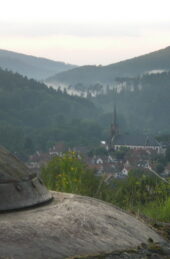
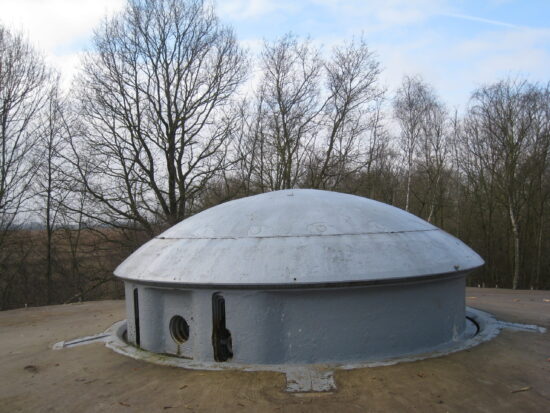
Thirty years ago, during a rare lull in my service with the SAS, my squadron commander allotted each of his troop commanders a special forces operation of the past to research and present to the squadron. I was given Fort Ében-Émael, a place – shamefully, for a special forces officer – I had not heard of before. The defence attaché at the German Embassy in London, namesake of the Stauffenberg of plot fame, arranged with his Belgian counterpart my access to the fort; back then, it was not open to the public. It was a time capsule. Several things struck me about it and have played into my account of the assault on Ében-Émael in the novel.
The true prominence of the raid in the development of special forces – as we understand the term today – lies largely forgotten. The strategic impact of drawing the attention of the Allies away from the Ardennes, the concealed avenue of Blitzkrieg, makes Ében-Émael the most successful special forces operation of the Second World War to that point – perhaps one of the most successful ever. And it occurred a full year before David Stirling first formulated the operating principles for his fledgling SAS – principles now adopted by most Western special forces.
The novel technology and tactics employed by the 86 Fallschirmjäger at Ében-Émael would seem to feed directly into Stirling’s later principles. The operation saw two firsts: the use of the shaped charge, in this instance to penetrate the steel observation cupolas of the fort’s artillery, thus effectively blinding its gunners; and the use of gliders as a means of delivering troops directly onto a target – at Ében-Émael piloted by members of the German national gliding team. As so often happens with methods that prove operationally successful, the wrong lessons can be drawn. Similar use of gliders, but without the critical element of surprise, led to horrendous casualties for the Germans in their airborne assault on Crete in 1941 and for the British 6th Airborne Division at Arnhem, where the landing grounds proved to be too far from the objective – itself a reaction to the carnage that had resulted from too-direct assault onto the Cretan airfields. On the other hand, the British capture by glider of Pegasus Bridge in the predawn of D-Day saw the lessons of Ében-Émael, including the pre-requisite of surprise, expertly applied to dramatic effect.
There is a famous photograph, which features in Beyond the Edge of Light, of the Fallschirmjäger officers who led the raid on Ében-Émael and the attacks on the nearby bridges over the Maas. They have just received the Knight’s Cross from Hitler, who poses in their midst. The expressions on the officers’ faces are grumpy, which led me to take the liberty of suggesting that one of them might be Conrad.
Bletchley Park
So much has been written about the Government Code and Cypher School at Bletchley that it needs no repetition here, except to say that Missie’s role as a translator in Hut 3 at ‘BP’ is pivotal to my story. The restored site at Bletchley is a masterpiece of modern museum curation. The attention to detail, right down to full ashtrays on every desk and the open dictionaries and atlases scattered about Missie’s workplace, contributes to a wholly immersive experience, which transports you back to a time when Bletchley was the epicentre of Britain’s war-winning efforts. If you haven’t already visited Bletchley Park, I cannot recommend it highly enough. It made research very, very easy.
Bawdsey Manor and Shingle Street
If there is another example of British innovation that can stand alongside Bletchley as a technological guardian of this country then it is radio detection and ranging, better known as RADAR. Validation of its potential took place on the Suffolk coast in the 1930s, first on a remote offshore spit (featured, in another context, in my novel), and then in earnest a few miles down the coast at Bawdsey Manor. By mid-August 1940, the Germans well appreciated the negative impact RADAR was having upon the Luftwaffe’s ability to prosecute its air campaign against Britain as precursor for invasion. They also understood the pivotal role Bawdsey Manor was playing, not just as one of the Chain Home RADAR early warning stations that now ringed the British coastline, but also as a principal research and development site for RADAR – and a geographically vulnerable one at that. To me, it is inconceivable that the Germans who, in technological terms, were 2-3 years behind the British in the development of their own FREYA system of radio detection and ranging, did not consider short-circuiting the developmental phase by snatching RADAR equipment and technicians from Bawdsey – if only to develop the countermeasures and flight profiles necessary to mitigate the effects of the Home Chain system on their campaign. After all, we did the exact same in reverse later in the war with the Bruneval raid.
It is at this point that I shamelessly mix history with legend as a mechanism for bringing my fictional protagonists back into the same orbit. Just to the north of Bawdsey lies Shingle Street which, in 1940, was a tiny, evacuated fishing hamlet. I don’t know what happened there that summer, and after the best part of a century I doubt anyone else does either. But the myth persists that it was the site of an abortive German raid – which, of course, suits my purposes as a novelist. All I would say is that many years ago when on leave from the SAS, I decided to sit down with maps, charts and a bottle of whisky to work out how, as a special forces officer, I would have tackled the task of snatching men and materiel from Bawdsey. One firm conclusion I came to was that I would make landfall up the coast by Shingle Street and approach Bawdsey covertly from the landward side. But that’s quite enough from me. It’s a legend, and legends need to be preserved.
***
I end on a more sombre note. When I started Beyond the Edge of Light six years ago, I believed that I was writing very firmly about the past – that doom-laden period leading up to the outbreak of the Second World War. But re-reading it recently in preparation for publication, it struck me that many of its theme lines – the emergence of extreme antisemitism and rise of rampant populism being two – seemed suddenly familiar and of the here and now. I remain a firm believer that history does not repeat itself. But, like those military planners having to relearn the lessons of Ében-Émael, we must be careful which path we choose.

Jamie Lowther-Pinkerton served for twenty years in the British army and is the author of Beyond The Edge of Light, his debut novel.