

Hello Paul. Congratulations on the release of The Last Emperor of China: Twilight of the Forbidden City. Why did the republican government allow Puyi to remain in the Forbidden City after his abdication? Was it a kind of insurance policy in case the new republic failed?
Not exactly – indeed the new government of the Chinese Republic was constantly nervous that Puyi could be a figure around which a restoration movement could rally to overthrow the republic and reinstate the Qing Dynasty or a new dynasty. But Dr Sun Yat-sen, the figurehead of the republic never believed there was anything to be gained from killing a boy emperor. It would not help the country unite. And so the imperial household reached an abdication agreement (Puyi was 6!) allowing Puyi and his so-called ‘Small Court’ to live in the northern portions of the Forbidden City, retain ownership of the Summer Palace and the imperial burial grounds. They also received a fairly generous annual stipend and were allowed to keep their imperial titles. However, they could play no role in politics or government. This was of course in stark contrast to the treatment the Tsarist Romanov family received a few years later in Russia!
What was daily life like for Puyi and his household inside the Forbidden City, and how isolated were they from the world beyond its walls?
They were not technically under house arrest but leaving was difficult. Wanrong, the last empress, entered the Forbidden City in 1922 when she married Puyi and didn’t leave until expelled two years later when an anti-monarchist warlord captured Beijing. Puyi visited his father, Prince Chun’s, house (the nearby Northern Mansion or Beifiu) several times and the royal couple visited the Summer Palace a few times – but always in chauffeured cars with military escorts and the ever-curious public kept away from them.
Why did the imperial court rely on eunuchs rather than a servant class of both genders?
Well, there were ladies-in-waiting, older men who were tutors, military guards on the gates of the Forbidden City and some close family but otherwise within the royal apartments and pavilions everything was done by eunuchs. It had been this way for over 500 years. A strange practice, but one parents condemned their sons to knowing a palace eunuch post was an “iron rice bowl”, a job for life. They were close servants, valets, advisers – but also they cleaned, cooked, swept up, mucked out the horses and much more mundane tasks. The main reason of course is that if only the emperor, a few trusted close family (and men like Reginald Johnston, Puyi’s Scottish tutor), no one else should be allowed near the empress and royal concubines to taint the imperial bloodline of succession. Eunuchs, obviously, are not a threat in that regard!
How do Isabel Ingram’s diaries change our understanding of Puyi and Wanrong’s marriage and private life?
It’s important to know that the young American tutor to Wanrong, Isabel Ingram, was almost totally written out of the story of the last days of the Forbidden City as an imperial palace before Puyi and Wanrong were disastrously expelled into the hands of the Japanese. She is not in Bernardo Bertolucci’s famous 1987 film, The Last Emperor, nor is she really mentioned in Johnston’s memoirs. Yet, she entered the Forbidden City with Wanrong in 1922, stayed by her side, came to know Puyi and Johnston well and, unbeknownst to historians, kept a diary of it all. I was lucky enough to be shown that diary by her descendants.
Traditionally the relationship between Puyi and Wanrong has been portrayed as distant and cold, loveless, the emperor impotent. But in Isabel’s diaries we get a very different picture. We see a young couple struggling in weird and unique circumstances to forge a relationship – playing tennis, enjoying photography, bicycling, trying western cuisine, watching silent movies, playing dress-up and having picnics. It is an altogether more sympathetic portrait of the young couple – which, in a sense, makes their later tragedy all the more painful.
What does Ingram’s perspective reveal about the couple’s lives that Johnston’s memoir and Puyi’s autobiography do not?
Primarily we see them as affectionate. Both Chinese and Western scholars and historians have long shown the couple as loveless, in a relationship lacking intimacy, sex. But Ingram, and this is reinforced in letters between her and Johnston, are aware that the young couple (they are 16 or 17 years old in this period) are intimate in their private quarters and affectionate in public. This is a major new understanding of the royal couple. Once again though, it makes their later estrangement and hard life all the more tragic.
What do we know about Puyi’s time under Soviet custody, and how was he transferred to prison and re-education in China?
Puyi did write about this period himself in his memoir, From Emperor to Citizen, but it is almost impossible to tell how much that was censored, ghost written or written to not anger the communist authorities. I think the years at Fushen Re-education Camp were tough – constant ideological “struggle sessions”, bad food, very cold weather. It certainly combined to shorten Puyi’s life in his 60s. However, he survived – even though he had been anointed the Emperor of Manchukuo (Japanese-occupied Manchuria) and had only called on the Chinese people not the resist the Japanese. Many who collaborated with the Japanese were executed after the war.
I tend to agree with Chairman Mao’s far more sophisticated and educated No. 2 – Zhou En-lai who invited Puyi to lunch in the 1950s in Beijing after his release back into society – everything you did as a child, become emperor, abdicate, be expelled from the Forbidden City, was not your fault – you were too young. But everything afterwards – Manchuria and collaboration with the Japanese – you must be held responsible for.
Did Puyi retain his scientific and Western-oriented interests in his later life, after becoming a gardener in Communist China?
Well he had always been interested in plants and gardens in the Forbidden City. He also retained a lifelong fascination with ants and insects, that begun as a young boy watching anthills inside the imperial palace. As a teenager in the 1920s he developed an interest, encouraged by his tutor Johnston, in vernacular Chinese writing and novels. Vernacular was the language of the ordinary Chinese, the ordinary Beijinger and was express by modernist Chinese novelists such as Lao She, Lu Xun and Mao Dun. This was in contrast to all that Puyi had read before which was the great Chinese classics, written in elaborate classical Chinese script. It was in a sense the only way Puyi had for many years of hearing how ordinary Chinese people spoke.
Your article challenges portrayals of Puyi and Wanrong as political symbols or exotic caricatures. What do you hope readers will understand about them as people?
The royal couple could never escape being symbols of an old regime, the end of the feudal system and one, the Qing, that many felt had allowed China to become weak, corrupt and controlled by foreigners. For others they are symbols of the final days of the exoticism, the orientalism of ancient China, swept away by modernity, republicans and then communism.
What I hope my book does, using these new eye-witness, day-to-day sources is reveal a young couple, two teenagers, in an arranged marriage in the strangest of circumstances, cloistered in a 500-year-old imperial palace trying to find a way to exist, for their lives to have meaning and for them to forge some sort of loving and intimate relationship.
Are you working on any future projects or titles you can tell us about?
It seems I am doomed to always write about Beijing – which is fine, as it is a big city with a lot of history and I am very fond of it and its people. So I was delighted to be asked to write The Shortest History of Beijing in the ubiquitous and successful ‘Shortest History of….’ series. It was in some ways a tough assignment – put 3,500 years of one city’s history, 143 emperors, half a dozen dynasties and a couple of republics, several wars and an occupation in 40,000 words… and make it readable and engaging but also informative! But it was also a fun assignment as I could look back over my 35 years of engagement with China, the city’s changes, it’s up and downs and try to make them all meaningful into understanding how Beijing arrived at the 23 million-strong megacity capital of China it is today. It’s out next July and I hope it’s a worthy addition to a fantastic and ever-growing series of ‘Shortest’ books.
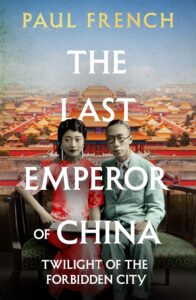
Paul French is the author of The Last Emperor of China: Twilight of the Forbidden City, published by Elliott and Thompson.
Trevor James was the editor of The Historian from 2006 to 2019 and is the author of Patterns in Local History; Five Case Studies.