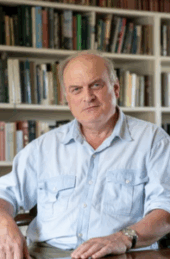

Welcome, Paul, to Aspects of History. Why did you choose to begin Reds: A Global History of Communism in antiquity rather than with Marx, Engels, or the Russian revolution? What do we miss when we treat communism as a purely modern phenomenon?
Because before it was a political movement, communism was an impulse. There’s plenty of evidence to substantiate the claim that hunter-gatherer societies in the Upper Paleolithic practised the same kind of altruism and sharing that surviving tribes do. I did a deep dive into the science and anthropology on this, only some of which is in the book, to show that the Marxist idea of “primitive communism” is flawed: hunter-gatherers who forbid private property almost always use coercion – ranging from scorn, ostracism to outright murder – against people who break their rules. So the idea that if you abolish property you abolish coercion and gender hierarchy is not proven. And that has big implications for modern-day communists: it means that, even where you abolish property, you run the risk of erecting new forms of hierarchy and violence – which is the precise risk Marx and Engels ignored.
On top of that I was frustrated by the claim that Marx somehow “invented” or systematised communism, and that everything before him was a kind of naïve Utopian experiment. Etienne Cabet’s 500-page book Travels in Icaria spells out in great detail what communism would look like: orderly, straight rivers, a single recipe book and a language that allows no deviations. It should have been read as a warning to those who – like me – do want to see capitalism replaced by something better. If you look at the whole history of communism as an idea – from Thomas More, the 18th-century French thinker Morelly, and Cabet right through to Lenin, Stalin and Mao – it’s Marx who is the aberration: the humanist, revolutionary democrat who refused to create a blueprint. Communism, before and after Marx, was basically a Utopian economic blueprint allied to an elitist revolutionary dictatorship.
One of your recurring themes is how idealistic activists came to acquiesce in repression and mass murder. What patterns did you find that recur across different communist regimes?
Not all did. I am attracted to those who saw the danger and veered away from it. I think they belong in the history of communism too: figures like Bogdanov, Lenin’s chief bank robber, who became an oppositionist under Stalin and wrote a science fiction novel predicting a society run by artificial intelligence; or Rosa Luxemburg, murdered in 1919, whose words in critique of Leninism were revived during the fall of the Berlin Wall.
But, ultimately, we are dealing with a Jacobin mentality: the ends justify the means. Marx is partially to blame here, because though his works are shot through with moral-philosophical assumptions clearly traceable to Aristotle, he publicly scorned the idea of moral philosophy. And when his immediate followers tried to graft a Kantian ethic onto Marxism, people like Lenin inculcated a complete and severe anti-moralism.
Paradoxically the working class themselves had a moral philosophy: we call it “class consciousness”. But Lenin’s touchstone was that the spontaneous ideas and cultures of working-class communities are “bourgeois” and had to be overridden by more rigorous ideas introduced from above by intellectuals. It’s all there in black and white.
It’s not well understood that Lenin’s biggest departure from Marx is his insistence that in a workers’ state there can be no law, only force. That’s a complete departure from the practice of Marx and his followers during the revolutions of 1848 and in the Paris Commune of 1871. And what it led to is something similar to what Arendt observed among the defendants at Nuremberg: people not only becoming numb to the value of human life, but numb to their own existence.
Pol Pot was an extreme example, but it’s not a paradox that he learned his genocidal politics on the Parisian intellectual left in the 1950s.
Was there a particular testimony or archive that fundamentally changed your understanding of the history of communism while researching the book?
Yes. The work of US historian Albert Weeks that shows the influence of a minor figure called Pyotr Tkachev on Lenin. Tkachev was an outlier in the Russian populist movement in the 1870s: he wanted a left-wing military coup against the Tsar, wanted to crush non-Russian nationalism (in Ukraine, Georgia etc.), hated the kulaks (the richer peasants) and advocated a “permanently revolutionary state”. Thirty years on, Lenin rediscovers Tkachev’s old newspapers in an archive in Geneva and adopts the whole prospectus. Lenin was often accused of “Jacobinism” or “Blanquism” – after the famous French armed insurrectionary Auguste Blanqui. Tkachev is the physical link between that tradition and Leninism. But Weeks got some of the dating wrong. With the help of Ukrainian researchers I managed to get my hands on a very rare memoir, of Lenin’s librarian in Geneva, that shows the exact sequence of how Lenin adopted Tkachev’s ideas. Until then, like many, I had assumed Lenin’s debt to Jacobinism and Blanquism was theoretical – but Tkachev was the living link, and the vehemence with which Lenin tells his followers to read this stuff is explicit.
It brought me to the ideas outlined above – that there is a communist tradition allying Utopian rigidity and totalitarian thought to the idea of an elite coup to create a revolutionary dictatorship, and that Marx, who rejected both ideas, is the outlier, not the founder.
You argue that the history of communism is not over. Which contemporary movement or trend most closely resembles the earlier moments in communist history?
It’s not over simply because of China. When I first reported from China – I’ve been five times – I met senior party members who assured me: “We are just Swedish social democrats, really. All we want is a welfare state and economic growth.” Under Xi Jin Ping, the party has revived the whole Marxist teleology. They fully intend to make the PRC the most powerful country in the world, and are using a mixture of state ownership, totalitarian thought control and rampant oligarchic power to achieve it.
As to movements, most far left movements in the West are now more influenced by anarchism, environmentalism or identity politics. The problem is, within them, you increasingly find people who think the PRC is somehow better than our liberal democratic system.
As you say, China occupies a prominent place in your account of the present. If China becomes the dominant global power, how might that reshape the world’s understanding of what communism means?
If China dominates the late 21st century they will get to write the definitions and the history books. So this is an attempt to set down what we, in the liberal democratic West, understand as a critical history of communism.
The danger is real. In the book I quote Walter Benjamin: “Not even the dead are safe”. The Chinese Communist Party has successfully smothered memories of Tiananmen Square in 1989: what might they do to 1917, the Spanish Civil War, or the American Revolution of 1776 if their historians gain the unchallenged power to rewrite such histories?
And the language of official Chinese history is impenetrable. I repeatedly go back and compare what happened in China – during the Great Leap Forward and Cultural Revolution – to the party’s own 21,000-word resolution on its history, which is a laughable set of euphemisms and cliches. Modern Chinese political discourse – to a far greater extent than in Orwell’s Ingsoc – is composed of meaningless preformed chunks of language. Orwell only imagined a world where individual words or phrases became cliches. Modern Chinese communism speaks in entire paragraphs that sound machine generated.
And fine, if that’s what you like in politics. But applied to historical narrative it is fatal to truth.
Having previously written about post-capitalism and the dangers of fascism, did researching Reds change your own views about what a radical but democratic alternative to today’s economic system might look like?
In the three years I’ve been researching this, the future for capitalism has darkened. The global economy is stagnant, democracies are decaying, the far right is rising. So we desperately need an alternative. But writing this deepened my determination to tell young progressives: not like this. My generation of left activists in the 1970s and 1980s despised Stalinism. Now, especially in the USA and in parts of the global south – for example South Africa – we’re seeing activists prepared to accept that the Gulag and Mao’s famines were real, with millions dead, but to shrug their shoulders and excuse these crimes as “decolonisation”.
Apart from Marx, which communist or socialist thinker emerged from your research with the greatest relevance for the 21st century, and why?
Like I say, I am drawn to the liminal figures: Elisabeth Dmitrieff, a feminist in the Paris Commune who tried to fuse Marxism with the idea of co-operatives; José Carlos Mariátegui – a Peruvian communist who in the 1920s was the first to advocate decolonising the mind; Vera Zasulich, the first Russian terrorist, who converted to Marxism in the 1880s and lived long enough to oppose Lenin’s seizure of power. And Manabendra Nath Roy, the first Indian Marxist, who towards the end of his life rejected Leninism and embraced humanism.
I suppose my own politics remain indebted most to Gramsci, under whose influence communist parties in the 1970s turned to democracy and alliances with liberalism. He’s hated by the modern tankie left. Sadly, because this is a history of communism, not Marxism, he plays a walk-on role in my narrative, spending the critical years a fascist jail where he died.
Reds feels like the culmination of a long engagement with the history of the left. After a book of this scale, what would you like to explore in a future project?
My next book is going to be a history of the League of Nations. The relevance should be obvious because, with the paralysis of the UN and the breakup of the rules-based global order, we are living through the second great failure of an attempt at international government.

Paul Mason is an award-winning journalist, a former economics editor of BBC Newsnight and Channel 4 News, and the author of Reds: A Global History of Communism, published by Head of Zeus.
Daria Santini is an independent scholar and the author of A Woman Named Edith: Emigre, Photographer and Secret Agent – The Extraordinary Life of Edith Tudor Hart.