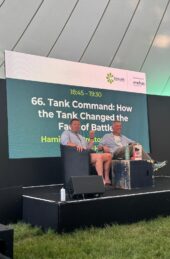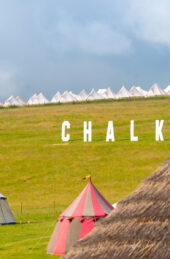

The passing of time has a strange way in these parts. As the carnyces sound around site, WW2 jeeps swing by, Celts mingle with civil war militia, Neolithic outfits juxtaposed with band members of the much-loved ABBA tribute, you’d be forgiven for a certain amount of confusion. The heat this week has only exacerbated that – and Friday, though marginally more temperate, had a ‘last days’ feel to proceedings. Accordingly, five days in, the hardcore – and I will take the liberty of including us in that – have begun imbibing and snoozing off the day’s exploits earlier than usual, girding ourselves for the night ahead.
Nobody rivals the mighty Saul David for bringing to life rip roaring military history. Recent volumes include Sky Warriors (about airborne troops), Devil Dogs and Crucible of Hell (Pacific WW2), and SBS Silent Warriors are must reads. He delivered a pitch perfect hour long lecture on Operation Torch, the joint US British operation to secure North Africa which has been neglected by history, quite unfairly. When Hitler found about the Alllied landings his arrogance resulted in a strategic blunder to reinforce, not withdraw, and the resultant loss of 250,000 men was a greater disaster than the better remembered Stalingrad. Making great use of maps, and a pacy lecture style (Saul used to run the wildly popular Buckingham Mil History MA), he took us through Churchill’s ‘periphery strategy’ designed to degrade the Axis strength via North Africa, and the battles which include the famous Kasserine Pass. The campaign ended Axis sea power in the Med and destroyed 40% of the Luftwaffe, as well as welding the team who would later win the war in Europe – Bradley, Patton, Monty and Alexander.
Ukraine: The Latest is one of the top podcasts that covers Ukraine, strategy, tactics, politics, and has been running daily since the start of the war. The presenters, Dom Nicholls, Francis Dearnley, and Adelie Pojzman-Pontay, are widely credited with keeping the Ukrainian’s fight in the public eye, even as the war slips from the front pages. The panel debated whether the war has reached a 1943-style pivot point, with Ukrainian strategy hinging on reaching 50,000 Russian losses per month. They are currently at 35,000. Unlocked European funding, a seeming shift in Trump rhetoric, and success in Crimea may all spell good news for Ukraine prospects. Two Ukraine soldier dialled in including the incredibly brave Anastasia, a combat medic, who movingly described the challenges of being 7-months pregnant on the front line, and being torn between front line soldiering and guilt for taking time out as a mother with a newborn. The team received a standing ovation from a packed out Guildhall tent, with overflow areas also full. Ukraine the Latest is so popular, and important, it deserves its own festival!
At the Forum, Gordon Corera and John Tregoning’s discussion, The Secret History of Chemical Weapons: Salisbury, Spies and Deadly Poisons, proved predictably popular for the Wiltshire crowd and ought to have been held in the Guildhall. The latter can take some applause for mentioning the Editor’s great-great-uncle, Sir Paul Fildes (a Porton Down developer of anthrax which was tested on Gruinard island) though he butchered the pronunciation.
Charles Moore, Thatcher’s official biographer, gave a nuanced defence of the Iron Lady’s leadership. Her ‘very English’ persona meant that she had a bit of a blind spot understanding Scottish culture, and couldn’t understand why the Scots might support any football team playing against England. I had no idea that Thatcher had three boyfriends simultaneously before she married Denis.
Thomas Asbridge has written a new account of the Black Death. His talk shifted the focus from biological data to the human dimension. Beyond the 100 million estimated deaths, the pandemic was defined by a pervasive “fear and dread” of the unknown, whereby some people feared the disease could be spread by a mere glance. Misconceptions Ashridge overturns included uniformity of experience, for some it brought “opportunity and advancement”, geography, the disease penetrated well beyond Europe into Asia and Africa, and transmission was unlikely to have been solely down to rats and fleas.
Nathen Amin, co-host of the Aspects of History podcast, was joined by Nicola Tallis and Matt Lewis to discuss, in entertaining fashion, that greatest of historical mysteries, the Princes in the Tower as the crowds swelled. The first sight of cloud was welcome, and the day continued to ebb away. Whispers that Tom Holland was finding his inner ‘Dancing Queen’ only added to the enthusiasm of the punters and bacchic atmosphere as the sun set behind the campsite.
Justin Doherty is a classicist, former army officer and advisor to governments on crises and complex situations.
Zeb Baker-Smith is a Classics teacher based in Malawi, a freelance journalist and Editor at Aspects of History.