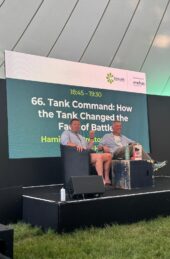

Chalke goers are a stoic breed and the 40 degree heat (and humidity) did not put a dampener on the day. Top of the billing was America 250: The Continuing Revolution: What Next for American Democracy with luminaries including Anne Applebaum (Gulag, Iron Curtain) and Sarah Churchwell (Careless People, Behold America). I gave it a wide berth.
Not because the speakers aren’t brilliant. Applebaum’s Iron Curtain is a magisterial account of the aftermath of the march of totalitarian communism and she’s great speaker. Rather, public discourse and now Chalke panels are so profoundly animated by anti Trump feeling that it is now obligatory to profess anti-Donald credentials at any turn. Whatever you think about the US President, it is incredibly dull to have to listen to speaker after speaker demonstrate their ideological conformity and to join in a ‘Two Minute Hate’: “The horrible thing about the Two Minutes Hate was not that one was obliged to act a part, but that it was impossible to avoid joining.”
So in order to avoid an hour of Trump bashing I went to Behind The Curtain: Stagecraft in the Age of Shakespeare. Why did the world witness such a dramatic surge in creativity, theatre, and playwriting in the 1570s? The dissolution of the monasteries freed up land, a new educated class emerged to replace the clerics, and an abundance of sources inspired not just Shakespeare, but a whole generation of writers. Shakespeare revels in blood and gore, animal blood was a common prop, and execution victims wore night shirts because they were easier to launder.
Next up was Tim Bouverie, a sure-fire crowd pleaser, who packed the Moot tent in 2025 having just published the excellent Allies At War, The Rivals Who Defeated Hitler. The book is now in paperback and Tim’s theme was the extraordinary relationship between Churchill and De Gaulle. De Gaulle rubbed everybody up the wrong way, and Bouverie brought his Gallic arrogance, hauteur and aloofness to life with brio. This ‘ill-tempered unteachable horse’ bit the hand that fed him, and was profoundly ungrateful to Churchill. He believed gratitude implied diminishing Frech greatness. De Gaulle’s tantrums were legendary but were a helpful negotiating tactic given that British hatred of rows often meant we backed down. Bouverie’s story has happy ending as De Gaulle pays Churchill a huge compliment when they finally enter Paris, and Churchill helps save the French empire from Roosevelt’s efforts to dismember it.
By this stage the heat had become so fierce (the hottest day for 50 years) that the only answer was to swap my customary Butcombe for a cold refreshing glass of cider. Off to ‘the Scottish Play’. A highlight of last year’s Chalke was the magnificent On Cue Theatre Company, who follow authentic Elizabethan performances with players never having time to learn every line, relying instead on a prompter for lines and stage directions. The artifice works well, and after a few minutes you don’t even notice it, in fact the rough and ready aspect of the performance adds a certain ad lib energy.
Macbeth’s “Is this a dagger” scene was addressed to two young boys in the audience, who certainly will never forget this performance. The witches pulled out dripping intestines (or were they chipolatas?) for the cauldron scene. It was an assured and well put together production and I do very much hope to see more of the brilliant On Cue Theatre Company.
Earlier in the stagecraft panel, we’d learned that the injunction against saying the Scottish Play directly is as twentieth century idea, a reaction to the rationality of Burnham Wood as moving camouflage, and Macduff’s Caesarean birth being simply a medical fact. The curse may have been an effort to inject an element of magic into a play which ultimately nails its rationality to a mast.
That said the curse can be lifted by quoting from A Midsummer Night’s Dream, and so “as the summer still doth tend upon my state…” “Now until the break of day, Through this house each fairy stray.” And goodnight from Chalke.
Justin Doherty is a classicist, former army officer and advisor to governments on crises and complex situations.