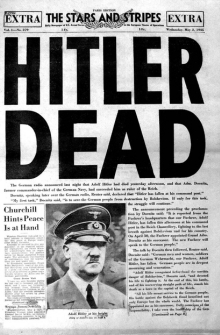
From 9pm on Tuesday 1 May 1945, the programming on North German radio underwent an abrupt tonal shift. Light, uplifting tunes gave way to sombre music, interspersed with urgent instructions to ‘stand by’ for an important government message. 90 minutes later, three dramatic drum rolls resounded across the airwaves. There were a few seconds of painful, radio silence and then the announcer delivered the brief but fateful news: Nazi leader Adolf Hitler was dead.
The next day, the international press was dominated by the recurring headline ‘Hitler Dead’. The phrasing offered a stark, and seemingly unambiguous, statement about the dictator’s mortal status. The cover of Time magazine struck out Hitler’s face with a large red cross, offering a vivid, visual metaphor for closure. Such representations conveyed a palpable sense of relief: Hitler’s death constituted the vanquishing of national socialism and promised an imminent end to World War Two in Europe.
And yet, doubts about the reality of Hitler’s demise set in quickly. By taking matters into his own hands and committing suicide within the privacy of his Berlin bunker, Hitler had avoided capture, trial and execution by the Allies. Leaving instructions for loyal staffers to burn his body likewise ensured that he evaded Benito Mussolini’s fate of having his corpse placed on mocking, public display. Hitler had not been seen to die. It was small wonder, then, that allegations of a Nazi cover-up began to spread. Rumoured sightings of Hitler proliferated across Europe and eventually evolved into enduring legends of his furtive flight to a South American hideout. The wartime Allies launched several postwar investigations to quell such speculation, but intelligence rivalries and Cold War tensions precluded the sharing of evidence. Accordingly, the search for definitive proof of Hiter’s death became a decades-long process.
To date, studies of Hitler’s death have typically borne all the hallmarks of a locked-room crime novel, with authors embarking upon a gripping, archival adventure to ‘finally’ solve the so-called ‘mystery’ of his fate. Much ink has been spilled over efforts to prove, or refute, the conventional historical narrative of a gunshot in the bunker. But tracing the twists and turns of the post-war intelligence enquiries is only one part of Hitler’s death story. It is surely more pertinent to ask why Hitler’s death has generated such an enduring public fascination.
To address this issue, my work has adopted a cultural history approach, aligning diary entries, newspaper reports, opinion surveys, songs, cartoons, exhibitions and other sources to explore the various meanings that Hitler’s death held for audiences around the globe. Embracing these materials exposes the extent to which people had invested emotionally in the prospect of the Nazi leader meeting a ‘fitting’ end. Indeed, if we step back from the events of 1945 and consider public discourse from the start of the war, it becomes clear that the death of Hitler was held up as a veritable war goal for the Allies. Propaganda posters imagined Hitler beaten and bloodied, crushed under the combined force of Allied military might, or fatally wounded by the strength of the civilian war effort. Hitler’s demise was imagined, rehearsed and even commercialised with several fundraising campaigns organised around the premise of selling nails for ‘Hitler’s coffin’, and recurring local newspaper stories about how people were planning to mark Hitler’s funeral. The popular American songwriter Irving Berlin captured the mood with a special 1942 ditty entitled When That Man Is Dead and Gone, the lyrics to which promised collective rejoicing when Hitler drew his last breath. In music halls, comedians performed skits about a dying Hitler while other pranksters printed mock versions of the Führer’s ‘last will and testament’. Anticipating Hitler’s death served as a form of entertainment and vital morale booster, an incentive to endure rationing and other wartime hardships. Unsurprisingly, there was growing public impatience for this moment to materialise.
But when North German radio finally made that momentous broadcast on 1 May 1945, it produced a complicated mix of emotions. From Australia, there were reports of coalminers downing tools and heading home in celebration as soon as they heard the news. In Central America, the government of Nicaragua declared a public holiday, perhaps realising that they might experience a similar loss of production otherwise. In London, the BBC offices erupted into cheers as word came in of Hitler’s demise. Yet many people expressed a sense of numbness, or bewilderment that the moment they had been dreaming of had arrived with so little fanfare. One British woman insisted, for example, that she thought she would ‘feel it’ far more strongly. There was also widespread dismay that Hitler had managed to cheat the executioner, prompting people to take matters into their own hands and enact their own form of reckoning one week later amid the VE Day celebrations.
Piecing together regional newspaper coverage reveals that many towns and villages across the UK marked the formal end of the war with singing, dancing – and the creation of a Hitler effigy for the local bonfire. Some communities even staged a mock trial for the effigy before carting it to the point of ‘execution’. By ‘prosecuting’, burning or symbolically executing Hitler’s effigy, civilians reclaimed a sense of agency, and transformed an unsatisfactory death into an act of popular justice. The moment proved cathartic – and also provided further opportunities for dark humour. One Gloucestershire village, for example, saw residents enjoying baked potatoes ‘cooked in Hitler’s ashes’ as their VE day bonfire was deployed to full effect.
The alleged sightings of Hitler that circulated throughout this period could likewise be interpreted as a desire to bring Hitler to account. Alerting the Allied authorities to a suspicious figure hiding in the woods near Hanover, or cruising around the coast of Schleswig-Holstein in a luxury yacht, implied a lingering hope that justice might yet prevail; that a living Hitler could be exposed, arrested and prosecuted for his deeds. But the emerging survival myths also owe much to both a legitimate public distrust of Nazi propaganda, and the general confusion that was fostered when competing narratives of Hitler’s final moments flourished in the days after that initial Hamburg radio broadcast.
The official Nazi message, as promulgated by Hitler’s named successor, Grand Admiral Karl Dönitz, was that the Führer had fallen in battle. But the Allies, anxious to quash martyrdom myths, responded by feeding the press stories of Hitler’s suspected health issues. Thus, just days after the German radio announcement, the media was filled with claims that the SS leader Heinrich Himmler had previously told a Swedish diplomat that the dictator was dying of a brain haemorrhage. Similarly, when captured bunker staff gradually began to talk of a Hitler suicide, there was considerable speculation about the most likely weapon. The Soviets, for instance, rejected the idea that Hitler could have shot himself ‘like a man’. Alternative theories emerged that Hitler may have ingested poison (typically regarded as a ‘woman’s weapon’) or had a lethal injection administered to him by one of his doctors. Each suggestion was designed to make the Nazi leader look as weak as possible. These competing claims over the very cause of death were less about forensic truth than about controlling his posthumous power.
Hitler’s death constituted a dangerous political weapon. For loyal National Socialists, he became the object of one last rallying cry: an example to fight to the bitter end and not let his ‘sacrifice’ prove in vain. For the Allies, he was a figure that needed to be handled with the utmost caution in order to affect a thorough denazification. This sensibility manifested itself not only in efforts to redirect the narrative regarding cause of death, but also in physical efforts to destroy the site of his former Berlin bunker to prevent it from becoming a shrine. Likewise, when copies of Hitler’s personal will and political testament were recovered at the end of 1945, there was considerable behind-the-scenes debate among civil servants and military intelligence staff as to whether these items should be displayed as a warning from history or destroyed altogether to prevent them falling into the hands of political sympathisers. The underlying Allied conviction was that, even in death, Hitler needed to be contained lest he infect the living.
Such debates over the handling of Hitler’s death have stretched beyond the immediate postwar period and into contemporary society and culture. The 2004 film Downfall, for instance, aroused criticism when it shied away from depicting the exact moment of Hitler’s passing. In a film otherwise littered with scenes of death and graphic injuries, the absence of Hitler’s suicide was perceived as giving him an unwarranted, dignified exit that risked mythologising him. The notion that Hitler requires special management also spilled over into the 2008 opening of the Berlin branch of Madam Tussauds. His waxwork was deliberately depicted as a tired, older and weakened figure, relegated to a darkened corner, set against a bunker backdrop and isolated from the other models. This was very much an uninspiring, end-of-days scene, rather than a representation of Hitler in his prime. Security cameras, rope cordon and a prohibition on photography endeavoured to deter people from getting too close, although the initial setup was not enough to prevent one visitor from immediately decapitating the waxwork. Today, the figure has been restored and put back on display, albeit behind glass. This is just one of many examples that suggest that Hitler’s death remains culturally unstable. More than 80 years after his suicide, attempts to visualise or narrate it provoke anxiety, as though mishandling his final moments might once again grant him symbolic agency.
Viewed through a cultural lens, then, it becomes apparent that the struggle over Hitler’s death did not begin in the bunker but long before it, in the fantasies and speculative scenarios through which civilians had already rehearsed his downfall. Because his demise had been so intensely anticipated, the absence of a visible reckoning in 1945 created a jarring gap between expectation and reality, one that only deepened the need to keep narrating what his death ought to have meant. His fate fostered rumours and reimaginings that drew directly on these earlier emotional attachments and granted Hitler a rather curious afterlife as a result. Cultural history, then, enables us to get closer to the myriad ways in which ‘ordinary people’ have engaged with Hitler’s death – and to better understand the sort of imaginative labour that societies undertake when formal justice is denied. But it also helps us recognise the challenges of handling the ‘difficult dead’. In death, Hitler retained the potential to disrupt the post-war political order. His end, therefore, had to be painted deliberately as unheroic; there could be no pilgrimage sites or makeshift shrines, no fond framing of his final words. Any posthumous legend had to be punctured before it could take hold and risk breathing new life back into the Nazi spirit. In these ways, Hitler reminds us that biological death does not necessarily constitute a neat endpoint. His demise was not the straightforward moment of closure that people had been hoping for, but the beginning of a protracted struggle over its meaning.

Caroline Sharples is lecturer at the University of Roehamptom, who specialises in modern German history, and the author of The Long Death of Adolf Hitler: An Investigative History.