Our Smolensk excursion was quite an event for me – being my first trip out of Moscow…
We were first going down there by car, but then plans were changed and a private train was provided – for us, two Foreign Office press officials and a bevy of N.K.V.D. The train was most sumptuous – clean – two cars with compartments and a diner. I had a compartment to myself and most of the others had three in a room. There was congestion only in the mornings – as 25 people for one john is quite a number, particularly when all the men shaved.
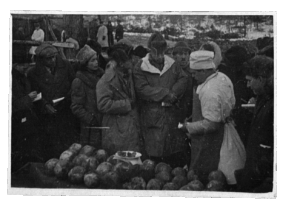
Kathy at the Katyn massacre site, January 1944. Image reproduced with the permission of the Russian State Archive. Photo provided by Paula Chan.
Though Smolensk isn’t much more than 200 miles away we took a goodly 18 hours to get there – our speed at best was not more than 30 mph and we spent hours on various sidings while priority supply trains passed en route for the front. Smolensk itself hadn’t much left of it – and compared to bombed English towns it gave the feeling of being completely dead and deserted. The town itself is on the top of the hill overlooking the Dnieper, with the railway station on the opposite side of the river. Back in July ’41, the Germans took the town quickly but had to fight a long time to capture the railway station – during that fight about fifty percent of the damage was done – the rest was German demolition last autumn. Smolensk has a lovely old Kremlin wall – the third oldest in Russia – dating back to mid-16th century. The Kremlin wall is fairly intact but in the town itself there are only some 64 buildings now whole out of nearly eight thousand. The present population is about a sixth of the prewar figure and they were occupied in getting the railway station in order or getting on with their own business of fixing up shelter to live in. Driving down the street, you’d see stove pipes sticking out of ground-floor windows – the cellars are the only really liveable places…
We travelled around in a convoy of cars – two of which were American trucks – but everyone else drove in slow pony-drawn sleighs – tough work for the ponies as there was only a slight amount of slush on the side of the main road – the middle was bear. After a short tour of the town we were conveyed out to the Katyn “forest” about half hour out…
The Katyn Forest turned out to be a small measly pine tree wood. We were shown the works by a big Soviet doctor who looked like a chef in white peaked cap, white apron and rubber gloves. With relish he showed us a sliced Polish brain carefully placed on a dinner plate for inspection purposes. And then we began a tour to each and every one of the seven graves. We must have seen a good many thousand corpses or parts of corpses, all in varying degrees of decomposition, but smelling about as bad. (Luckily I had a cold, so was less bothered by the stench than others.) Some of the corpses had been dug up by the Germans in the spring of ’43 after they’d first launched their version of the story. These were laid in neat orderly rows, from six to eight bodies deep. The bodies in the remaining graves had been tossed in every which way. All the time we were there, the regular work of exhuming continued by men in army uniform. Somehow I didn’t envy them! The most interesting thing, and the most convincing bit of evidence, was that every Pole had been shot through the back of the head with a single bullet. Some of the bodies had their hands tied behind their backs, all of which is typically German. Next on the program we were taken into post mortem tents. These were hot and stuffy and smelled to high heaven. Numerous post mortems were going on, each and every body is given a thorough going over, and we witnessed several. If Shirley had been there we might have been able to understand a little better than we did – personally I was amazed at how whole the corpses were. Most still had hair. Even I could recognize their internal organs and they still had a good quantity of red-colored ‘firm’ meat on their thighs. You see, the Germans say that the Russians killed the Poles back in ’40, whereas the Russians say the Poles weren’t killed until the fall of ’41, so there’s quite a discrepancy in time. Though the Germans had ripped open the Poles’ pockets, they’d missed some written documents. While I was watching, they found one letter dated the summer of ’41, which is damned good evidence.
So ended the first section of our tour. All feeling as though our clothes still retained the smell, we trooped back to our train for a hearty meal. Afterwards we were bundled back to town, where the Atrocity Commission received us. We had a long session with them – lasting until about eight o’clock – had dinner and then returned for another two-hour session. The committee room was warm and stuffy and I was very sleepy. Being scared of falling asleep, I kept verbatim notes – and thus kept from disgracing myself. We were given every bit of evidence the committee had unearthed and saw some of the key witnesses and were allowed to ask them our own questions. We were shown all the various documents that had so far been found (the committee had only been working a week) which included some U.S. notes and six twenty-dollar gold pieces!!!
Finally the show ended and we came back to Moscow. We tried to persuade the Foreign Office press people to let us stay another day to see the town, but the train’s schedule had to be kept, so we came back to Moscow. It would have been interesting to have talked to some of the town folk – we noticed that the marketplace was doing thriving business, but couldn’t see what was changing hands, other than huge logs of wood. Quite by chance I spotted a hospital (a converted one). There were huge truck-like ambulances with red crosses painted on their sides and people being taken out of them. Conceivably it was a base hospital as the front isn’t much more than eighty miles away.
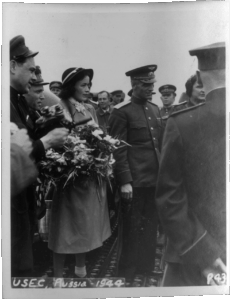
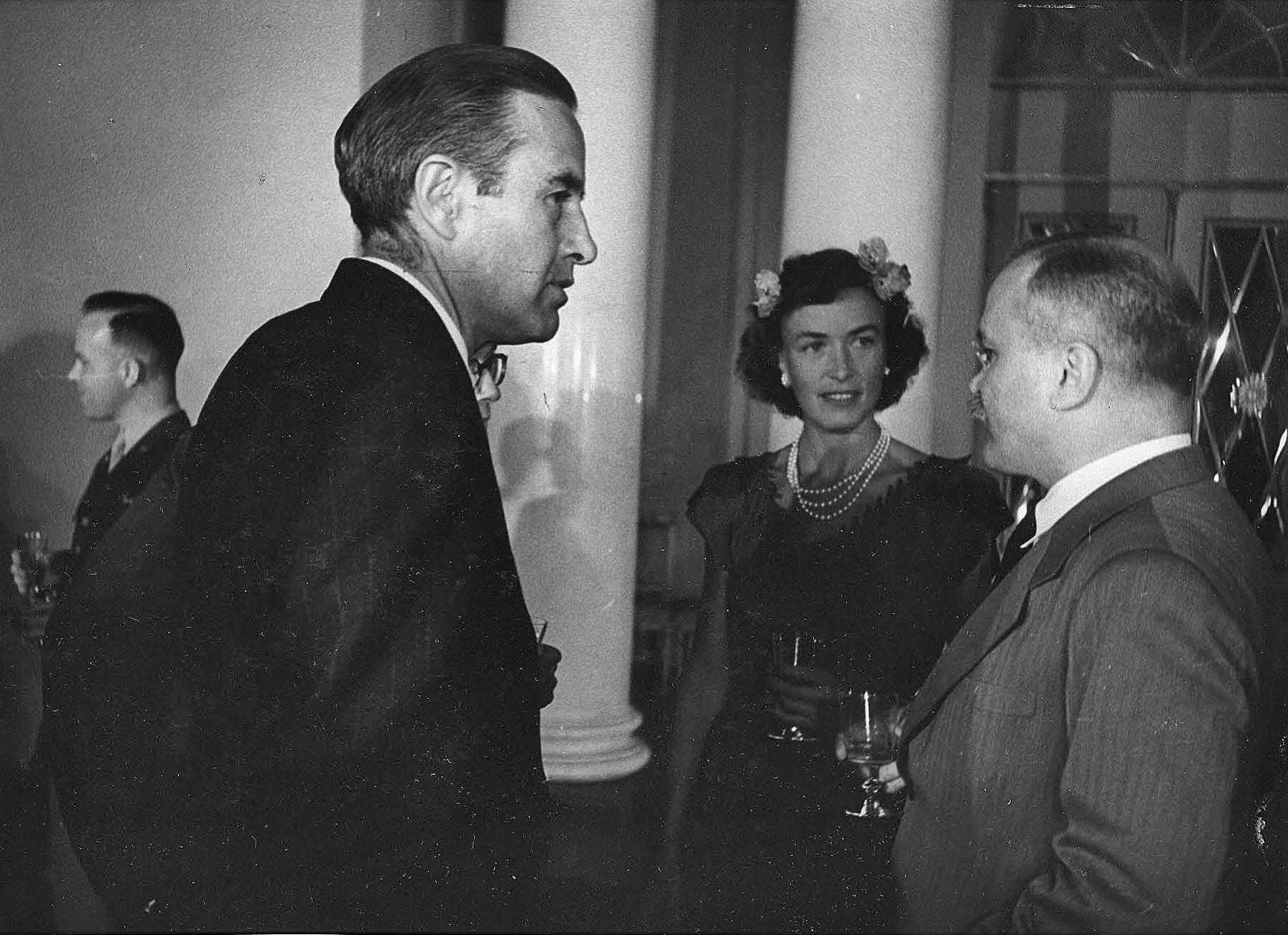
Kathy receiving flowers at the US air force base at Poltava, Ukraine, June 1944. Reproduced with kind permission of the Harriman family.
I did get a chance to talk to one inhabitant, though. While we were being recited a speech about damage done to Smolensk’s Lenin Library I sneaked off with the Christian Science Monitor correspondent, who speaks good Russian, and started questioning a bunch of inquisitive onlookers. We discovered that during the German occupation those who worked got 200 grams of bread a day, those who didn’t and children got only 75, which is sort of starvation ration. They told us the Germans took everything of any value away with them and destroyed the rest, killed thousands of people etc. The peasant woman who did most of the talking, talked in a calm matter-of-fact way – just as though she were discussing the weather. These people certainly are tough. There didn’t seem to be very many kids around the town but those I saw were sliding on the ice, playing with snow, just as they do in Moscow. I guess by now they are used to living in a destroyed town, but it looked pretty depressing to me. But cleaned up – all rubble had been removed – what remained might have been a historic ruin – just the shells of former houses with jagged walls, surrounded with a pink and grey brick fortification. The town proper is on top of a hill – so it must have been quite pretty – with the main road circling it and smaller alleys going straight up. It will be a terrific job rebuilding – someone told us “We hope the Germans will have to do it for us.”
One other sidelight – back on the train as we had our fifth meal for the day (all identical and starting with vodka) and finally around four a.m. a bunch of us started singing Russian and American songs. When the train stopped in a station or siding or something, the senior-ranking Soviet official with us asked us to stop. I guess he figured it wasn’t sufficiently dignified for slightly maudlin voices to be heard coming out of a private train. Then the moment the train resumed its motion, he once more loosened up and became natural and gay again.

This is an extract taken from Wartime Letters: London and Moscow 1941-1945 by Kathleen Harriman, one of two hundred letters which feature in a recent collection edited by Geoffrey Roberts and published by Yale University Press in February 2026.