On the morning of 12 September 1942, off the West African coast, the watch officer aboard U-156 spotted a plume of smoke on the horizon. Already three weeks out of Lorient, U-156 – a Type IX submarine, on its fourth war patrol – was due to join a wolfpack in the virgin waters off Cape Town. En route south, her crew had already sunk a 6,000-ton British freighter, Clan McWhirter, and had stopped a Spanish merchantman, the Monte Nuria, which was allowed to proceed unmolested.
Their commander, Korvettenkapitän Werner Hartenstein, was a veteran of the German Navy, who had served in torpedo boats in the Spanish Civil War before switching to the U-boat arm, and had taken part, earlier that year, in the first patrols that had targeted the Caribbean oil industry. Aged 34, he was well-liked and respected and was known to his crew as der Alte; “the old man”.
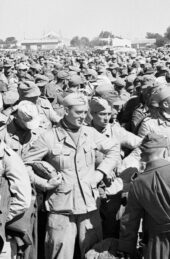
What the watch officer had spotted was the British former-Cunard liner RMS Laconia, now serving as an Allied troopship and transporting some 1,800 Italian POWs, as well as civilians and military personnel, from Egypt to Britain, via Cape Town. Hartenstein opted to give chase and, seeing that she was armed, blacked-out and zig-zagging, deduced that she was probably fair game. As night fell, he closed in and commenced his attack, firing two torpedoes at Laconia’s starboard flank from around 1,500 metres. On board U-156, they heard the two detonations, followed, some minutes later, by the morse message “SSS SSS Laconia torpedoed”.
Initially, Hartenstein held U-156 at a distance, while he observed Laconia’s agonies through his periscope. Dead in the water, she would take little over an hour to sink; finally rearing up out of the water, as one eye-witness recalled, “like a great monster, hissing and roaring.” As was customary, Hartenstein then moved in closer and surfaced, intending to question the survivors and perhaps capture an officer who could be pressed for intelligence. As he did so, however, his men reported hearing voices crying out for help, Aiuto, in Italian. With that, a routine sinking became anything but.
There can be little doubt that the presence of those Italian POWs among the survivors changed the narrative as Hartenstein saw it. But for them, he would almost certainly have gleaned some information, offered his sympathies, and been on his way to find new quarry. Yet, the presence of Germany’s allies in the water, and the sheer scale of the disaster unfolding that night, demanded a different response
Immediately, he ordered his crew to begin pulling the survivors from the water, bringing them below decks, tending to the injured and providing them with coffee and hot soup. Very soon, the available space aboard U-156 – already extremely limited – was filled with damp and huddled survivors; Italians and British, soldiers and civilians alike. Shortly after 1 a.m., Hartenstein sent a message to his superiors, reading: “Sinking by Hartenstein British LACONIA in naval square FF 7721. Unfortunately with 1,500 Italian prisoners of war. Up to now 90 fished out.” He closed by requesting orders.
Dönitz’s response, which arrived some two hours later, was perhaps surprising. He sanctioned Hartenstein’s rescue operation and instructed the closest U-boats – U-506 and U-507 – to proceed to the Laconia site to assist. In addition, knowing that his own vessels were still some 700km away, and would take more than 48 hours to reach the scene, he forwarded a request for help to the Vichy French authorities, whose fleet at Dakar was better equipped to take on the survivors.
In the meantime, Hartenstein and the crew of U-156 worked alone to save as many of the survivors as possible. Before dawn on 13 September, less than six hours after Laconia had gone down, he reported having 193 survivors aboard U-156, with many hundreds more in tow in lifeboats. With daylight, realising the scale of his task, he ordered a radio message to be sent, in English and en clair, giving his coordinates and asking for help, stating: “If any ship will assist the ship-wrecked LACONIA crew, I will not attack her, providing I am not attacked by ship or air force.” The message was repeated three times.
The risks of this course of action – which potentially left one of Germany’s newest submarines on the surface, exposed to enemy attack – were obvious to all concerned. Hitler was apparently furious. According to one account, he raged at Dönitz that the idea of saving the survivors from enemy ships was “nonsense”, which not only endangered the U-boats themselves, but went against the very principles of the U-boat war: “ship and crew are to be destroyed”, he ordered, “even those that find themselves in lifeboats.” Dönitz, to his credit, refused to accept the order, replying that shooting survivors contravened a seaman’s honour and would fatally undermine morale. Hitler backed down, telling Dönitz to “do what you want”, but added that giving assistance to survivors must be stopped.
Hartenstein, meanwhile, continued with his rescue operation. The wolf turned sheepdog, spending the next two days circling the area, collecting up the lifeboats and picking up those survivors still in the water, hampered throughout by the fact that everything on the surface was drifting north-westward by about 15 miles per day.
At one point, he estimated that there were as many as 1,500 people, shared between twenty-two “chock-full lifeboats” and assorted floats. He reckoned that U-156 had picked up 400 survivors by the time that the first to assist – U-506 – arrived, on the morning of the 15th. After transferring some of the survivors to the second U-boat, he continued his efforts. That same afternoon, he wrote in the ship’s log: “Picked up a swamped boat occupied with Italians and Englishmen. Took over the exhausted passengers. Boat equipped and taken in tow. […] 2 other boats sighted and visited. Supplied passengers of both boats with water.”
One of those rescued by Hartenstein was Doris Hawkins, a young British nurse, who was brought aboard U-156 on the evening of 13 September, one of around 200 picked up that day. She recalled initially being scared of the sight of the submarine; “we had heard so many atrocity stories”, she said, “we feared a shower of machine-gun bullets.”
But the sight of the crew of U-156 hauling other survivors up onto their decks was reassuring. When Hawkins was eventually rescued, she was taken below and was shown to the officers’ wardroom, along with a few other women, where they could be given a modicum of privacy. They were treated “with great kindness and respect” by the crew, she later recalled. Their clothes were taken from them to be dried, and they were supplied with blankets, hot tea and coffee and bread and jam.
Later, they were given cold cream for their sunburn, as well as tinned fruit. Hawkins was fascinated by the rich selection of food available and how the men wasted so little time eating. If she had any concerns for her safety, they were quickly assuaged by the generosity of the crew. “They were really sorry for our plight,” she wrote, “the commander was particularly charming and helpful; he could scarcely have done more had he been entertaining us in peacetime.”
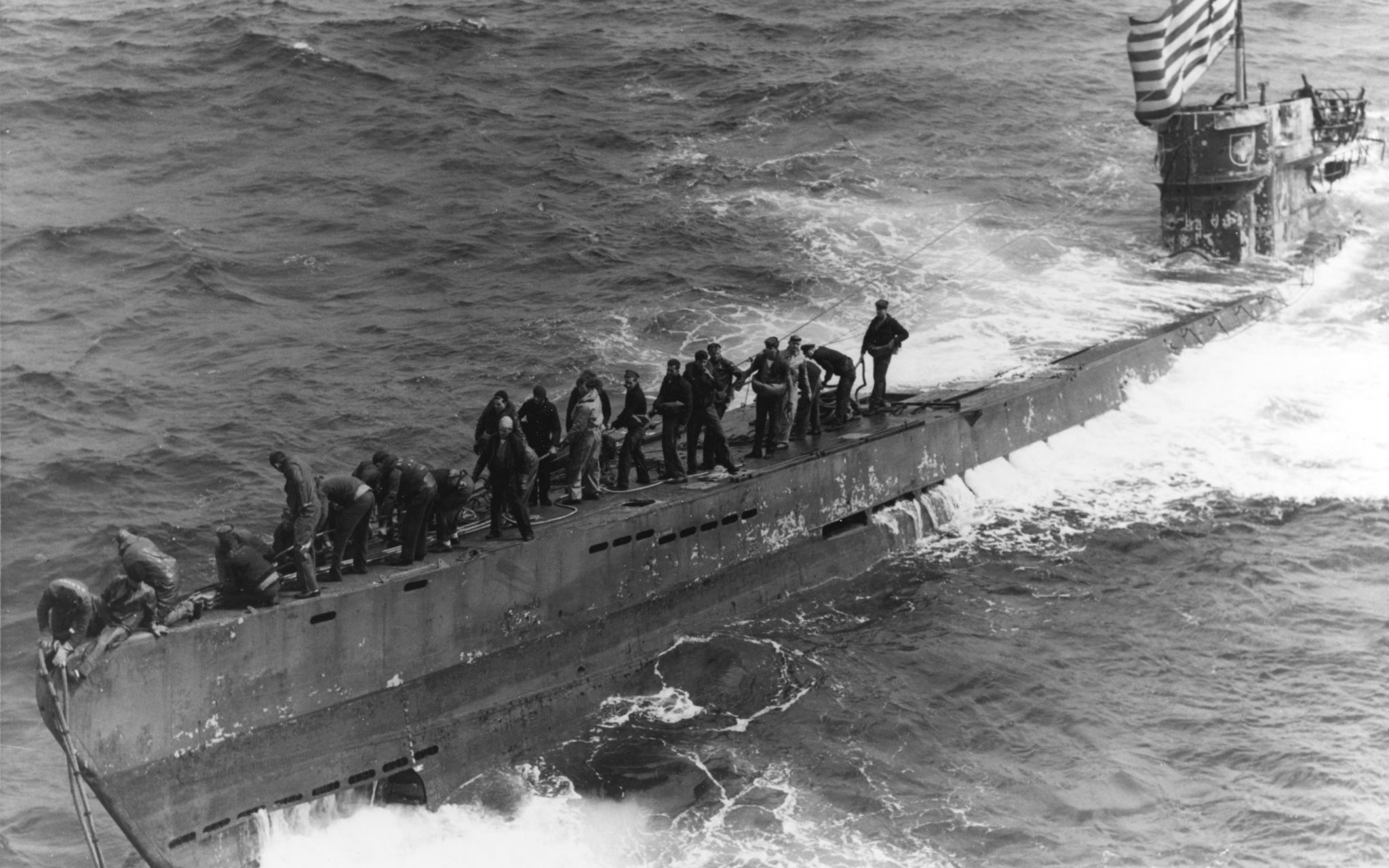
For all his hospitality, Hartenstein felt a similar sense of urgency, given how exposed he was to enemy attack, towing four crowded lifeboats and with more than 100 of the rescued crowding U-156’s decks. His fears were finally realised on the morning of 16 September – fully four days after the sinking of the Laconia – when U-156 was overflown by an American B-24 Liberator, which circled a number of times. Hartenstein attempted to signal the aircraft, but in vain, and a Red Cross flag was draped across the conning tower to signal their good intentions, but the Liberator disappeared to the south-west.
Soon after, the Liberator returned, making to attack. Hartenstein ordered the tow lines to the lifeboats cut and crash-dived, pitching those survivors huddled on his decks into the foaming sea. Three depth charges were dropped, two falling wide of the target, the third falling among the lifeboats, capsizing one. A second approach brought two more depth charges, one of which detonated directly beneath U-156, causing a water leak in the bow, and a momentary release of noxious gas from the flooded batteries.
With that, Hartenstein surfaced and – “genuinely distressed”, according to Hawkins – ordered those survivors of Laconiathat were still inside U-156 overboard, before diving again to escape the danger. Later that night, he sent a message to Dönitz to explain what had happened. His frustration was clear: “From Hartenstein. American Liberator bombed five times from low altitude while towing 4 full boats despite 4 square meter Red Cross flag on the bridge in good visibility. Both periscopes temporarily out of service. Broke off assistance, everyone overboard, moving off to the west.”
While U-156 retired to carry out the necessary repairs, the survivors of the Laconia were left to fend for themselves. Fortunately for them, French ships out of Vichy-controlled French West Africa – the cruiser Gloire and two sloops – arrived on the afternoon of 17 September and began to take them on board. Over the next two days, more than a thousand survivors were rescued, around half of them British, and 373 of them Italians, and were taken to Dakar.
Of the 2,741 passengers, crew and prisoners that had left Cape Town aboard Laconia, 1,083 survived. Their fates were intimately bound up with the crew of U-156 and Hartenstein himself, who acted as both heroes and villains in the unfolding drama. In her memoir of the episode, Doris Hawkins paid tribute to the humanity with which the survivors were treated by the crew of U-156, but she added: “I know that this German captain, so courteous and humane, was at the same time responsible for our ordeal.”
The political ramifications, meanwhile, continued to rumble on. Though Dönitz had pushed back on Hitler’s order that survivors were to be “destroyed”, he was obliged nonetheless to rein in those of his commanders that still harboured humanitarian impulses. Up until that point, it had not been unusual – despite the lurid claims of Allied propaganda to the contrary – for U-boat commanders to surface following a sinking, to confirm the identity of the ship primarily, but also to provide water, medical supplies or perhaps just a compass bearing to the survivors. All that stopped with the Laconia.
On 17 September, Dönitz issued an order named “Triton Null” – commonly known as the “Laconia Order” – which formally forbade U-boat crews from assisting survivors from their sinkings. “No attempt of any kind must be made at rescuing members of ships sunk”, the order read, “and this includes picking up persons in the water and putting them in lifeboats, righting capsized lifeboats and handing over food and water.” Next, Dönitz echoed Hitler, adding that “Rescue runs counter to the rudimentary demands of warfare for the destruction of enemy ships and crews.” He concluded the order with the instruction to “Be harsh”, and a reminder that German women and children were suffering under Allied bombing.
Compliance was swift. On 19 September, two days after the Laconia Order was issued, Hartenstein intercepted and sank the 5,000-ton British freighter Quebec City, 500km north-west of Ascension Island. In the aftermath, according to one of the survivors – Welshman Cledlyn Jones – U-156 surfaced close to the lifeboats, whereupon Hartenstein apologised for sinking their ship – saying “war is war, alas!” – and invited the master of the Quebec City aboard to consult his charts. In line with Dönitz’s instruction, Hartenstein expressed his regret that he was unable to give material assistance and did not offer food or water, but he wished them good luck and expressed the hope that they might meet again under better circumstances. The U-boat war – already brutal – was now more deadly still.
Interestingly, however, the Laconia Order would come back to haunt Dönitz at the Nuremberg Tribunal after the war. By that time, Allied prosecutors – in the first flush of moral outrage over the crimes of Nazism – were minded to see barbaric intentions behind every German action, and the U-boat war was no exception. Consequently, one of the key accusations against Dönitz was that the Laconia Order – far from merely bringing an early end to what remained of German naval chivalry – was actually a coded instruction to kill survivors.
Indeed, the testimony of Korvettenkapitän Karl-Heinz Moehle, former commander of the 5th U-boat Flotilla, suggested that this had indeed been the case, and he confirmed that he had passed the order on in that form to his officers, albeit with the caveat that each individual commander had to act according to his own conscience.
It is not known how many commanders interpreted the Laconia Order in the same way as Moehle, but it is fair to suggest that the majority did not. Even after the order had been issued, some sporadic rescues of survivors continued, especially in extremis, and in 1946 some 67 former U-boat commanders signed a petition asserting that they had never been ordered or encouraged to kill survivors.
The only documented exception, it seems, was the sinking of the SS Peleus in the spring of 1944, after which the crew of U-852 machine-gunned the debris in a vain attempt to get rid of the evidence of the sinking. Only three of the crew survived. The captain of U-852, Heinz-Wilhelm Eck, along with two of his crew, were duly tried and executed by the British in November 1945.
Of course, absence of evidence is not evidence of absence. Yet, despite the horrific example of the Peleus, it is striking that so few instances of atrocities committed by U-boat crews have come to light. On the available evidence, it is hard to escape the conclusion that the U-boat war does indeed appear to have been the ‘cleanest’ of the theatres of the European conflict, with many more instances of assistance given to survivors than there were examples of atrocities. The case of the Laconia might have been an outlier, at least in its extent and its generosity, but it was nonetheless illustrative of a deeper truth – that, despite the wider crimes and depredations of Nazism – in the U-boat war the old-fashioned ‘solidarity of the sea’ seems to have endured.
Roger Moorhouse is a historian and author, specialising in Nazi Germany, Central Europe and World War Two in Europe, and his latest book, Wolfpack: Inside Hitler’s U-Boat War, is released this month.