Do the good guys always win? It would be nice to think that open, democratic societies are healthier and stronger and have inbuilt advantages over authoritarian regimes. After all, in World War Two the democracies led by Britain and the USA smashed totalitarian Germany and Japan, admittedly with a considerable contribution from the repressive Soviet Union. Underlying the industrial capacity which overwhelmed the opposition were the political and economic systems fostered by Western democracy. Was this a fluke, were other factors more decisive, or is there good reason to hope that democracy gives resilience and strength? Does the ancient past offer a clue?
In the 5th century BC, Athens pushed the concept of democratic government further than almost any other state in history. It was an open, confident and creative place, producing monuments, art and literature that continue to inspire, as well as fostering ideas that have profoundly shaped thought ever since. By contrast, its rival – and eventually enemy – Sparta was inward-looking, fiercely traditional, with everything geared to maintaining the dominance of the narrow elite granted full citizen rights. Spared from the need to work, these Spartans – calling themselves the ‘peers’ – trained to fight, whether against foreign enemies or the helots, the far more numerous serf population who toiled to feed and provide for their masters. In a world of amateur, part-time soldiers, the Spartans as specialists became the finest fighting men in Greece.
Polar opposites in so many ways, Athens and Sparta were alike in being exceptionally large compared to other Greek states. This was a time long before any concept of Greece as one country existed, and Greeks lived in hundreds of independent city-states, many of them tiny communities of a couple of thousand inhabitants. They shared a common language, the same songs and stories, such as the poems of Homer, and they came together at regular intervals to compete in festivals, most famously at the Olympic Games. To allow safe travel to and from the Olympics, a month-long truce was declared, suspending any conflicts between Greeks. This was necessary, because, for all their shared heritage, Greek cities went to war with each other often and with considerable enthusiasm. When not at war they vied for prestige, trying to add to their honour and status and fiercely resisting anything that might diminish them. Unsurprisingly, such competition often enough spilled over into warfare, and the most prestigious way of winning a war and proving a city’s essential worth was to prevail in a pitched battle.
The Spartans excelled in these clashes between massed phalanxes of spearmen known as hoplites. A Spartan army included allies, neighbours of lower status and even helots acting as servants and skirmishers, but the heart of the army was always the Spartan peers. To prepare them for this role, the state supervised the training of Spartan boys from an early age, emphasising fitness, determination and the ability to endure hardship, as well as a degree of cunning. Kept short of food, the lads were expected to steal, and the only crime was being caught. Most of a man’s time up to the age of 30 was spent in training or on campaign, and after that they were still expected to be ready to serve, even if they had slightly more freedom. The opinion of other Spartans mattered and they were constantly judging each other and being judged in turn. They cultivated the clipped, laconic style of speaking, and the ability to mock and be mocked, as long as it stayed within limits. Most Greek cities were prone to revolution as rivals sought to dominate by any means. In contrast, Sparta was admired for its stability. There were political disputes, not least in the punishment of a surprisingly high proportion of their kings and other senior leaders, but this never became violent. Spartans were disciplined and stuck together, because of the ever-present threat of rebellion by the oppressed helots. There were always far more helots than peers, a problem made worse by the gradual decline in the numbers of the latter – perhaps 9,000 at the start of the 5th century BC, 5,000 by mid-century and at the very most 2,000 by the early 4th century BC.
Athenian territory was a little smaller than Spartan territory and significantly less fertile, but there were always far more Athenians than Spartans. Athens had had its civil wars and revolutions, but, after the expulsion of its last tyrant in 510 BC, the Athenians created a new democratic state which proved remarkably stable. Citizens were divided into four classes based on property, but from the beginning all were granted the vote and all votes were equal. The poorest could attend the sessions of the People’s Assembly, which met on the Pnyx Hill in the city, and if they could attract the favourable attention of the presiding officials, they could also voice their opinion. Here they elected their leaders, passed laws and made all the major decisions of what the state was going to do. Once a year, they also had the opportunity to send an unpopular politician into exile, a ten-year ostracism which barred the man from the city but did not deprive him of property or rights once the ban was over. Decisions of the Assembly were instant, and its rulings were sovereign for there were no permanent institutions or officials with their own power. At trials, there were no judges, and, instead, juries of citizens, sometimes numbering in hundreds or even a couple of thousand, ruled on the charges. Athenians were directly involved in every aspect of communal affairs, and over time more and more roles became open to all classes, with salaries provided so that public service did not bring financial ruin to the less well off.
Athenian citizens participated in public life far more than citizens of modern democracies. While some who dwelt in the countryside may rarely have felt free to travel to the city for meetings, even these could be allocated tasks by lot. Being an Athenian was seen as a great privilege and a great responsibility. When the Assembly voted for war, it was the voters who would be called upon to fight, and every year the names of those who had died as a result were commemorated on memorials in the Acropolis. Women did not go to war, so women at Athens – and in every other Greek state – were excluded from politics. So were resident foreigners, a sizeable group in Athens which had become a big trading and manufacturing centre. Then there were the slaves, for the Athenians accepted slavery as normal as did everyone else at the time. Perhaps there were 200,000-250,000 inhabitants in the Athenian state, of whom about a fifth were citizens, and they were jealous of the privilege. Over time, the qualifications for being an Athenian became very strict indeed, requiring more than one generation of pure Athenian descent.
Athenian public life was centred around debate and argument, all carried out openly, in contrast to secretive Sparta, where real power was concentrated in a small council of senior men. However, as in Sparta, the Athenian system proved remarkably stable by Greek standards, while the decision-making was often shrewd as well as ambitious, even if the rhetoric of debates, let alone the satirising of leading figures on stage, was often vitriolic.
Athenian citizens voted to use the windfall profits from collectively owned silver mines to create a navy of modern warships larger than anything else in the Greek world. This was not just a question of constructing the oared galleys known as triremes, but of crewing them. A ship was only as good as the skill of its helmsman and rowers, which required practice, so funds were voted to pay the mainly citizen crews to learn their trade. Just a few years later Athenian ships made up well over half the Greek fleet which smashed the Persians at the Battle of Salamis in 480 BC, making possible the defeat of King Xerxes’ invasion. In 479 BC, Sparta’s hoplites led the way in routing the Persians’ land forces, although even then the Athenians were the next most important contingent.
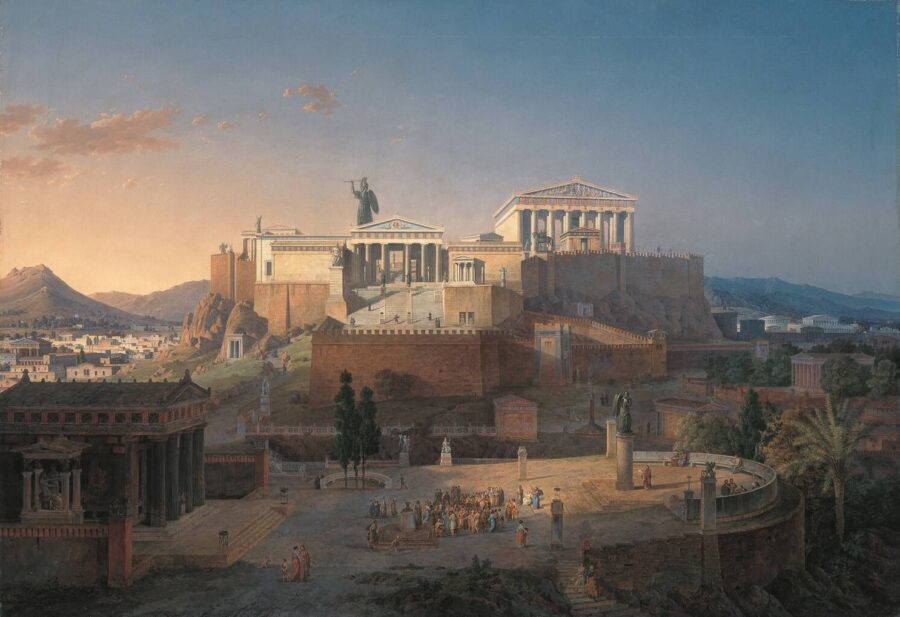
In the aftermath, the campaigns to open the Persians back on the far side of the Aegean allowed the Athenians to take the lead, for the land-lubbing Spartans had no taste nor capacity for such fighting. Athens acquired an empire, composed of many tiny states paying tribute which went to fund the Athenian navy. Every year the Athenians sent out powerful squadrons to cruise the seas, honing their skills, and backing up the active ships were great reserves of carefully maintained triremes and experienced sailors. Never before had there been a naval power of this sort, and Athenians celebrated their might and glory, most obviously in grand monuments like the Parthenon. Athenian prominence made the Spartans uncomfortable, for they refused to recognise any other state as their equal, while the vaunting Athenians demanded this. Discomfort turned into rivalry which led to a succession of conflicts, most famously what is today called the Peloponnesian War from 431-404 BC.
It was the clash between an open democracy and a narrow, insular state dominated by the peers. It was also an asymmetric clash between the greatest land power of the Greek world and the greatest naval power. Athenian foresight had seen the construction of fortifications connecting their city with its main port at the Piraeus. Thus, when the Spartans invaded each year, the Athenians did not contest their farmland and risk facing the feared enemy hoplites in the open. Instead, they crowded into the city and brought in supplies by sea to feed everyone. The Athenian fleet dominated the seas, but there was no Spartan fleet to defeat, and raiding the shores only achieved so much.
Each side had a strategy for not losing the war, but no idea of how to win, and most of the fighting was carried out by allies and proxies. Plague devastated Athens, but the Athenians did not give in. Sometimes the Assembly proved fickle, condemning to death the entire male population of a rebel ally one day and the next reversing the decision and restricting the death sentence only on the ringleaders. Fortunately, the second order arrived before the first had been carried out. In 415 BC the Athenians developed what the Athenian historian Thucydides called ‘a passion’ to intervene in Sicily. Plans ballooned from something modest into a grand expedition, which was poorly led, not least because a scandal convinced the Athenians to recall the most talented of their commanders, and the one who most believed in the plan.
The result was a disaster, dismaying the Athenians and encouraging the Spartans, whose cause was boosted even more when they secured financial backing from the Persians. Using Persian gold, the Spartans paid for the construction of a series of fleets, crewed by allies or hired men. Experience could not be bought so easily, and Athenian superiority in seamanship brought them victories. Then the fickleness of Athenian citizens stepped in once again when they decided to execute successful admirals because, during the latest success, they had failed to rescue all the survivors from sunken ships and left these fellow citizens to drown. Spartan persistence and Persian money prevailed in the end, as the Athenians, deprived of their best leaders and their resources exhausted, lost the final battle and capitulated.
The closed society of Sparta had beaten open, creative and exuberant Athens, but it did not adapt so well to the new world created by this success. Spartan dominance lasted barely a generation, before she was humbled by the Thebans, who beat them in battle and, worse still, freed many of the helots. In contrast, Athens recovered, restoring its democratic system, reviving its prosperity and empire and showing the same adaptability and ambition that had led to its first rise to power. If not, unambiguously, the good guys, for they were slave-owning, aggressive and often arrogant, the Athenians did better in the long run.
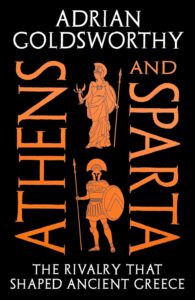
Adrian Goldsworthy is an historian, novelist and the author of Athens and Sparta: The Rivalry That Shaped Ancient Greece, published by Head of Zeus. You can listen to a full conversation with Adrian here via the Aspects of History podcast feed.