
On the afternoon of 30 June 2007, outside Terminal One at Glasgow Airport, a baggage handler was on a fly cigarette break when a Jeep Cherokee sped towards the main entrance and smashed into the security bollards. It looked like some sort of crazy ram-raid. After the two occupants emerged from the vehicle one was swiftly tackled by the police while the other presented a terrifying spectacle. The driver, Kafeel Ahmed, had doused his head and body with petrol and set himself alight. Because he had taken a great deal of morphine, the burning man felt little pain from the flames ablaze on his hair, skin and clothes. He rushed to attack the police. A taxi driver, Alex McIlveen, who had just dropped off his fare, kicked Ahmed so hard in the balls that he tore a ligament in his foot (which still hasn’t healed). Another man had his leg broken in the scuffle as the terrorists fought on and attempted to get to the boot of the car to ignite the contents. The baggage handler, John Smeaton, rushed forward and kicked Ahmed hard before pulling the man with the broken leg to safety. Stephen Clarkson, who was picking up family members just back from a holiday in Benidorm, felled the burning man with a forearm smash.
It was the busiest day of the year, and there were at least 4,000 people in the terminal at that moment. All the while the Jeep was a bomb waiting to go off. The boot had been filled with containers of petrol, propane gas canisters and nails that would have acted like deadly shrapnel. Part of it appeared to be on fire. An off-duty policeman grabbed a fire extinguisher, managed to soak the car to make it safe and drenched Kaleef Ahmed. After the incident, John Smeaton was interviewed on television. Still wearing his yellow high-vis jacket, with adrenaline still surging, he was emphatic: ‘They can try and come to Britain . . . you can come to Glasgow. But Glasgow disnae accept this. This is Glasgow. We’ll set aboot ye. That’s it.’
It was not only the instinctive courage of all the men who happened to be there at the time that ricocheted around the world’s media. Smeaton’s interview played from Austria to Alaska and most points between. It was also their powerful sense of themselves as citizens that resonated deeply with communities living in fear of terrorist attacks in the wake of 9/11. At that terrifying moment these men were Glasgow – and Glasgow disnae accept this. Representatives of a community with a distinct identity, they tackled the terrorists. That was it. The chest of every Glaswegian swelled with pride at the defiance of a taxi driver, a baggage handler, a groundsman, an off-duty policeman and several airport workers who got stuck in. But few were surprised. Their city, their people, needed at that moment to be defended, and they did not hesitate. ‘I come from Glasgow’ has always been more than a statement – and much, much more than an address.
Twenty years earlier Michael Marra composed a song that captured some of the reasons for all that unhesitating heroism. In ‘Mother Glasgow’ he sang of a maternal city that nurtures her weans, that nestles the Billy and the Tim, both Protestants and Catholics, and riffed on a dander, an imaginary walk with St Mungo, Glasgow’s founder and the icon who gave the city its coat of arms and motto. A version recorded by Hue and Cry, Pat and Greg Kane, has become an informal anthem for the city.
Unlike other great cities, those perhaps more steeped, even stuck, in the past, Glasgow has no history of hesitation. It is constantly changing, moving forward. By 1980, when the A8 from Edinburgh had been upgraded to the M8, the motorway did not go around the outskirts as in other British conurbations. It pierced straight through the heart of the city like an American expressway and swept all before it.
After the Second World War, Glasgow Corporation did not hesitate to act in dealing with the housing crisis. Slum clearance in the city centre was radical as entire densely populated neighbourhoods were quickly levelled and replaced with high-rise tower blocks and peripheral housing estates. With their inside toilets, hot and cold running water and modern conveniences now taken for granted, the new council housing was generally welcomed. But it also became the butt of Glasgow’s particular brand of humour. In 1967, Adam McNaughton wrote ‘The Jeely Piece Song’. It mourned the passing of the three- and four-storey tenements of Govan and the Gorbals where jam sandwiches could be flung by mothers out of windows and caught by hungry weans playing in the streets and drying greens below. From the twenty-storey high-rise flats of Castlemilk, piece-flinging didn’t work. Pieces went up rather than down, becoming a hazard to passing aircraft or even going into space to orbit the Earth as tiny satellites. McNaughton advocated a campaign to prevent more housing being built that was over piece-flinging height. It was a perfect example of how Glaswegians combine humour with criticism of their city and its people, criticism only they are allowed or qualified to air.
Mother Glasgow’s nestling of the Billy and the Tim is only one of many paradoxes wrapped up in Glaswegian identity.
In the past two centuries, the city has become increasingly diverse and cosmopolitan with successive waves of Highland, Irish, Jewish and Asian immigration. Sharp edges and unwelcome prejudices have sometimes flared into conflict, but there has also been a growth of great cultural richness. Perhaps one of the most memorable, surprising and quirky examples is the invention of Britain’s favourite national dish in Glasgow. Chicken tikka masala was created by a Bangladeshi chef in response to a diner’s preferences. And emblematic of a peculiarly Glaswegian cocktail of diversity is the career of the actor and writer, Sanjeev Kohli. He was educated at St Aloysius College, a Roman Catholic school in the city centre, took a first class honours degree in mathematics at Glasgow University, played an Asian shopkeeper in the hit TV series Still Game (itself a cultural icon centred around the lives of Jack and Victor, two pensioners who live in a block of high-rise flats at Osprey Heights), supports the Scotland football team, wears a kilt to formal occasions and made a very successful, and very funny, advertisement for the national soft drink, Barr’s Irn-Bru. Kohli had no hesitation in becoming involved with the life of the city and embracing its collective identity. His is a uniquely Glaswegian story.
For stories, true, false or imagined, are the basis of the city’s sense of itself. The civic coat of arms is almost entirely mythic. Unlike the solidity of Edinburgh’s mighty castle, the heraldry of Glasgow shows a mitred saint holding a crozier in one hand and conferring a blessing with the other. He is St Mungo, or Kentigern, a holy man who may have lived in the sixth or seventh century and about whom almost nothing is known for certain. Below him two salmon make an unlikely leap upwards, each with a ring in its mouth. Within the outline of a shield stands an oak tree, and perched on its top is a robin. Beside the tree is a bell, and below both another salmon. All of these are visual references to events that almost certainly never took place, miracles performed by St Mungo. Below the shield is something he might have said, and ‘Let Glasgow Flourish’ has become the oft-quoted motto of the city.
Glasgow is built on stories, words and ideas, some true, some false, all of them informative, and what follows is a compendium of more words, more stories, that help define the Mother City.
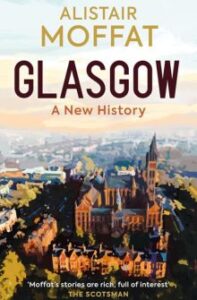
Alistair Moffat is an historian and the award-winning author of Glasgow: A New History.