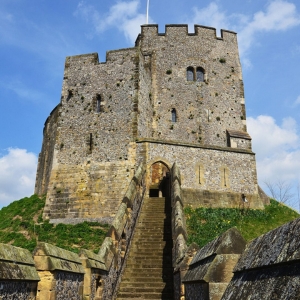
At various times during my Rebellion trilogy, castles play an important role in the narrative, not least the one built in the south east corner of York which we know today as St Clifford’s Tower.
The castle would become a significant factor in the spread of Norman dominance of their new domain, standing as an obvious and imposing symbol of their power. You only have to look at the surviving stone examples, especially those of the iron ring that Edward I erected around the rebellious Welsh to see just how impressive – and downright terrifying – they would have been to the native population.
Origins of the Castle in Britain
It is a common fallacy to say that the Castle arrived in Britain on the back of William the Conqueror’s fleet in September 1066. That said, it is true that he did bring with him the materials needed to erect two wooden castles to defend his narrow foothold on the south coast, (i.e. those at Pevensey and Hastings). Think of them like modern day IKEA flatpacks which they unloaded and then began to assemble in very quick
order.
One can only imagine how many bruised thumbs, left over nails and visceral arguments accompanied these constructions.
However, they were not the first. That honour actually fell to three sites in Herefordshire (on the Welsh border) in the early 1050s, called Ewyas Harold, Richard’s Castle and Hereford Castle, none of which have managed to leave much in the way of significant physical footprints on the land. I cheated a little bit earlier: though they predated William the Conqueror, these three older examples were still the result of Norman / French influence (i.e. being built by nobles who were part of King Edward the Confessor’s court and to whom the king had gifted land for the purpose of strengthening the defences in that region). Quite what the Earl of Mercia thought about it is unknown.
Prior to castles, the defensive structures favoured by the Anglo-Saxons were called burhs. Begun under King Alfred’s rule, these were effectively fortified towns (in the sense that a ditch and rampart (the latter topped by a wooden palisade), were built around the entire settlement). The difference between them and the Norman castle is really down to their respective purpose, the latter of which will be explored in more detail below.
For Alfred and his descendants, the burhs were a response to years of Viking incursions. By the time the king’s army had been mustered and deployed, they would invariably find that the enemy were long gone leaving nothing but dead people and smoking ruins.
The burhs therefore initially served a defensive purpose: the permanent garrison would keep the raiders at bay behind their palisade while those of the other nearby burhs (they were deliberately positioned so that each one was roughly a day’s march from the next) sallied out to attack the Vikings as they laid siege to the first. It was only as the 10th century progressed that the function of burhs began to resemble that of castles in terms of being built to secure territory gained as King Edward the Elder, his sister, Aethelflaed, and later his son, King Aethelstan, began the slow process of pushing into and taking control of the Danelaw.
Castle Design
Duke William’s early castles were generally of a motte and bailey design (a term with which most schoolchildren – certainly of my vintage – were very familiar).
Built of wood, their main advantage was the speed with which they could be erected. With 8,000 troops to call on, the castle at Hastings, for example, could have been thrown up in a matter of days (far quicker than the Saxon burhs). Needing only wood, earth and manpower, they were also remarkably cheap.
A motte and bailey castle typically comprised three key elements:
– The large earthen mound (the motte) surrounded at its base by a ditch.
– Next to the motte a large area would be levelled to form a yard which housed all the supply and support buildings needed by the castle to function (tanners, smiths, armourers, barracks, butchers etc.) This was the bailey.
– Finally, and perhaps most importantly, was the tower (or keep) which was built on top of the motte. This would be the final redoubt where the castellan could hold out for some time, even if the bailey had been overrun.
Impact
Though susceptible to fire, and in need of frequent maintenance as timbers rotted, these early castles were critical to the success of the Norman Conquest, a claim illustrated by the fact that over 1,000 of them were built across England, Wales and Scotland.
Many of the sources relate how everywhere King William went in the country (especially when putting down rebellions) he would build a castle. Not only would the insurgents be defeated but they would be left with a permanent reminder of what they were up against. Warwick, Nottingham and York offer just three such examples.
Their key impact (other than striking awe in the hearts of the locals) was that they allowed a relatively small invading force to control a much larger population. Not only would the Saxons be pressed into service to build the object of their oppression, but once it was up, its garrison could then dominate a sizeable swathe of surrounding land.
The castle formed a base from which the Normans could roam the countryside, ravaging malcontents as and when required, while also acting as a safe place behind whose walls they could retreat should things become a little sticky.
Though hugely influential, the success of the motte and bailey castle was relatively short-lived. By the end of the 12 th century, stone was much more the preferred material, providing far greater security, more lavish furnishings and undoubted endurability. Though the cost was immense (and the time needed far greater), the wealth gained by the nobles over the previous hundred years meant that they could afford it.

Paul Bernardi is an historical fiction writer, and the author of Blood Feud.