
These new methods of waging war were tried, tested, rejected and refined during the Italian Wars. This series of wars was triggered in 1494 when Charles VIII, King of France, invaded Italy in pursuit of a fairly spurious claim to the throne of Naples. Charles did not mean to end the Middle Ages. All he wanted was Naples and a little respect. But that is what his invasion effectively did.
To get to Naples, Charles had to march south through Italy, past the various city states, republics and duchies that existed in a patchwork across the north of Italy, and then get through the belt of Papal States that ran across the middle of Italy’s boot, from calf to shin, before arriving at the border of the Kingdom of Naples. Others had tried invading Italy in the past in pursuit of some claim or other, and they had always come to a slow, grinding halt as they tried to make their way past all the fortified towns, castles and redoubts that kept north Italy in a state of political tension.
But this time it was different. The French army blasted its way past castles that had withstood previous invading armies for months. Terrified cities opened their gates rather than face the prospect of being sacked by a French army growing drunk on plunder.
The difference this time was cannon: to be precise, the highly mobile field artillery that the French had developed during the last years of the Hundred Years’ War. Before then, cannon were large, heavy, unwieldy and about as easy to manoeuvre into position as a large tree. But the French had started to cast cannon in lighter bronze. They had also begun casting trunnions, the hinges on which the cannon rotated, directly into the barrel as well as developing the gun carriage. They had, in effect, created the prototype of the cannons that would dominate European battle fields for the next four centuries.
When these cannon opened up against the old medieval defences, they brought them tumbling down. Tall, thin walls were shattered, defenders panicked, and the French bulldozed their way down through Italy, sweeping aside any resistance.
Dazed and horrified, the Italian city states and the Pope looked on in horror as Charles crowned himself King of Naples.
But while Charles now had the army to take Naples, he did not have the political or logistical structures to keep what he had gained. This was to become a characteristic of the Italian Wars that Charles’ invasion started: huge tactical successes for negligible strategic gains.
Another unfortunate side effect, for Italy, of the French invasion was that it revealed all too clearly to the other European powers the wealth to be had in Italy as well as the relative weakness of the Italian city states when it came to protecting that wealth. Italy also provided an arena in which France, the Empire and Spain could contend without the danger of invading each other’s territories directly.
The invasion of 1494 set off 65 years of warfare that tore Italy apart and brought the glories of the Quattrocento to a shuddering halt. But it provided the space for the rise of a new type of soldier, the military engineer.
The commanders of medieval armies were aristocrats, trained from birth in the arts of war. But these arts were proving less effective in the wars of the early 16th century. For these wars, you needed to be able to predict the trajectory of a cannonball, build effective defences against cannon, arrange logistics over long distances, raise enough money to pay mercenaries, dig tunnels under defences and mine them, and detect those tunnels and countermine them.
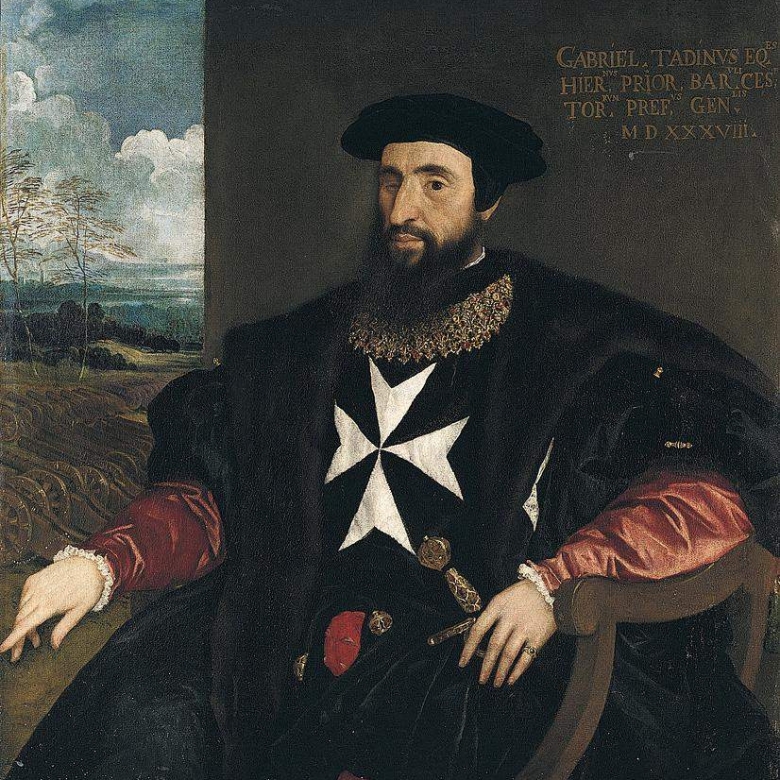
Learning how to ride and wield a sword was only minimally useful for this new sort of warfare. But in Italy, new technical schools were training the sons of artisans and merchants in practical knowledge: arithmetic, geometry, bookkeeping. These were the skills the new soldiers needed, and it was at one of these scuole d’abaco that Gabriele Tadino had been educated.
After that, he learned on the job. The Italian Wars were notable for the number of players involved and for the frequency with which enemies changed sides, allying with old enemies and attacking their erstwhile friends. Indeed, it was during the Wars of the League of Cambrai, from 1508 to 1516, that Machiavelli wrote The Prince, the first book of political theorising to expose the naked self-interest that underlay the treachery and deceit of the Italian Wars.
The Italian military engineers learned fast. It was quickly clear that the old, high, thin walls of medieval fortifications were no longer fit for purpose. Instead, they cut them down and widened them. They widened moats to create free-fire killing zones and they made the first bastions to provide enfilading fire along the length of the moat.
Gabriele Tadino became a master of the new ways of war. In reward for his service to Venice, in 1522 the Republic rewarded him with a plum placement: he was made commander of the fortifications of Crete. Crete was the key part of Venice’s Stato da Màr, the Republic’s overseas possessions that allowed it to control a trading empire in the eastern Mediterranean.
It was a job that could make Tadino’s fortune.
But Tadino would only remain in post for six months. For in July, an emissary from the Knights Hospitaller arrived on Crete. Fra’ Antonio Bosio had been sent by the Grand Master, Fra’ Philippe Villiers de l’Isle-Adam, to seek help. The Hospitallers, on their island fortress of Rhodes, were about to face the full might of the Ottoman Empire led in person by the sultan, Suleiman the Magnificent.
However, Venice had signed a treaty with the Sublime Porte to safeguard its trading rights in Constantinople and the Levant. The governor of Crete refused any help to Fra’ Antonio. But Gabriele Tadino, on hearing of the Hospitallers’ plight, volunteered to go to Rhodes. However, the governor refused to give Tadino permission to go to the Knights’ help, even as a private citizen.
But Tadino went to Fra’ Antonio Bosio secretly and told the Knight that he was determined to accompany him back to Rhodes. Fra’ Antonio Bosio pointed out that doing so would mean that he would be exiled by Venice and all his wealth confiscated. What was more, the Hospitallers had about 700 Knights to face Suleiman’s army, which was expected to be a 100,000-strong. Death was his most likely payment for volunteering to come to Rhodes.
Nevertheless, Tadino would not be dissuaded. The question was how to get Tadino to Rhodes. The governor, suspicious now, had placed Tadino under surveillance to make sure he did not leave.
Next day, Fra’ Antonio Bosio ostentatiously boarded his brigantine and sailed away from Crete. But, once out of sight, he moored his ship in a secluded cove and waited there for two days while Tadino went about his normal business. With the danger of Tadino absconding now apparently gone, the governor removed his watchmen.
This was what Tadino was waiting for. On the third night, he crept from his house and made his way to where Antonio Bosio was waiting for him. He went aboard the brigantine and they set sail.
But then, weather disaster struck. The wind turned violently against them and Bosio had no choice, in his light brigantine, but to find shelter on shore.
The next day, when Tadino did not come for his normal appointment, the governor realised that something was up. Finding Tadino’s home empty, he dispatched fast galleys in pursuit of Bosio’s brigantine – not knowing that the said ship was laid up, unable to move, in a cove just down the coast.
Knowing that there would be boats searching for them, Bosio had his crew dismast his own ship and haul it ashore, so that it looked like an ordinary vessel undergoing shore repairs. Passing Venetian galleys even hailed, asking if they had seen a fleeing brigantine belonging to the Knights Hospitaller.
Finally, when night came, the wind dropped and Fra’ Antonio Bosio remasted his ship and set sail. Carrying Gabriele Tadino, he sailed away from Crete, arriving in Rhodes just before the Ottoman siege was closed.
Gabriele Tadino arrived in Rhodes on 22 July 1522. He did not leave again until the first day of the New Year.
Temperamentally, Gabriele Tadino was a man of the Middle Ages, inspired by the ideals of Christian chivalry. But professionally, he was a man of the new age that was coming into being. He himself straddled this divide: a Christian knight and a professional military engineer. But while individuals might be able to unite such different perspectives within a single life, cultures cannot. The old Middle Ages were passing away and the modern world was coming to birth.
Europe changed but Gabriele did not. He lived, and died, the last knight of Christendom and the first man of the modern world.
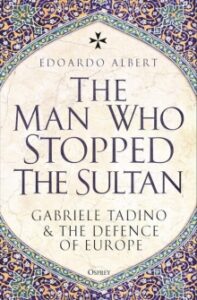
Edoardo Albert is a historian of the early medieval period and the author of The Man Who Stopped the Sultan: Gabriele Tadino and the Defence of Europe.