Usually in British history, the death of a British regnant Queen has led to a change of ruling house. After Elizabeth I, it went from Tudor to Stuart. After Anne, it went from Stuart to Hanover. After Victoria, it went from Hanover to Saxe-Coburg-und-Gotha. On the death of Queen Elizabeth II in 2022 however, this did not occur; or did it?
On the surface, at least, the House of Windsor remains in place. For political reasons, that name may never change, but, for the rest of us mere mortals, the tradition of taking your surname from your father (and his father) remains very much the overwhelming custom – even in 2026. So, with that in mind, what is the ‘real’ surname of the British monarch now?
Most of us are familiar with the House of Windsor and that it is an officially adopted name of the Royal Family taken in 1917 during WWI in lieu of Saxe-Coburg-und-Gotha in order to sound less Germanic. Fewer of us are aware that Mountbatten is the adopted anglicized name of the princely family of Battenberg who also made the switch in 1917 for similar reasons. The Battenburgs/Mountbattens were the family of Prince Philip, Duke of Edinburgh’s mother – not his father. Philip adopted his mother’s name in 1947 also in an effort to sound less German.
So, if the King’s mother’s name was Windsor (or Saxe-Coburg), and his father’s name was Mountbatten (Battenburg) – but that was taken from his maternal family – what is The King’s ‘real’ or ‘original’ surname? Answer: Schleswig-Holstein-Sonderburg-Glücksburg – or just ‘Glücksburg’ if you need to save time!
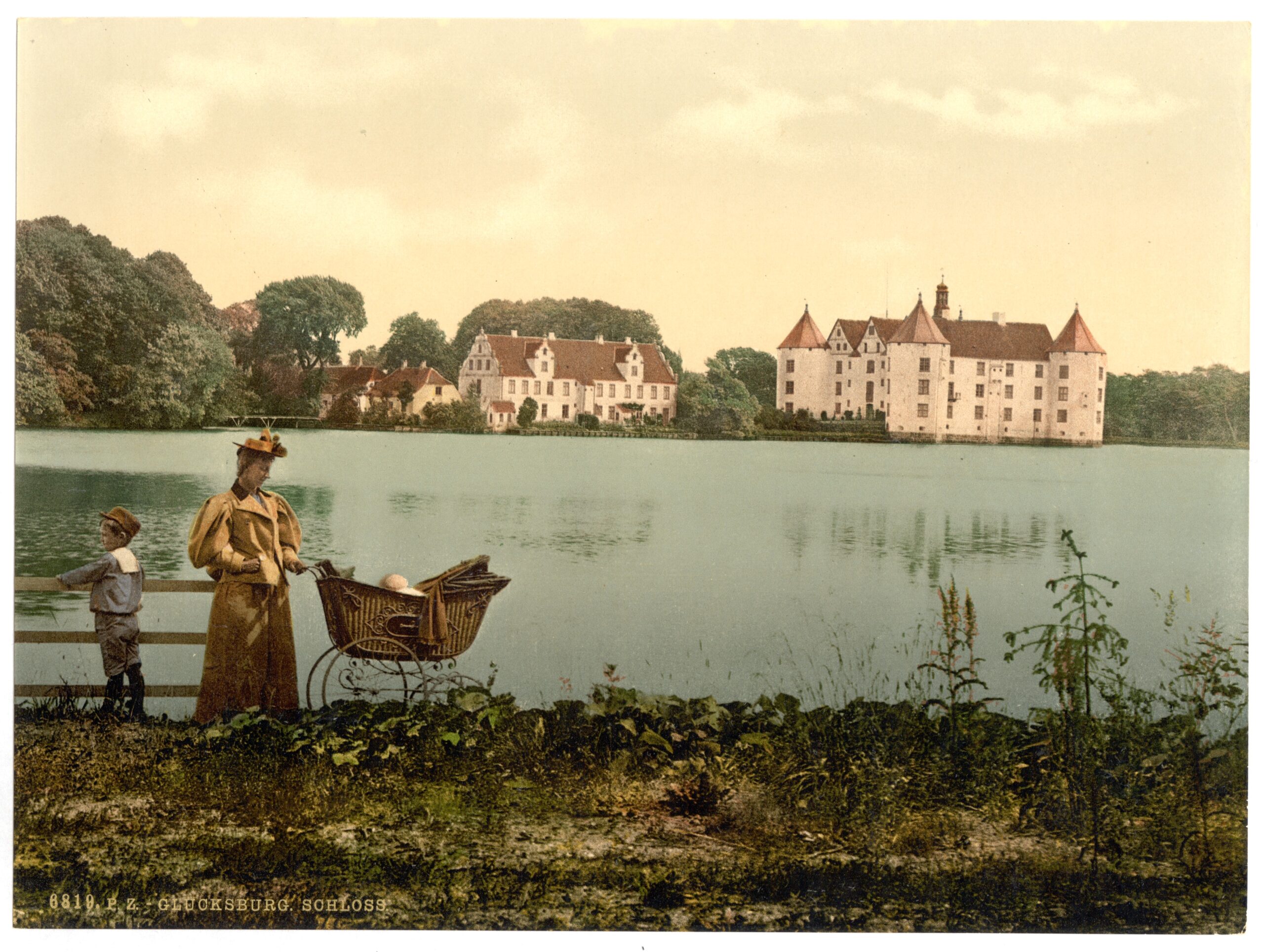
Glücksburg is a castle in Schleswig-Holstein in modern-day Germany. Originally the castle and territory had come under the crown of Denmark and, at times, served as the official summer residence of the Danish monarch. It was established as the home of the Dukes of Schleswig-Holstein-Sonderburg-Glücksburg – a branch of the Danish royal family. After the War of Schleswig-Holstein, from 1864, control of the duchy became Prussia’s and subsequently Germany’s. The castle, however, returned to the Danish royal/ducal family from 1871.
Prince Philip was part of royal family of Greece as well as simultaneously being a member of the Danish royal family. His father was Prince Andrew of Greece and Denmark, a military officer who was embroiled in one or two public scandals – which will sound familiar to some. Philip’s paternal grandfather, King George I of Greece, was made king following an 1862 referendum to determine who would be the constitutional monarch of Greece. It was the first referendum ever to be held in Greece (in modern times). Philip’s grandfather was not, however, the winner. The clear victor with 95% of the vote was Prince Alfred The Duke of Edinburgh – Queen Victoria’s second son. The British government was strongly opposed to this and ruled that no royal from one of the Great Powers of the day – Britain, France, or Russia – could accept an invitation to be king of the fairly new country of Greece. Looking down the list, a candidate which the powers could agree on was a young Prince William of Denmark. He had received just six votes in the referendum. This is ironic given that Greece is the birthplace of democracy. Nevertheless, the 18-year-old prince was chosen, and he changed his name to be King George I.
Tragically, Greece was not an easy place to rule. King George I was assassinated in 1913. His son, King Constantine I, abdicated (twice), and his grandson, King Alexander, was killed by a monkey (while protecting his German Shepherd dog)!
The paternal ancestry of King Charles III of the United Kingdom stretches back to c.1100 with Count Elimar of Oldenburg. Oldenburg is a city in Lower Saxony in Germany. Not much is known about him although he may have bought membership to a fraternity with buckets of eels. Arguably, Elimar founded one of Europe’s grandest and most widespread dynasties of all time. Male-line descendants have sat on the thrones of Russia, Sweden, Greece and Denmark, and still do in Norway and the United Kingdom. Through luck and advantageous marriages, Elimar’s ninth great-grandson became King Christian I of Denmark, Norway and Sweden in 1448. Christian I’s grandson, Christian III, made the second of his sons, Prince John, the Duke of Schleswig-Holstein. Thus, this ducal branch of the Danish royal house was founded and multiplied into many more branches.
As minor and somewhat distant members of the Danish royal family, many of King Charles III’s paternal forebears sought service in other European courts. Some served as generals in the armies of Prussia and of Russia. Following a succession crisis in Denmark, the minor Glücksburg royals endured an upgrade as the crown passed to Christian IX (Charles III’s great-great-grandfather). Queen Victoria may have been known as the ‘grandmother of Europe’ but Christian IX was known as the ‘father-in-law of Europe’ owing to his daughters marrying the rulers of the most powerful royal families.
For now, officially, the King is of the House of Windsor and various members of the family are known as Mountbatten-Windsor. In the traditional sense, the dynasty is secured with the Prince of Wales and Prince George to follow. Yet, who knows? In time, the British may come to accept and count the name of Glücksburg among the names of its other great ruling dynasties from Plantagenet to Windsor.

Edward Hilary Davis is an historical consultant, a special advisor and the author of All the King’s Fathers: The Paternal Ancestry of King Charles III and the House of Glücksburg.