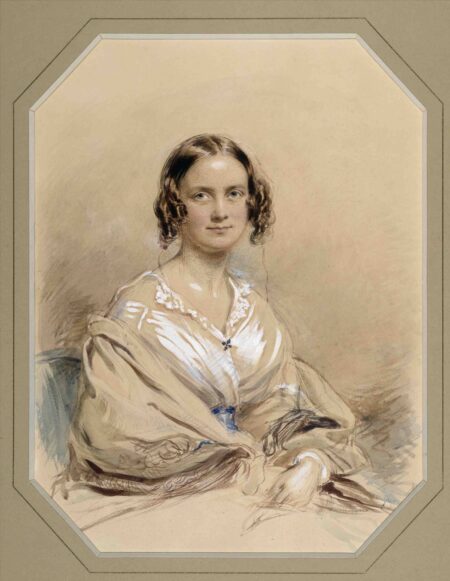
In May 1838, Emma Wedgwood travelled through London on her way to Paris for a family gathering. She had just turned 30 and was already an experienced traveller, with visits to France, Switzerland and Italy behind her. London offered the chance to see her brother Hensleigh and his wife Fanny, who was also a cousin of theirs, and two more cousins, Erasmus and Charles Darwin. This was one of Emma’s many visits to London, where she often stayed for anything from a few days to several weeks. But this time, something was changing. Before the year was over, she and Charles would be engaged.
Emma had grown up at Maer Hall in Staffordshire, the youngest daughter of Josiah Wedgwood II. Her grandfather’s pottery business had connected the family to the industrial and intellectual changes transforming Britain. Politics, science and questions of conscience were familiar subjects of conversation. An accomplished pianist, Emma enjoyed books, art and languages, followed current affairs and had been encouraged to form her own opinions.
Her young life had also been marked by loss as in 1832, her beloved sister Fanny had died, aged 26. They had rarely been apart, and Emma’s hope of seeing her again made belief in a future life particularly important to her.
Charles’s life had taken a different course: his mother had died when he was eight, and at 16 he had been sent to Edinburgh to study medicine, but left after two years. He then went to Cambridge with the prospect of becoming a clergyman, Instead, his growing interest in natural history led to an invitation to join HMS Beagle and when he returned in 1836, after nearly five years, it would be with collections and observations that would establish his scientific reputation.
By 1838, he was busy in London, preparing his voyage publications and filling notebooks with questions about how species changed. He was also wondering whether he should marry. His notes on the subject make entertaining, if occasionally exasperating, reading: companionship and children and were weighed against expense, family obligations and the loss of time for work. Having considered the alternatives, he concluded that marriage was the better option, but deciding whom to marry was another matter.
Emma’s letters give us a rather different view of those months. Returning from Paris, she spent time in London and later described a cheerful family party, including Charles. She enjoyed his company, but could not be sure what his affectionate manner meant. He had always been fond of everyone at Maer, was she now imagining that his attention towards her was something new and different?
During the summer Charkes visited Maer and their correspondence offers glimpses of the growing attachment, although Emma remained uncertain where it might lead. That autumn, Charles was making a crucial intellectual step as after reading Thomas Robert Malthus he had arrived at the principle of natural selection. Within weeks, he made another decision and, on 11th November, he proposed to Emma, and was accepted. He recorded it as “the day of days”. Their families were delighted and Emma admitted that the proposal had surprised her: she had thought their friendship might continue for years without anything more coming of it.
Their engagement also brought a difficult conversation as Charles had begun to question the truth of Christianity, although his views were still developing. His father had advised him to conceal his religious doubts from a future wife, but he chose to confide in Emma. She worried about where his questioning might lead, yet valued his honesty and recognised his sincere desire to discover the truth. For her, faith included the hope of being reunited with those she loved after death. Could she and Charles share that future if they did not share the same beliefs?
They married on 29th January 1839 and, over 43 years, they would have 10 children, lose three, and make a home first in London and then at Down House where family life and scientific work were closely connected. Emma read Charles’s manuscripts, offered comments and became someone whose judgement he trusted.
In writing about Emma, I have found the events of the summer and autumn of 1838 particularly revealing. Both had grown up in families that valued independent thought, and neither expected the other to abandon it on marriage. Emma retained her faith, while Charles would eventually describe himself as agnostic. In November 1838, they could not have known what lay ahead, but the honesty, love and trust in each other’s judgement that would sustain their marriage were already there.
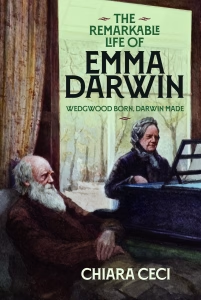
Chiara Ceci is the author of The Remarkable Life of Emma Darwin: Wedgwood Born, Darwin Made.