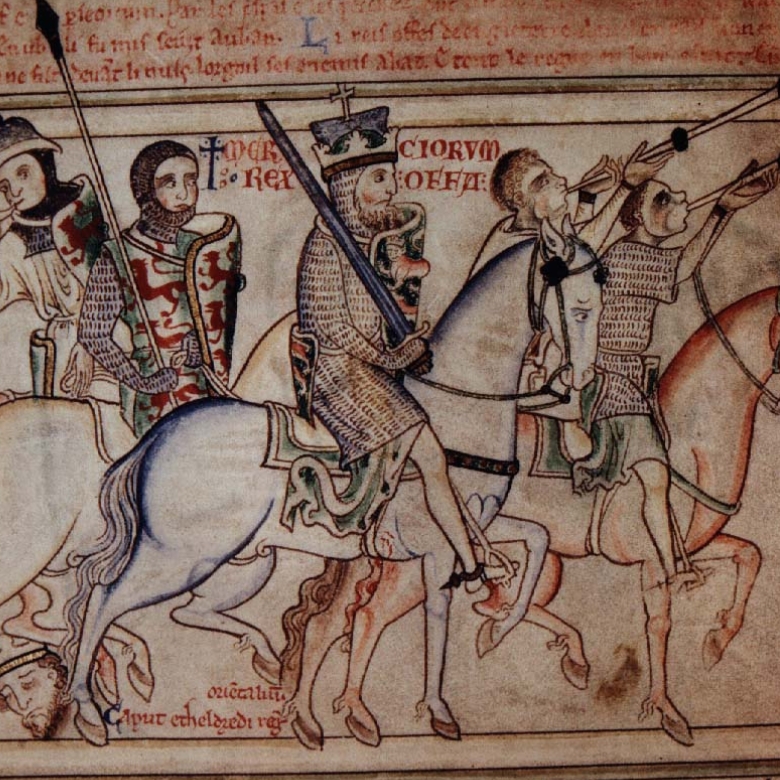
The pair of Anglican archbishops at Canterbury and York have been pillars of England’s ecclesiastical establishment for centuries, going back long before the Church of England itself. However, for a brief period between 787 and 803 England had a third archbishopric, in Lichfield, set up under the auspices of Offa, king of the Mercians.
This was not perhaps as radical a step as it might seem. York had only become an archbishopric about fifty years earlier in 735, and the archdiocese of Canterbury was relatively large by Western European standards. Yet the brief elevation of Lichfield has been seen as an aberration from very early times. The Anglo-Saxon Chronicle, written in Wessex in the 890s but probably drawing on earlier sources from Canterbury, put it in stark yet heavily slanted terms in an annal for 787: ‘in this year there was a contentious synod [ecclesiastical meeting] at Chelsea, and Archbishop Iænberht [of Canterbury] lost a certain part of his province, and Hygeberht was chosen by King Offa [as archbishop of Lichfield]. And Ecgfrith [Offa’s son] was consecrated king’. The perspective here is very clear. This was Canterbury’s loss rather than Lichfield’s gain, and moreover it was a scheme engineered by Offa to raise his son to be co-king with him – an act that he apparently couldn’t or wouldn’t get the archbishop of Canterbury to undertake. In effect, the archbishop of Lichfield was presented as a wheeze, a power-grab, cynically created to further the ends of Offa and his family.
It is certainly true that Ecgfrith’s elevation was one of the first acts undertaken by the new archbishop, but that is not the same thing as accepting that Offa created it solely for that end. In fact, one of the letters exchanged between England and Rome in the process of dismantling the archbishopric hints at the reasons Offa presented to the pope in the first place: that it was the unanimous wish of the English, and reflected the size of Offa’s kingdom and the extension of his power. These last claims had considerable merit. Offa’s kingdom, which covered everything south of the Humber save Wales and Wessex, was fast becoming a new kind of entity: one that had both broad geographical reach and a ruler who wanted to consolidate it into a single regnal unit, not a collection of kingdoms under a single overlord. The bishoprics assigned to Lichfield reflect the ‘Anglian’ part of that territory, meaning the ones north of the Thames (save London, the bishopric of the East Saxons), leaving Canterbury with the traditionally Jutish and Saxon bishoprics to the south. The choice of Lichfield to lead this unit was a deliberate one. Lichfield was the oldest of the Mercian bishoprics, having been founded in the 660s. It sat in the heartland of the Mercian kingdom, close to the major royal seat at Tamworth. Although little has survived from its first few centuries, a building project in Lichfield Cathedral in 2003 uncovered a beautiful, elegant carving of an angel, probably made in the eighth and thought to have once adorned the shrine of the Cathedral’s founding, patron saint, Chad. This clearly was an important, cultured centre, and so were the other Mercian bishoprics such as Leicester, which is also very poorly known.
Herein lies the basic problem for the archbishopric of Lichfield: that its creation and existence are known almost entirely from outside, hostile points of view. A good part of the information comes from the letters concerning its end. Again, the reasoning here is murky, for the letters present Canterbury’s primacy as obvious and desirable, and go completely over the head of the archbishop of Lichfield. Yet the circumstances had changed. Offa and his son both died in 796, removing the key supporters of the Lichfield scheme when it was still in its infancy. The new king who took the throne, Coenwulf, had different attachments and priorities. Moreover, he had a much more cooperative archbishop of Canterbury to deal with, who had been plucked from a monastery in Lincolnshire (i.e. solidly Mercian territory) to take on his new post in 792. There were the conditions that led to a sharp change of fortune for Lichfield, and eventually it was agreed that once Hygeberht, the one and only archbishop, passed away his successors would no longer claim that title or the powers that went with it.
The brief existence of England’s third archbishopric was cast as a mistake, or at best a false start. Yet this is only one side of the story, and emphatically not Lichfield’s or the Mercians’ side.
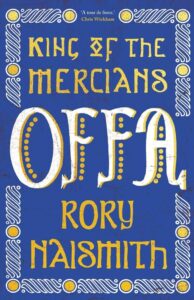
Rory Naismith is the author of Offa: King of the Mercians, which is published by Yale University Press.