“Soldiers, when I give the command to fire, fire straight at my heart. Wait for the order. It will be my last to you. I have fought a hundred battles for France and not one against her…. Soldiers! Fire!”
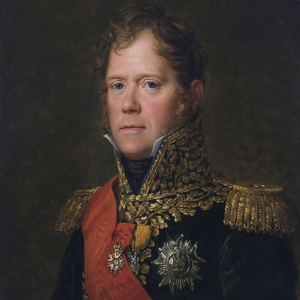
The oft-quoted last words of Michel Ney, Marshal of France, stirring stuff and wholly in keeping with the fearless character of the man known to history as The Bravest of the Brave.
Only there is no evidence that he ever said them.
Aggressive, indomitable and, by many standards, reckless. Many finely trained generals in armies throughout history excelled at those aspects of warfare which are necessary adjuncts to the actual commitment of men to the business of killing. Ney is among those who were at their best when armed forces come to the ultimate test of battle. As a subordinate commander he handled his units with a sure touch, the troops imprinted with Ney’s native aggressiveness and absolute self-expression in combat.
Unfortunately, Ney’s reputation has been marred when he essayed strategy after Napoleon unwisely promoted him beyond his capacities to army command. He was a fighter not a thinker. He was, as an independent commander, never able to think of battle except in terms of troops charging to glory across an open field. Ney could not make war on the map.
Most of Ney’s mistakes grew out from the nature of his personality. He was a man of emotion not of intellect. He was never a reasoning and analytical man who carefully weighed up all possible factors in a problem or situation. He was much inclined to be impetuous in his decisions. Which ultimately cost him his life.
Ney was already a legend before he faced a line of muskets in the Luxembourg Gardens in Paris on the morning of 7 December 1815. Before the powder cleared he had taken on a near mythic status. Despite the absence of onlookers, pamphleteers immediately went to work scribbling a suitably dramatic death. The key witness to Ney’s execution was General Comte Loius-Victor de Rochechouart, military commandant of Paris. The Comte was an émigré French nobleman who fled from the Revolution to serve in the Russian Imperial Army eventually rising to major-general. Upon the First Bourbon Restoration, he had transferred to the new French Royal Army. After Napoleon’s return from Elba and the collapse of royal authority caused by Ney’s defection, he had accompanied King Louis XVIII into exile. Upon the Second Restoration he was appointed to the politically sensitive command of the Paris garrison. A constitutionalist royalist of moderate politics, he had opposed the reactionary Ultras who had demanded that Ney be put on trial for treason. Now his duty obliged him to organise the execution by firing squad of a fellow Frenchman he respected and admired.
General de Rochechouart’s memoirs make clear his instructions from the Tuileries Palace via the Ministry of War. Ney’s execution was to be conducted without any public demonstration or spectacle. That morning, Ney was taken under heavy escort a short distance to the Luxembourg Gardens as opposed to the plain of Grenelle, the traditional site in Paris for military executions. There a firing squad was in position. Ney left his coach, walked to the wall, was offered and refused the blindfold. The major commanding the firing squad, an Italian mercenary (de Rochechouart thought it distasteful giving the job to a French officer) ordered his men to take aim. At that Ney raised his hat and cried out “Soldiers! I protest against my condemnation….” But was cut short by the impact of eleven .69 calibre lead musketballs. One soldier fired high hitting the top of the wall.
General de Rochechouart had carried out his orders. A private death for Marshal Ney.
A regular question asked by readers is why, after the defeat at Waterloo, Ney did not make his escape from France. After all he knew was a marked man. Only Napoleon was more loathed by the Bourbon Ultras. Wisely he had taken ship from France almost immediately after his abdication. If he had been captured either by French royalist militia or by Prussian soldiers he would have been almost certainly shot out of hand.
Ney on the other hand lingered. He did not leave Paris until 6 July. Two days before the Allied armies entered the city. The Treaty of Paris, signed on 3 July, had granted amnesty to all Frenchmen who had followed Napoleon, but contained a flaw: King Louis XVIII had not signed it. He was under pressure from the Ultras to purge France root and branch. Top of their list was Marshal Ney.
One explanation is that Ney was suffering from combat fatigue, the long-term effects of over twenty years of warfare. At Waterloo, he had been in the thick of the fighting with five horses shot from under him. At the end, he had desperately tried to rally Napoleon’s fleeing army. Eyewitness accounts have left us with an unforgettable picture of Ney alone and on foot, tattered and filthy, holding a broken sword and screaming “Come and see how a Marshal of France dies!”
In the days that followed Ney seems to have given the appearance of being punch drunk, like a boxer who has been hit on the head too often. In his state of mental and physical exhaustion he was effectively paralysed.
Another explanation is Ney’s naivety combined with his vanity, which was as much a part of his character as his bravery. He simply could not comprehend the danger that he was in. He was hated by Royalists for betraying the Crown and defecting to Napoleon. He was hated by Bonapartists who blamed him (unfairly) for Napoleon’s defeat at Waterloo. Yet Ney appears to have believed that such was his status as the Bravest of the Brave that he would be called upon by France’s Provisional Government and be given a command, thus securing his future. His attitude was, as Shakespeare had Othello put it, “I have done the State some service and they know’t”. He waited too long for a call that never came.
Finally recognising the danger he was in, Ney left Paris. Days after the list of those to be tried for treason was published, Ney’s name was at the top. But, rather than take ship for America or cross the border into Switzerland, he drifted in a trance-like state around the country until he was arrested on 3 August 1815 by local police acting on their own initiative. The reaction of Louis XVIII made it clear that he regarded Ney’s arrest as a political disaster: “Everything was done to favour his escape”, adding, “He has done more to arm us by being arrested than he did on the day he betrayed us!”
As for the myth of Ney faking his death and escaping to North Carolina? It rests on the Duke of Wellington being a man of sentiment towards a brave enemy. Which he wasn’t. It rests on Ney not being Ney. That he could somehow live a life of obscurity as a rural schoolteacher. That he would abandon his wife and family that he was devoted to. That myth was finally put to rest in 2023 by DNA testing.
That Ney died because of a judicial murder has, if anything, enhanced his status as the symbol of a romantic warrior tradition whatever his shortcomings as a general.

Brian Williams is an historian and author, whose book, Marshal Ney: Fall from Glory, was published in August 2025.