In the early hours of 3rd July 1940, a powerful British fleet cut steadily through the Mediterranean towards the Algerian coast. Led by HMS Hood, one of the largest and most formidable warships afloat, Force H moved with quiet determination through the warm darkness, its bows slicing cleanly through the calm water beneath a sky not yet touched by dawn.
On deck, the mood was tense but controlled. Sailors moved quietly, checking ammunition, adjusting equipment, speaking in hushed tones. The great guns were already trained and ready. There was no uncertainty about what lay ahead. They were heading into battle.
But this was no ordinary naval operation. Force H were not sailing to engage the enemy. They were sailing to confront their closest ally.
At the head of the fleet stood Vice Admiral James Somerville, a thoughtful and measured commander, widely respected for both his judgement and his restraint. He understood, perhaps better than most, the extraordinary nature of the orders he had been given. Even now, in the midst of war, he retained small habits of normality – for example his Siamese cat, Figaro, slept somewhere aboard the ship – but there was little comfort to be found in such things. Their mission had been transmitted over the ship’s Tannoy system: ‘We are proceeding to Oran to try and persuade the French Fleet there to sail with us, and should they prove obstinate, it would be our unpleasant duty to sink them.’
The simple reason for the orders was that the French fleet must not be allowed to fall into German hands. If that happened, it would likely lead to the instant defeat of Britain.
As dawn approached, the coastline of Algeria began to emerge from the darkness, first as a faint line on the horizon, then gradually resolving into low hills and rugged shoreline. Beyond them lay the harbour of Mers el-Kébir. Somerville knew exactly what was waiting there – a fleet of powerful warships, manned by officers and sailors who had only recently been allies.
The amber dawn broke over the bay, lighting Algeria’s blood-orange hills and catching on the elegant steel hulls of the eleven French ships of the Force de Raid lying quietly at anchor. The water was still, almost glass-like, disturbed only by the occasional ripple of movement from small boats or the gentle shift of moored vessels.
Aboard the 214-metre battleship Dunkerque, the flagship of the squadron, the day had begun as usual. Sailors moved about their duties – scrubbing decks, checking fittings, preparing for inspections – the familiar rhythms of naval life asserting themselves even in uncertain times.
On the bridge, Vice Admiral Marcel-Bruno Gensoul surveyed the harbour. There was no outward sign of alarm. Nothing to suggest that within hours, everything before him would be reduced to wreckage. It was, on the face of it, a morning like any other.
Yet the wider context was anything but routine.
In just over six weeks, France had collapsed under the force of the German offensive. The scale of the defeat was staggering: some 92,000 dead, around 200,000 wounded, and more than 1.5 million taken prisoner. The government had capitulated. The armistice had been signed. France, one of Europe’s great powers, had fallen with astonishing speed.
And yet, one crucial element remained untouched – its navy.
By 1940, the French Fleet was one of the most powerful in the world. Modern, well-equipped, and strategically vital, it was the fourth largest fleet afloat, behind only Great Britain, the United States and Japan. At Mers el-Kébir lay some of France’s finest ships, including the fast battleships Dunkerque and Strasbourg, vessels designed to counter German naval threats. Their speed and firepower made them formidable, and in the wrong hands they could alter the balance of power at sea.
For Winston Churchill, this posed an existential dilemma.
One of the few weaknesses in the seemingly unstoppable German war machine lay at sea, where the Kriegsmarine remained comparatively small. But if the French Fleet were to fall into German hands, whether through coercion, negotiation, or gradual control, that balance could shift decisively. Britain, already facing isolation, could find itself dangerously exposed. The invasion of Great Britain would no longer be a distant threat, but an imminent reality.
Churchill resolved that the risk was too great to accept.
Force H had been dispatched to ensure that outcome would never come to pass.
In a final attempt to avoid bloodshed, Vice Admiral Somerville sent Captain Cedric ‘Hookie’ Holland ahead aboard HMS Foxhound. Holland was ideally suited to the task. A committed Francophile and former naval attaché in Paris, fluent in French and well known to many senior officers, he was both diplomat and sailor. If anyone could find a peaceful solution, it was him.
He carried Britain’s ultimatum. The French fleet must either join the British and continue the fight, sail to neutral ports, or scuttle their ships. Failing that, they would be destroyed.
From the outset, the negotiations faltered.
Vice Admiral Gensoul received Captain Holland coldly. The request itself was deeply offensive. An expectation that a French admiral would effectively surrender his command to a foreign power. There was also the matter of rank. Captain Holland, though respected, was several grades junior, and Vice Admiral Gensoul took immediate umbrage at being expected to negotiate on such terms. Worse still, Captain Holland was not even granted the courtesy of a direct meeting at first, forced instead to parley through intermediaries as tensions simmered on both sides.
As the day wore on, the situation grew increasingly strained. Captain Holland travelled repeatedly between the British fleet and the harbour, each time pressing for a peaceful resolution. The heat was oppressive, tempers frayed, and time slipped away. On each return to HMS Foxhound, the mood grew heavier, the chances of success diminishing.
Vice Admiral Gensoul, however, was not merely being obstinate. Bound by France’s naval commander-in-chief, Admiral François Darlan’s explicit orders to fight rather than surrender, he deliberately prolonged the negotiations. His aim was to buy time – time to consider his options, to prepare his ships, perhaps even to slip out of the harbour after dark, or if attacked, he was willing to return fire.
As the hours passed, mistrust deepened. Signals were delayed or misunderstood. Messages were reinterpreted. Opportunities for compromise slipped away. Captain Holland, who only weeks earlier had worked alongside these same officers as allies, now found himself pleading with them to avoid catastrophe. Each journey carried less hope than the last.
By late afternoon, the situation had become irretrievable.
At 17:54 hours, Vice Admiral Somerville signalled the codeword to open fire: ANVIL.
Moments later, the guns of Force H let rip.
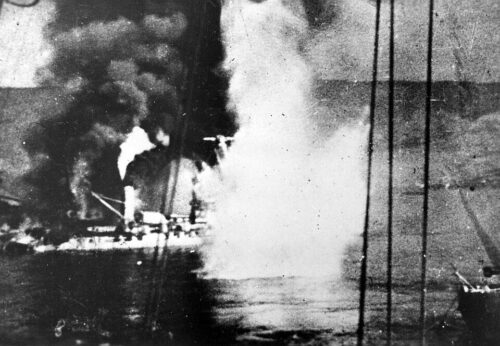
The effect was immediate and devastating. In the confined waters of the harbour, the French ships anchored stern-to the breakwater had little room to manoeuvre. Heavy shells from the British ships HMS Hood, HMS Valiant and HMS Resolution tore into their targets with overwhelming force. The sound was immense, a continuous roar punctuated by violent explosions, splintering steel, and towering columns of water and flame. Within seconds, the still evening was transformed into chaos.
The French responded as best they could, thanks mainly to Vice Admiral Gensoul’s preparations. Guns roared in defiance, and shells fell among the British ships. One struck HMS Hood, wounding two sailors and causing superficial damage. But the return fire was brief and increasingly ineffective. One by one, French gun positions were smashed, their fire faltering under the relentless bombardment.
The destruction was catastrophic.
French battleship Provence was struck as she attempted to get underway, a shell smashing into her stern and detonating an ammunition store. Fire engulfed the aft of the ship as sailors fought desperately to contain the blaze. Damage-control teams worked in suffocating heat, flooding compartments and clearing ammunition by hand. Their efforts saved the ship, but at a cost. With fire still raging, she was forced to run aground, crippled and out of the fight.
Bretagne was destroyed outright.
A massive explosion ripped through the ship, sending a column of fire high into the sky. The blast was so violent it shook British spotter aircraft overhead. Within seconds, she was gone. Of the roughly 1,200 men aboard, the vast majority were killed instantly. What remained was burning oil, scattered wreckage, and a handful of survivors struggling in the water.
At 18:10 hours, just sixteen minutes after the first shots had been fired, Vice Admiral Gensoul signalled: ‘All my ships are out of action. I request you cease fire.’
The battle had lasted barely a quarter of an hour.
As the smoke began to clear, the harbour revealed a scene of utter devastation. Ships burned fiercely, others lay sunk or crippled against the breakwater, and the water itself was choked with oil, debris and bodies. Fires continued to rage, sending thick black smoke into the evening sky.
Aboard HMS Hood, Vice Admiral Somerville stood staring out over the destruction. One of his officers later recalled seeing him begin to cry. Around him, even hardened sailors struggled to comprehend what they had just witnessed. This was no ordinary victory.
Yet even then, the story was not over.
At 18:20 hours, an urgent signal arrived from one of the aircraft carrier HMS Ark Royal’s spotter aircraft: ‘One [French battleship] has left harbour and is going east.’
Strasbourg had escaped.
Taking advantage of the thick smoke, Captain Collinet had expertly navigated his ship clear of the harbour, slipping past the British guns and threading a path through the minefield laid across the entrance. She was already steaming at speed for open sea.
Vice Admiral Somerville immediately ordered pursuit.
‘Captain Glennie,’ he shouted, ‘immediate starboard turn to the east and make full speed.’
But by the time they had started to give chase, Strasbourg, capable of over 28 knots, already had a significant head start. HMS Hood was some 25 nautical miles astern and initially heading the wrong way. With little realistic chance of catching her, Vice Admiral Somerville turned to the air.
From HMS Ark Royal, six Fairey Swordfish were launched, each armed with an 18-inch Mark XII torpedo – a heavy weapon designed to cripple even the largest warships. Escorted by the nimble Blackburn Skuas, they climbed into the evening sky, heading east in search of their target.
At around 20:30 hours, they attacked under heavy anti-aircraft fire.
‘Torpedo wakes heading to starboard!’
Captain Collinet reacted instantly. ‘Hard-a-port!’
Driving his ship at full speed, he turned sharply, evading the spread. One torpedo struck near the stern, throwing up a vast plume of water, but the damage was minimal. The rest missed entirely.
By 20:55, as darkness fell, Vice Admiral Somerville called off the pursuit.
Strasbourg had escaped.
The following morning brought a different kind of horror.
Vice Admiral Gensoul ordered recovery operations. Small tugs moved slowly through the wreckage, their crews hauling bodies or fragments from the water. Identification was attempted using whatever remained: a tag, a ring, a scrap of uniform. Many could not be identified.
They were buried in mass graves, marked only by simple crosses bearing a single word: INCONNU.
Days later, further British air attacks ensured that Dunkerque could not be repaired.
For Britain, it was a necessary act. Harsh, brutal, but essential to survival. It sent a clear message, not least to the United States, that Britain would continue the fight at any cost.
After all the attacks, in total, 1,297 French sailors had been killed, with a further 350 wounded, men who, only days earlier, had stood as Britain’s allies.
For France, this was the worst betrayal.
Churchill himself would later call it ‘a hateful decision… but one necessary for the life of Britain.’
At Mers el-Kébir, in the space of sixteen minutes, not only ships but trust itself had been destroyed.
Edward Abel Smith is a writer, documentary maker and the author of A Hateful Decision.