
The western Roman Empire collapsed so long ago that we might well ask ‘why should that matter to us now?’. Yet, in multiple ways, our lives are conditioned, still, by those events. Take language, for example. Mostly, the western Empire spoke Latin. Despite substantial inflows of Germanic speakers, Spain, France and Italy still do. Or religion? Continental Christianity descends directly from the Roman period. What about place-names? Again, continuity is commonplace. Against that backdrop, Britain looks distinctly odd. Here, Latin was never universal, for Celtic resisted colonisation, but it was the Germanic of 5th-century incomers which eventually triumphed, evolving into English, now a world language. In contrast, British Latin is lost. Celtic survived as Welsh, Breton and Cornish, but today has barely a million speakers. Additionally, most place-names were replaced, albeit river-names proved stickier. And the Germanic community long remained pagan, until conversion was initiated not by locals but Continentals, most famously Pope Gregory.
Taken separately, British and Continental experiences are explicable, for migrations have variable outcomes. Put side by side, though, we have all sorts of problems explaining why comparable situations panned out differently.
Making sense of this is difficult. Firstly, this is the Dark Ages, when even a basic chronology of events is beyond us. That was already so in the central Middle Ages, when sorcerers, giants, magic swords and, yes, King Arthur were added to the mix. Scholars spend vast amounts of time and energy separating late additions from the few facts surviving from the period. The degree of opacity necessitates a multidisciplinary approach, involving archaeology, genetics, environmental research, history and language studies, but combining these creates further challenges. Finally, this era divides Antiquity from the Middle Ages. Romanists often shun a period they characterise as ending, while medievalists distrust what feels like a prequel of dubious relevance.
There are several possible approaches. We can compare Britain with the Continent to see if differences pre-AD400 affected how the 5th century played out. Secondly, we can explore Roman collapses on either side of the Channel, and compare the migrations affecting each. And, finally, we need to see just how like, and unlike, relations developed between provincials and incomers.
Firstly, then, did Roman Britain differ from Gaul or Spain? By the 4th century, lowland Roman Britain probably looked much like neighbouring Gaul, with roads and towns, similar governmental structures, and civil society controlled by villa-owning aristocrats, who presided over numerous peasants. But late-Roman government centred on Gaul, and the emperors were Spanish, providing opportunities to both elites. In contrast, no Britons attained high office, and British identity and language withstood colonisation better than Continental equivalents, creating an outsider status.
The Roman world was prone to civil wars. Western armies lost several across the late 4th century, causing the imperial court, and coining, to withdraw below the Alps. Under-funded and marginalised, the British garrison rebelled in AD 406. Its eventual leader, Constantine III, led the more mobile units across the Channel in AD 407 to counter barbarian invaders. He was, though, unable to consolidate his hold on the western dioceses and was captured by forces loyal to the pre-existing regime in AD 411.
Efforts were made to restore imperial power, but these fell short of recovering Britain. Rome’s leaders seem not to have considered the risks worthwhile, seeing Britain as less threatening than ‘barbarian’ forces on the Continent. The window of opportunity narrowed in AD 435, when the Vandals seized Africa, then closed in the early AD 450s, when the Huns crashed into Gaul, then the last, capable, western general, Aëtius, was murdered.
Until then, though, southern Britain was part of the empire but outside its active control. Previously, that had always returned; there was no reason to think things different now, making it risky for Britons to assert their independence. In the interim, civil leaders needed security, so hired mercenaries, mostly from outside the empire, in the normal, Roman fashion. Men, and their families, came for multiple reasons: some were refugees or exiles, others economic migrants or adventurers. Germanic graves, metalwork and pots begin c.AD 420, mostly near the eastern coasts, with concentrations in Norfolk and the Thames Valley. Some distributions imply settlement was initially under British control, suggesting multiple, small-scale communities of invited warriors. Ancient DNA reveals those buried in these cemeteries were predominantly of incomer descent.
Alongside, though, British elites remained committed to Roman dress, and Christianity, the imperial religion. British clerics were sufficiently aware of heresy to invite Gallic bishops to preach against it, and supported Continental missionaries converting Ireland. The lowland, British elite continued to align themselves with Rome for several generations, therefore, despite the collapse of imperial functions in Britain.
But these interim arrangements gradually took on greater permanence. Without a state apparatus capable of raising taxes in coin to pay wages, British aristocrats gave mercenaries land, probably mostly territory controlled earlier by the state or overseas magnates. Environmental research demonstrates continuing land use, suggesting peasants continued farming on behalf of incomers.
But their greater military capacity and the lack of effective government enabled immigrants to seize further territory. We should probably envisage a mishmash of local land-grabs. In AD 441, a Gallic chronicler noted ‘the British provinces were reduced to the rule of the Saxons’. This is overly generalised and probably exaggerated, but the presence of a British abbot, Faustus, at Lérins, near Marseilles, may explain how information reached southern Gaul. We see the general trend.
Post-AD 454, the likelihood of Rome’s return to Britain evaporated, allowing independent rulers to emerge. The 6th-century British writer, Gildas, first mentioned British kings at this point, and his awareness of one ‘Roman’ couple having ‘worn the purple’ suggests some kind of imperial status. But a figure later named Vortigern eventually established himself in power. A later genealogy suggests he derived from a comparatively Roman, Christian family centred on Gloucester, implying political power had shifted westwards from the south east. That Vortigern, too, hired Saxon federates, whom he supplied via Roman-style taxation and stationed on the east coast, implies his power was widespread. But these mercenaries rebelled. They raided Britain ‘from sea to sea’ and fought a messy war against British forces, until peace was eventually agreed, probably in the AD 490s. Historians generally interpret this conflict as ending with British victory at Badon, but more careful interrogation of Gildas reveals the Saxons won. Likewise, archaeology shows Anglo-Saxon material culture spreading widely from around this time, consistent with the incomers acquiring control of wide, new territories.
On the Continent, provincial aristocrats and bishops frequently co-operated with barbarian leaders. In Britain, though, a similarly Christian elite identified with the Old-Testament Israelites whom God subjected to outsiders to punish their sins. Repent, Gildas urged, and return to the Lord. Then He will renew His protection, and dispense with those oppressing His people. Saxons were viewed, therefore, as equivalent to Old-Testament Assyrians and Babylonians; they were criminals who had stolen Britain; infidels and savage animals, unrecognisable as human beings, so entirely unfit for conversion.
This sense of ‘othering’ was mutual. Like other German-speaking ‘barbarians’, Saxons distinguished themselves from wealas (‘foreigners’, from which ‘Welsh’ derives). In Old English, though, this came to mean ‘slaves’. Welshmen occur in early English law codes, alongside agricultural and household slaves likely to have descended from the indigenes. Incomers had migrated from a wide range of Continental communities, so owned multiple identities, but they shared a common language, and the gulf between them and Britons encouraged their coalescence around one identity, long before political unity was achieved (in the 10th century). Bede referred to them collectively as Angles, hence ‘English’, despite recognising different tribes contributed settlers. Racial distinction was central to England’s emergence, therefore, on both sides.
This separation of indigenes from incomers found expression particularly in religion, with the Britons Christian and English pagan. In the AD 530s and 40s, though, a severe, climatic downturn triggered successive plagues, impacting population and agricultural output. The effect was probably greatest in the uplands, weakening British kings disproportionately. English leaders took advantage, compensating for shortfalls by fresh land-grabs midway through the 6th century, which absorbed further, lowland, British territories and pushed on into upland regions (particularly the north).
These traumas impacted additionally at an ideological level. Christianity had well-established mechanisms for dealing with disasters, but English paganism was more transactional. Across the second half of the 6th century, Frankish influence spread in the south east, connecting Continental Christianity with England. Around AD 580, Æthelberht, heir to the Kentish throne, married a Frankish princess. That a bishop accompanied her suggests conversion was intended. After this mission faltered, Pope Gregory despatched monks to Canterbury. In AD 597, they began converting the English.
Gregory clearly anticipated British support, but local clerics opposed his project. The focus had long been on their adherence to a form of Easter-dating long abandoned on the Continent, but hostility to converting the incomers was equally important. To British churchmen, the English presence would end once God renewed His protection of His Britons. Their conversion was neither necessary nor helpful.
Even so, the English were converted. Thereafter, indigenous communities came under increasing pressure to conform to Continental norms, particularly once Archbishop Theodore began imposing Roman orthodoxy on all England, suppressing British cults in the process. Outside British-ruled areas, indigenous saints were pared down to the few whose advocates could claim they dated back to Roman times. St Alban is the main survivor.
In this period, identity relied heavily on the relationship between God and his people. Persecution and cancellation of their priests, denial of their saints’ sanctity and suppression of their ancient churches undermined British-ness. Lowland Celtic was widely spoken in the 5th century. It did not, though, survive the 8th, as users switched to Old English to avoid the taint of heresy applied to an entire ethnic group. Those of indigenous descent thereby melded with the lower strata of Anglo-Saxon society. High-status men of British descent likewise ceased advertising their British-ness. To this point, various English royal families sometimes used British personal names. The last such figure was Caedwalla, a West Saxon king who died at Rome a convert, in AD 689.
On the Continent, incomers adopted the Roman language and religion, abandoning their own. In Britain, though, British Celtic and an indigenous identity had survived. Despite strong links with Christian Gaul, British-ness was predicated on the assumption that Britons, not Romans, were God’s chosen people within Britain. Just like Old-Testament Israelites, what was needed was the renewal of His people’s relationship with God, at which point He would rid Britain of its pagan, ‘barbarian’ oppressors. But conversion of the incomer community by Continental clergy re-aligned them with Rome. This re-positioning is best seen in the closing chapter of Bede’s narrative, where he condemned the Britons as heretics while celebrating Roman Christianity’s success among the English.
So, why did England emerge? We singled out three areas where differences might be important and, yes, there were important contrasts between how and when Britain joined the empire, versus Gaul and Spain, and their experiences of Roman rule. Then, again, there were differences in how Britain left imperial control, earlier and more completely than Spain and Gaul, where processes were slow and largely managed by the empire itself. And, finally, we can see differences in the scale, organisation and number of Germanic groups entering Britain, versus Gaul and Spain, and how relations developed differently between locals and incomers. Continental elites generally accommodated and converted the ‘barbarians’ in their midst, while Britons and Saxons adopted more adversarial stances. Then an English conversion led by Continentals, despite local opposition, enabled their becoming fellow Christians, so in a sense fellow Romans. Roles were reversed, therefore, with the ‘barbarians’ now Roman, while those of provincial descent became ‘barbarians’ and heretics, as Bede repeatedly reminded his audience. Britain witnessed unusual crossovers in both culture and identity, therefore, very different from developments across the Channel. These affected how the English and Welsh saw both themselves and each other, and go some way to explaining how English identity and language have proved so resilient.
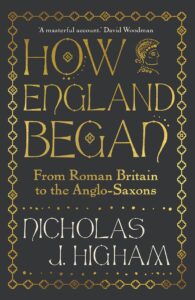
Nicholas Higham is an archaeologist, academic and the author of How England Began: From Roman Britain to the Anglo-Saxons, published by Yale University Press. You can read a Q+A with Nicholas on the Aspects of History website.