
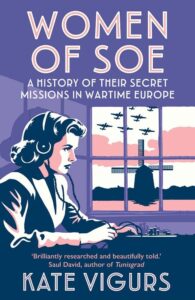
Women of SOE from the historical research and pen of Kate Vigurs’ is a meticulous history of the women who served with the Special Operations Executive (SOE) across occupied Europe during the Second World War. Building on the success of her earlier book, Mission France, Vigurs has remedied a shocking gap in women’s SOE history by including the experiences of female agents who were in dangerous missions behind the lines in Belgium, Poland, the Netherlands, Denmark and the Balkans. She has organised the history by country which has enabled a better understanding for the reader of the unique political, military and social circumstances in which these women operated. She highlights the diversity of the agents’ experiences and how resistance work varied depending on local conditions. Importantly, she avoids the temptation to romanticise the women or present them as flawless heroines. Instead, they are complex individuals who experienced fear, and a range of emotions from uncertainty and failure, yet are revealed to be extraordinarily courageous.
The book examines betrayals, arrests, torture and executions, and is a poignant reminder that the risks for women elsewhere in Europe were as great as for those dropped into France. The research is impressive. Vigurs has travelled abroad to consult other archives, personal testimonies and post-war investigations, often working with fragmented files. She has deconstructed decades of unhelpful myth-making around these agents; and what emerges is a real covert world in which women played crucial roles in supporting resistance networks, as wireless operators, couriers and carrying out sabotage missions in countries that have had little focus thus far in the SOE histories. The SOE actively recruited women because they could often travel more freely and attract less suspicion than men in occupied territories. It created opportunities for women to enter fields traditionally dominated by men, including intelligence and military service. In the Netherlands and Belgium, they worked amid complex intelligence and escape-line operations. In the Balkans, they navigated competing political factions and guerrilla-type movements. Their roles in other Western countries under German occupation were as dangerous as for operatives in France. If captured they faced brutal interrogation, torture and execution under the notorious German Gestapo apparatus.
Vigurs has emerged as the foremost SOE historian for our times, and through her latest book encourages us to move away from a France-centred narrative. It is surely appropriate now for the heroism of these women to be the subject of films and documentaries so as to restore a balance to the history of SOE and enable a better public understanding of their sacrifice. They have been overlooked, even undiscovered, for far too long. The agents in Women of SOE certainly “set Europe ablaze” and they deserve high acclaim and recognition alongside the female agents of France, and Vigurs has done just that.
Helen Fry is a historian of the Second World War with a particular focus on intelligence, and the author of The White Lady: The Story of British Secret Service Networks Behind German Lines.