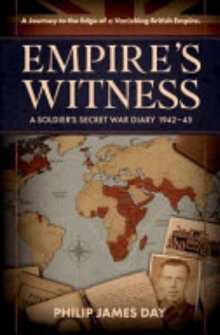
Empire’s Witness is not just about Corporal Day’s war, but also about its rediscovery by his grandson, Emmy-winning filmmaker Philip James Day. Decades after the soldier’s death, Philip was in Yorkshire for his daughter’s wedding and almost by chance came across his grandfather’s slim, carefully handwritten 90-page journal. It had been lying at the bottom of an archive box for almost 80 years.
The result is a beautifully crafted book, and very easy to read. It weaves Day’s words from the journal with Philip’s detailed research on what was happening around him. Evocatively, we experience the heat, the danger and the scale of the war he was fighting. We realise how vital the behind-the-scenes tasks he performed in the REME was – Day looked after equipment without which, his grandson vividly tells us, “tanks would not cross the desert, convoys could not reach Burma nor could Spitfires fly over Kent”. The depth of research brings to life the people, sights and sounds of Bombay, Tehran, Beirut, Jerusalem, just some of the historic cities Day was in. He reminds us of the often-forgotten family back home, looked after carefully by his grandmother Gwen.
Most compelling is Philip’s description of how, when he first saw the journal, ‘instantly he sensed that something had shifted’, how it had been “hiding in plain sight” and finding it “seemed like an accident of fate”. His quiet grandfather, Alwyn Robinson Day was in fact Corporal A.R. Day, a survivor of Dunkirk and five more years of war where he saw half the world and much within it.
Philip decided to research the journal for the family, a project that eventually resulted in this marvellous book, constructed as carefully as Corporal Day did his journal. The original handwritten journal is more log than memoir, filled with dates, places and facts rather than opinions. Philip then verified the facts, concluding that if Alwyn recorded that a ship had sailed, it had. He then reconstructed the world around his grandfather—the heat, the danger and the scale. He wove family memoir into the narrative. Together, the diary, the archives and family memory formed a coherent whole. In his words: “The diary is the skeleton of this book; archives gave it structure; family memory gave it texture.”
Corporal Day volunteered when war clouds were gathering and was called up into the Royal Army Ordnance Corps as soon as war broke out in September 1939. There was not much glamour in the RAOC – the men looked after equipment and repaired things when they failed. But without them, as Philip says, tanks would not cross the desert, convoys could not reach Burma, nor could Spitfires fly over Kent. This was the work Corporal Day carried out for the next six years. As part of the BEF in France during the Phoney War, he was evacuated from Saint-Nazaire in 1940. He had not kept a journal then, and in a typically self-effacing entry for 19 June 1942 simply wrote, “Two years ago left France.” This was the moment Philip first learned that his grandfather had been there.
Exactly two years later, Corporal Day boarded HMT Abosso in Liverpool, part of Convoy WS20 (“Winston’s Special”) headed to an unknown destination. He tells us it’s a large ship and how difficult it was to get into his hammock but little else. This is where his grandson steps in and we learn that the ship was part of the Elder Dempster line with First Class services to West Africa. The chandeliers had been stripped, but the galleys and even some stewards remained. Breakfast was eggs with soft yolks, thick and crispy bacon, warm sausages and toast, and marmalade. The lead escort was the battleship HMS Malaya, which warmed my Singapore heart. Thus began a voyage and three years at war that eventually covered 27,000 miles by ship, train and truck, across oceans with stops at Freetown, Cape Town, Bombay, through the Straits of Hormuz, into the deserts of Iraq, Iran, Syria and the green valleys of Lebanon.
Then on 2 June 1943, Corporal Day was summoned to Egypt. He was the only one in his unit to be so ordered and a staff car put at his disposal for the first leg of the long journey. Strange indeed for a humble NCO. He did not explain this in the journal and Philip, puzzled, did not give up the quest. The interesting answer is all in the book.
Corporal Day continued his service, recording events in his usual matter-of-fact way, and finally, after D-Day and VE Day, he writes, “14 July 1945. The day I’ve been waiting for. I’m finally going home.” When he reached Britain on 9 August, he notes, “After spending three years abroad, it made me realise how much I had missed the old country and how glad I was to be home again.”
All the while, his wife Gwen had quietly and without complaint looked after their children, for whom his return was not easy, as they had been so young when he left. Then Day did us one final service – using his diary notes and assorted photographs, he assembled the journal and handed it to his wife, who told him she would read it one day. That was enough for Corporal Day. He had not wanted any fuss. And so it lay for almost 80 years.
We must thank Corporal Day not just for his service, but also for leaving behind his journal; his wife Gwen for holding the fort with equal courage during the long years of war; his daughter Kate for preserving his papers and thinking to show them to her nephew Philip; and, last but not least, Philip himself for not allowing the pressures of his day job to prevent him from bringing his grandfather’s story back to life, not just for his family, but for all of us.
It is a moving story of a humble soldier doing his duty quietly, and his family’s rediscovery of their grandfather.
Gautam Hazarika is Singapore-based historian of World War 2 and is the author of The Forgotten Indian Prisoners of World War II: Surrender, Loyalty, Betrayal & Hell.