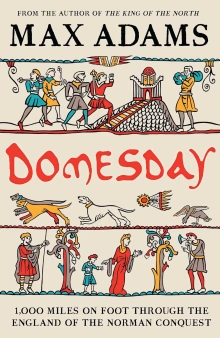
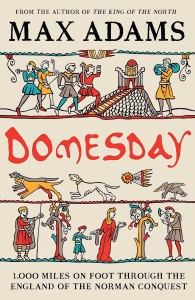
When presented with the opportunity to review Max Adams’ latest oeuvre, I didn’t need asking twice. Having read some of his previous books, I knew I would be treated to a work that demonstrates passionate research and dedication to detail but also one which is presented in a manner that is easily accessible to the reader (whatever their experience and background).
And I can happily confirm that I was entirely correct. Domesday is a book that oozes careful crafting, expert writing and loving delivery.
But that, for me, is where the similarity with his previous works ended. What I expected was a scholarly analysis of the Domesday Book in terms of its origins, its construction and content, and its importance (both then and ever since… down to the present day).
What I actually found, however, was a good deal of that but also a whole lot more besides. In short, the book is the culmination and representation of many days over several months, hundreds of footsore miles and an abundance of excruciating blisters. Or, put another way, Domesday describes a series of walks undertaken by Max (on occasion accompanied by his wife, Sarah) in which he treks his way through 10 of the counties covered by the Domesday Book (as well as County Durham and Northumberland which – while not included in the original – were nevertheless covered in another, later survey (The Bolden Book).
I also appreciated the structure of the book wherein the author elected to separate the walking chapters with brief interludes that helped to establish the key events leading up to and after the compilation of the Domesday Book. Like a sorbet palate cleanser, they left you refreshed and ready for the next perambulation.
Ever since I finished the book, I have been struggling to find a way to describe it and the affect it had on me. I confess it has not been easy and that may well reflect the author’s intention. In fact, I imagine different readers might well take many different things from it, which can never be a bad thing.
For me, however, I think I can sum up my feelings about Domesday – and bear with me here – by relating it to Mackenzie Crook’s comedy series Detectorists. I mean that in the sense that they both characterised by a deep vein of nostalgia for a bygone age. In Detectorists, the broad vistas of rolling hills and sweeping fields and meadows, its gentle comedic camaraderie, underpinned by its wonderful folk music soundtrack by the brilliant Johnny Flynn, were the visual backdrop conjured in my mind while I was reading the book. And that’s even without mentioning the underlying core theme of searching for Saxon gold.
It is worth noting that much of the filming of Crook’s series took place in and around Framlingham in Suffolk, a county that features strongly within Domesday.
Domesday also evoked a feeling of something quintessentially English, while also wistfully bemoaning its passing. In part this is due to the gradually increasing industrialisation of the country (much like the way in which Tolkien portrays what has become of the Shire by the time the hobbits return from Mordor). But it is also due to the inexorable decline of rural traditions dating back centuries. More than once does Adams refer to walks where he met barely another person or came across soulless villages that have ceased to be communities and become, rather, a coincidentally-located collection of individual dwellings. It’s a subject that is close to my heart too; I am forever moaning about the number of pubs you see boarded up as you drive through the countryside (OK, so it’s closed watering-holes that fuels my ire, but I like to think we’re in the same ball park).
Leaving aside the doom and gloom, what I really enjoyed about Domesday was the way in which Adams, by merely walking through the countryside (assiduously avoiding the main thoroughfares wherever possible) was able to meld the details captured within the actual Domesday Book with the landscape around him, blending the historical record with the archaeology and geography in a way that not only puts you alongside the author but also transports you to a different time and place. I’d be surprised if anyone manages to finish this book without having compiled a list of places to visit, such is the attractiveness of their descriptions.
If I was to have one gripe – other than the quirky style which might not be to all tastes – it was that my own county of Cheshire did not make the cut. Perhaps there will be a sequel.
Paul Bernardi is the author of historical fiction set around the Norman Conquest. His forthcoming book, Wolf of Wessex, will be released in December 2026.