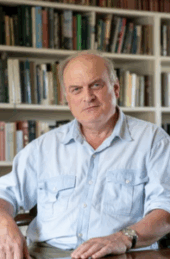

Antony, thank you so much for joining me. I very much enjoyed the book. I read it over the weekend, absolutely raced through it, as always. My first question, I suppose, is why Rasputin? What took you to that? I appreciate it’s very much related to your previous book on the Civil War, but why the Rasputin story specifically?
Well, you’re right. In a way, it is a prequel to the previous book, to Russia: Revolution and Civil War, but I’ve always been fascinated by not just Rasputin as a character, but how a simple, virtually illiterate Siberian peasant could have had such an effect on world history. Alexander Kerensky, the leader of the provisional government, said after the February 1917 revolution, that without Rasputin, there would have been no Lenin. I’ve always been intrigued by the debate over the Great Man theory of history. Well, here, paradoxically, you have almost the opposite – a strange confirmation of the Great Man theory of history, but in a very paradoxical way.
And it’s also so very Russian. I mean, every single paradox you can imagine is there, especially in Rasputin’s character, but also in the whole situation. Here you have somebody who was a fervent monarchist doing more to destroy the monarchy than even the most ferocious revolutionary.
I was interested to see that the Rasputin that emerges from your biography is to some extent shorn of many of the worst accusations that traditionally have been levelled against him. And he appears, to some extent, to actually have had some considerable gifts or at least potentially so. What was your assessment of him as an individual?
Well, as I say, like Russia, you cannot generalise in any way at all. Rasputin was a man of paradoxes. He was corrupt, yet gave away all of his money. He was intensely spiritual and yet completely lascivious. He claimed that he loved women and yet he treated women sometimes very badly indeed and was even a part-time rapist. So as I say, there was every single paradox there.
Fyodor Tyutchev, the great Russian poet of the 19th century – who interestingly was the grandfather of the Tsar’s children’s nanny – made this rather wonderful remark, saying that Russia cannot be understood with the mind alone. And that is, I think, also very true of Rasputin and the way that people viewed him. It is remarkable, for instance, that women would throw themselves down in worship of him, regarding him almost as a saint. Most of the men were much more cynical and disapproved of him, but the women found that here was somebody who actually could understand them because he was a very good listener and he also had a very soothing – if rather unnerving – presence. They had a complete mixture of emotions about him; fear, reassurance, distrust and a belief in his abilities.
And it was amazing the way that you never really knew where you were with him. And, fortunately, there were many very intelligent women and men who watched him with great care in an attempt to assess his character. So this is where one can start to understand the man rather better. Of course, it is an open question whether one can ever understand him completely, but these sources do at least give us a much better idea of who he was, not least because Rasputin’s own writing was so shambolic, mostly rewritten by the Empress herself. And even when he spoke, his words were all over the place. So quite often he was very difficult to understand. His tongue seemed to get in the way of the words. And yet people were absolutely captivated by him, even though most of what he actually said seemed incredibly banal; about love, about the beauty of nature and all the rest.
And to top it all, he would play his seductive card trick, which was to tell the women that were so enthralled by him, that without repentance, there was no goodness. And to have repentance you had to sin – and preferably with him. So, he used all of that in a very paradoxical way, using sin as the path to redemption.
Did you get a sense that he believed in his own gift?
Yes, I think he did. I mean, he also had doubts too. I don’t think there’s any doubt about that. I think he got greater confidence that he did have certain powers, the further up the social ladder he climbed when he found that all of these grandees in St. Petersburg, all the way up to the Emperor, believed in him.
And nobody really can tell for sure whether he did have certain gifts in that particular way. But at the same time, I think we have to keep a slightly open mind because, as some of the doctors had to admit, they could not explain some of the ways that he managed at least to ease the pain of the Tsarevitch, at moments when they thought he was going to die. So, he obviously did have some sort of gift, which maybe came from his voice, which could be incredibly calming in a peculiar way, or from his eyes. Some people also believe that he did it all through hypnotism or a sort of psychosomatic power that he was able to use. But he also did obviously have some sort of magnetic power.
Of course, all of those gifts that we’re talking about would really have been for naught, were it not for the role played both by the Empress and the Emperor, and of course by the Tsarevitch. So can you just sketch for us how that combination of characters played out and how it became so fatal?
The interesting thing, really, about the Tsar and his wife, was that Nicholas II had a terrible inferiority complex, mainly about his height, but also about the way that he didn’t think that anybody would actually obey his orders. Another problem he had was that he suffered from a real daddy problem, because his father Alexander III, who was a bear of a man, was very popular because of his reactionary policies and the firmness with which he ruled Russia. And all this meant that Nicholas had all the obstinacy of the unimaginative man and yet had very, very bad judgment.
To make things worse, his wife had even worse judgment, especially in terms of who to trust. And she was incredibly naive. She was certainly not stupid; she was very well read. She had been brought up in a very impoverished German court in Hesse, and then as Queen Victoria’s granddaughter, so she was in many ways far more English than she was German, but when she was finally persuaded to convert to Russian Orthodoxy, she then became more Russian Orthodox than the Russians, imbibing all sorts of folk mysticism, a belief in miracles and the belief that the royal family should have this close connection with the peasantry.
So when Rasputin came along, then she convinced herself, and especially after the first time he relieved the Tsarevitch of pain from his haemophilia, then she became more and more convinced that Rasputin was a saint, a man sent by God to ensure that the succession of the holy House of Romanov would continue through the Tsarevitch.
And when, in 1912, the Tsarevitch nearly died in Poland, Rasputin achieved what appeared to be the greatest miracle of all – passing on a message, merely by telephone, that he would survive. That gave her the confidence that the crisis was over. Maybe somehow she conveyed something to the child, we can’t tell, or maybe it was just a very fortunate coincidence that his message coincided with the crisis of the fever coming to an end. We’ll never know the truth. But the doctors themselves were absolutely flabbergasted by the fact that the Tsarevitch could have come back from the point of death. It’s fascinating how that combination of the characters of the Emperor and the Empress, and of course the Tsarevitch Alexis, all play a part in the dysfunctional dynamic.
Of those characters, it’s amazing how few of them come across even remotely positively in the book. They’re all fundamentally flawed; vanity, stupidity, arrogance. And it struck me that Rasputin almost comes out of the story quite well. So, is it possible to see him as a victim of this story?
Yes. Well, in many ways, I think he is. Of course, he was a victim because he was murdered, so I agree he was in that respect. But, he was also a victim of his own ambition and of his own behaviour. Because he was terribly corrupt. And above all, he was – unwittingly of course – the greatest contributor to the downfall of the Romanov dynasty, because in a highly patriarchal society, the idea that the Tsar’s wife might be sleeping with a peasant meant that none of those who would ordinarily defend the Tsarist regime was willing to raise a hand in its defence.
All that was really, to quite a considerable degree, the fault of Rasputin. The demoralization and the chaos which Rasputin and the Empress caused, and all of it at the most critical time of the war, meant that the setbacks when they came were immediately blamed on the Tsar himself and, therefore, on the whole regime.
You work very hard in the book, I think, to give us sight of the man himself, the man beneath the mythology. How hard was that for you as a historian to sift the fact from the fiction? Was that a particularly difficult task now after more than 100 years of mythmaking?
Well, I think that is our primary task as historians, isn’t it? And I think it’s probably the most fascinating part of it. Over the years, through experience, you tend to get a better nose about things which are false and things which are not. In this respect, I was fascinated to find that in 1921, or 22, just after the end of the Russian Civil War, there was this so-called diary of Rasputin, which is still in the Russian state archives. And although the great experts have looked at it and they say it’s a fake, it has such good material in there on Rasputin that whoever the faker was they obviously were very close to the entourage of Rasputin and knew exactly his phraseology.
But the most fascinating bit in there was the story of Nicholas II’s mother’s dream. And, this was actually confirmed to me as genuine by an old friend, Princess Olga Romanov, who was the granddaughter of the Tsar’s sister. And the dream was that when the later Dowager Empress was pregnant with Nicholas II, she had this terrible nightmare in which she was walking up a mountain with her husband, Alexander III, and suddenly this baby appears in her arms and she says, “What’s this?” And he says, “That’s your future child. That is the future Tsar.” And the baby jumps out of her arms and scrambles up the mountain ahead. And on the mountain, there is this peasant with an axe who chops off the baby’s head.
Of course, not surprisingly, she was traumatized by this dream and was horrified – 38 years later – when she heard that her son and daughter-in-law have become absolutely besotted with a Siberian peasant called Rasputin. She then leads the opposition to Rasputin. So, as far as the myths are concerned, it is important when one can, one mustn’t chuck out the baby with the bathwater. Even in the realm of rumour and hearsay, there can be the grain of truth. Just because something isn’t true doesn’t mean that it doesn’t have an influence. So I think historians in the past have been far too dismissive of the importance of rumours in history. Rumours still have a certain power, and they can affect the course of events.
How would you assess Rasputin’s contribution to the ultimate collapse of the Romanovs? Obviously, there are many systemic factors, but on the other side you have the Great Man interpretation – or the very flawed man in Rasputin and the imperial family’s case. So, where do you see Rasputin in the grand scheme of the Russian Imperial collapse?
Well, I think he has a pretty central role. Of course, it was not entirely him. There were a huge number of other aspects contributing to the collapse. I mean, I think most people have agreed that if Russia had stayed out of World War One, then the regime might well have survived. In addition, one can argue that Russia was starting to take off economically in the period of 1912, 1913, beginning of 1914, and that might have given it the opportunity to have improved standards of living and all the rest of it.
On the other hand, however, the Romanov dynasty was spending the resources of the country almost entirely on their own grandeur; the armies, the uniforms, the monuments, the cathedrals, all to the glory of themselves. And that was a terrible waste at a time when a vast investment in infrastructure and in education was needed. Education they did not want. They did not want to have an educated peasantry, because that was dangerous. They wanted to have a holy, Russian Orthodox peasantry which would stay where it was rather than becoming intellectualised.
And, in the end, this was what Rasputin got wrong in his prophecies. It wasn’t the intellectuals who killed the Tsar, of course, it was actually the peasant soldiers of the Red Army. So, the great irony of all of this is the idea that Rasputin was some sort of soothsayer. Well, he proved sadly incapable of predicting his own rather ghastly death, or indeed the brutal murder of the Imperial family.
Do you have a sense of how Rasputin is viewed today in modern Russia? I know Mr Putin has been rather cautious about commemorating the revolution, fearing that it might give people ideas. But how is Rasputin viewed today?
Well, it’s a mixture, but on the whole, what the Russians hate is the idea that Westerners treat Rasputin as sort of almost an archetypal Russian because of the drinking and the whoring and the chaotic life. They regard this as a distortion of their history, trying to fix an evil stereotype on Russia as a whole. So as a result, they’re rather defensive about Rasputin. They say that he was this great spiritual character, and of course they will play down the drinking and the whoring.
Antony, congratulations on the book, and thanks very much for speaking with me.
Sir Antony Beevor is one of the nation’s bestselling historians, whose work has been translated into 37 foreign languages. and the author of 17 books including Rasputin and the Downfall of the Romanovs.
Roger Moorhouse is an historian and the author of Wolfpack: Inside Hitler’s U-Boat War.