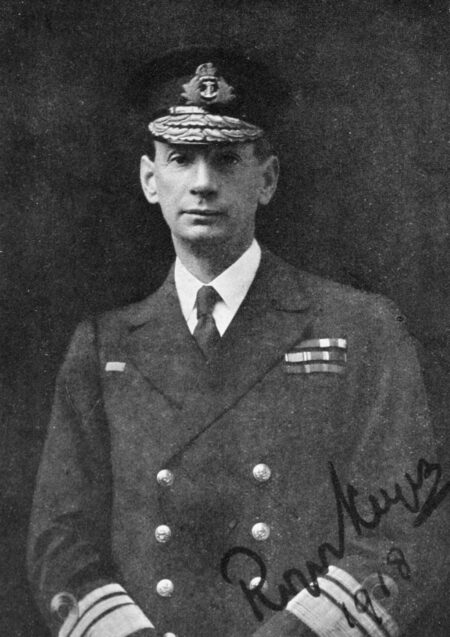
Admiral of the Fleet Sir Roger Keyes is one of Britain’s lost military and political heroes who deserves to be restored to his rightful place in history. Vain, argumentative and often difficult to work with, Keyes also had a habit of more often than not being right about the big issues of war and peace that faced Britain in the first half of the 20th century.
I first came across Keyes in 2020 doing my MA at King’s College London, Department of War Studies. He then became a major part of my PhD on naval heroism studying under the supervision of the superb team of Professor Andrew Lambert and Dr David Morgan-Owen. My new biography of Keyes In the Cannon’s Mouth tells his dramatic story. It is also the first serious biography of Keyes to be published since 1951 and is based on five years of detailed research into his life.
The military career of Keyes is wide-ranging and impressive. Joining the Royal Navy as a naval cadet, aged 13, in 1885, Keyes rose through the ranks to become an Admiral of the Fleet in 1930. In the intervening period he saw action in Africa suppressing the slave trade, then Latin America before being posted to the China Station in 1899. By 1900, during the Boxer Rebellion, he had captured 4 Chinese destroyers, blown up the Taku forts and helped free the imprisoned foreign legations besieged in Peking. In 1910 he became responsible for developing British submarines in the run up to the First World War and, in August 1914, secured the first British naval victory at the Battle of Heligoland Bight, sinking three German cruisers for no losses of British ships in the first month of the conflict. In 1915, Keyes was sent to the Dardanelles as Naval Chief of Staff to all three Admirals who served commanding British naval forces in that controversial campaign. Keyes always held to the view that the Royal Navy could have forced the straits even after the naval defeat on the 18th March 1915.
His time as Head of the Dover Patrol in 1918 has become the stuff of legend following the daring raids on the enemy-held ports of Zeebrugge and Ostend in April and May 1918. Whilst debate has raged over just how successful the raids were in military terms by impeding the ability of German U-boats to enter the English Channel from their naval base in Bruges, the effects on Allied morale was transformational. The Royal Navy had returned to offensive operations and the Germans had been taught a lesson in the finest traditions of Drake and Nelson.
A fighting Admiral was deemed however to be not what the Royal Navy required in 1930 when the Labour government unwisely passed over Keyes for the position of First Sea Lord and appointed Sir Frederic Field instead. Keyes was retired in 1931. Determined to still contribute to public life Keyes instead stood for Parliament and was elected to represent the naval constituency of Portsmouth North at a by-election in February 1934. A vocal and consistent opponent of appeasement, Keyes stood with Churchill throughout the latter’s wilderness years and refused to endorse the Munich Treaty in 1938. Keyes also used his reputation as Britains naval hero of the First Word War to mobilise support through the tabloid press to oppose the policy of appeasement. His dramatic speech, dressed in his uniform as an Admiral of the Fleet, on the opening day of the Norway debate on the 7th May 1940 is widely credited to have facilitated the fall of the Chamberlain government and hence enable Churchill to become Prime Minister three days later.
Recalled to the colours, aged 68, Keyes served during the Second World War as liaison to King Leopold III of Belgium during the German invasion of May 1940 before becoming the First Head of Combined Operations in July 1940. It was in this role that Keyes founded the Commandos, the elite special forces who terrorised Hitler’s coastal defences. Dismissed from this position in October 1941 due to his frequent clashes with the Chiefs of Staff, Keyes was invited by the Americans to assist them with their plans to retake the Philippines in 1944. In October 1944 Keyes received an injury during the battle for Leyte Gulf, aged 72, that would weaken him and lead to his premature death a year later.
A hero in the two world wars of the 20th century, the founder of the Commandos and the man who led the political assassination of Chamberlain at a pivotal time in world affairs, Admiral Sir Roger Keyes deserves his place in history.
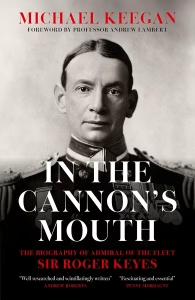
Michael Keegan is the author of In the Cannon’s Mouth. The Biography of Admiral of the Fleet, Sir Roger Keyes.