
Welcome to Aspects of History, Charles. What first attracted you to the period or periods you work in?
My teenage fiction reading was prewar novelists like Waugh, Buchan, Wodehouse, Powell, Nancy Mitford, Orwell et al. and I relished the art, architecture, fashions and films of the era. Much later, clearing out drawers, I stumbled on some scrapbooks of a visit to Nuremberg in 1936 to meet Adolf Hitler.
Can you tell us a little about how you research? Has the process changed over the years?
Delving through archives, collating primary sources into a narrative thread, weaving in contemporary colour from diaries, memoirs, newspapers, magazines. As the internet did not exist when I was an undergraduate, while fabulous online resources were on offer for my doctoral research, yes, the process had changed!
The common phrase is that history is written by the victors. Do you think this is true?
Up to a point and certainly initially. Most obviously in the immediate aftermath of the Second World War, when Churchillian orthodoxy took hold. But good, younger historians seem naturally revisionist, and, in time, real efforts were made to support studies by German historians and to apply some objectivity.
Are there any writers or historians who helped shaped your career? Similarly, can you recommend three history books which budding historians should read?
Many, as acknowledged in my books. John Morrill, my tutor, and Gordon Johnson, my Director of Studies at Selwyn College, were both remarkably tolerant and supportive. David Cannadine supervised my undergraduate dissertation (on Victorian memorials and tombstones) and then over 30 years later examined my PhD thesis, which Miles Taylor and Karina Urbach painstakingly supervised.
My grumble is that many history books make hard reading so I urge aspiring historians to read the better-written stuff for inspiration such as Nicholas Shakespeare’s Six Minutes in May: How Churchill Unexpectedly Became Prime Minister and anything by the incomparable Robert Caro. An essay not a book, but anyone hoping to write non-fiction must read George Orwell’s ‘Politics and the English Language’.
If you could meet any figure from history, who would it be and why? Also, if you could witness any event throughout history, what would it be?
Tempting to say the great statesmen of the 20th century, but perhaps I would learn more from their wives? The coronation of Charles II, from good seats.
If you could add any period or subject to the history curriculum, what would it be?
Many think the Nazis are already overrepresented on the curriculum, but I do champion 20th-century history as inspiring for young historians as it shapes the world they will inherit. With so rich a supply of vivid primary sources, they can make their own discoveries and come to their own conclusions.
If you could give a piece of advice to your younger self, either as a student or when you first started out as a writer, what would it be?
Go to a wide range of lectures beyond your chosen courses. Take any opportunities to meet other historians as writing history can be a lonely business. Learn to edit your own writing with the same rigour you would apply to another’s.
Can you tell us a little bit about the project you are currently working on?
I am intrigued by the history of London, in my biased eyes the greatest city in the world.
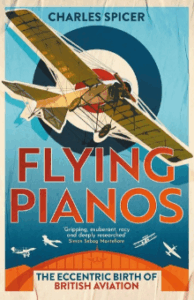
Charles Spicer is a Suffolk-based historian and the author of Flying Pianos: The Eccentric Birth of British Aviation, published by Oneworld Books.