

Congratulations on Cyprus 1974: Conflict in The Mediterranean: No Control, No Conspiracy, Andrew and welcome to Aspects of History. Was 1974 primarily the consequence of Greek Cypriot nationalism, Turkish intervention, Greek military policy, British failure, or wider Cold War geopolitics?
Turkey had no overriding reason to intervene in Cyprus 1974 without provocation putting its fellow Turkish-Cypriots and its strategic position vis-à-vis Greece at risk.
While international circumstances and domestic politics in all affected countries played a role, the profound miscalculation by Ioannidis provoked Ankara when he sponsored the coup against Makarios. Ultimately, the division of Cyprus was caused by one bad decision of one bad man.
Was the Turkish intervention as a legitimate response to the Treaty of Guarantee, an opportunistic invasion, or something more complicated?
Mainland Turks on the streets would not countenance their government sitting by when their fellow citizens faced harm, if not slaughter, as happened in the 1960s. The Treaty of Guarantee provided the instrument for Turkey to enforce this obligation. Second, from a strategic vantage, Ankara could not tolerate the prospect of any Greek base in Cyprus in the possible event of enosis, which would have meant Turkey faced adversaries along all of its sea and land borders.
What could realistically have been done to prevent the division of Cyprus?
There appeared two opportunities when the outcome could have changed. The first was Washington’s failure to warn Ioannides off of acting against Makarios. American and British failure to identify Ioannidis’ coup plans stand out as one of three or four major intelligence failures of the post-Second War World. The second opportunity came during the 1974 August peace conference in Geneva when Ankara may have been prepared to accept roughly 30% of land for Turkish Cypriot enclaves within a federal structure (which the Greek Cypriots opposed), provided its military had a secure port access.
Was the coup essentially a Greek domestic political operation transplanted into Cyprus, or was it part of a deliberate strategy for achieving enosis?
While Greece had its own school of romantics bent on creating a greater Hellenistic world which included Ioannidis (and which had a precedent when Britain returned to the Ionic Islands, including Corfu, back to Greece in 1864), enosis was not necessarily a long-term ambition for Athens (unlike a minority of Greek-Cypriot nationalists). Even these Greeks understood that Turkey would not tolerate the loss of Cyprus to Greece. Instead, Ioannidis executed his folly on the basis of a hatred of communism and of Makarios.
Was Turkey seeking security for the Turkish Cypriot community, a federal solution, territorial control, or partition?
Once the coup had started and Sampson installed as Cypriot president, Ankara’s unwavering objective became a military sea base in Cyprus. This was the means to protect Turkish Cypriots and counter any future Greek forces on the island whose planes and missiles would be withing flying range of Turkey. Decisions about the form of the constitutional system to protect Turkish-Cypriots and restore their rights had not yet crystallised. Debates in Ecevit’s government about the actual solution, which focused on a federal system, continued right up to the second peace conference in Geneva.
Why did Britain fail to prevent the crisis despite being a guarantor power?
The fundamental problem stopping Callaghan from restoring Makarios was the dispersal of service families, not to mention tourist and expats, across the island. Thousands were exposed to reprisal if Britain intervened against a motley crew of nationalists, irregulars and the 10,000 strong Cypriot National Guard, who might have turned on the bases. Once the coup happened and Turkey launched a military intervention, it was inconceivable for Britain to act against a fellow Nato power, which had a vital national interest in Cyprus and with which, in the early stages, it sympathised.
Could a credible British military intervention in July 1974 actually have prevented the Turkish advance?
The point about any British unilateral action or jointly with the United Nations was simply one of deterrence, to show Turkey that it risked a conflict with an ally and rupture with the Western world. British service chiefs poured cold water over the idea by pointing out the size of a force needed and fears about denuding West Germany and Northern Ireland commitments. Kissinger, aghast at any notion of military blockade, thought Callaghan was acting like a madman and effectively killed the idea.
How important was the fear of a Greek-Turkish war to American policy?
Overwhelming. Kissinger’s ‘linkage’ policy saw every conflict anywhere across the world in terms of the Cold War battle between ‘blue’ and ‘red’. Prospect of a Greco-Turkish conflict risked the Nato alliance, the tenuous Mediterranean balance of forces and support for Israe, all aside from the loss of military facilities and intelligence posts. He feared Turkey turning to Russia, which might cause a domino effect on the allegiance of other Mediterranean countries, especially Italy.
How much responsibility does Makarios bear for the deterioration of relations with Athens and the Turkish Cypriots?
In part with Athens, because in June 1974 he thought Ioannidis was weakened by domestic factors and by squabbling with Turkey over prospective oil rights and directly challenged him to withdraw the Greek officers of the National Guard. However, while this provided the immediate cause, Ioannides, who detested Makarios’s supposed communism, always intended to remove the archbishop. And completely, regarding Turkish Cypriots, who detested him for removing their constitutional rights, which caused the ethnic clashes of the 1960s and their withdrawal into enclaves.
Does Southam adequately distinguish between Turkish Cypriot political objectives and those of Ankara?
Turkish-Cypriot communities sought local autonomy without a fixed view on the form provided they had self-management and protected rights. Ankara’s lens was protection of Turkish Cypriots and protection of its borders and position in the Eastern Mediterranean. Provided there was no threat to Turkey’s interests and relative peace on the island, Ankara wanted Cyprus solved at the community level. After the coup, Turkish-Cypriot leader Rauf Denktash pushed for partition but was controlled by Ankara, which remained flexible on a form of federation until the collapse of the Geneva peace talks.
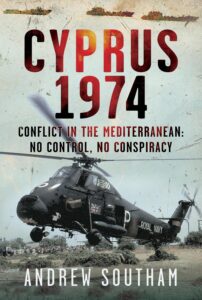
Andrew Southam is a a freelance history journalist and the author of Cyprus 1974: Conflict in the Mediterranean: No Control, No Conspiracy.
Robert Lyman is a historian and the co-author, alongside Richard Dannatt, of Korea: War Without End.