Nearly sixty years after his fellow countrymen, Orville and Wilbur Wright, first flew an aeroplane with an engine, President John F. Kennedy, addressing a large crowd at a university in Texas, reaffirmed America’s ambitions to be the first country to land a man on the moon. Challenging the sceptics, he asked rhetorically ‘But why, some say, the moon? Why choose this as our goal?’ before adding, ‘They may well ask why climb the highest mountain? Why, 35 years ago, fly the Atlantic?’
35 years before – in 1927 – it had been Charles Lindbergh, the intrepid American aviator, who had sensationally completed the first solo non-stop flight in an aeroplane from New York to Paris. He arrived to be greeted, much to his embarrassment, with a rapturous Gallic kiss on either cheek from the whiskered father of French aviation, Louis Blériot, who had eighteen years previously been the first person to fly across the English Channel. But, as Lindbergh acknowledged immediately on landing in the French capital, he was not, as JFK clearly implied, the first pilot to cross the Atlantic without stopping.
That extraordinary feat had been achieved eight years earlier, in June 1919, by two demobbed Royal Air Force officers, Jack Alcock, as pilot, and Arthur Brown, as navigator, flying a converted Vickers-Vimy bomber powered by two Rolls-Royce Eagle engines for 16 hours through the worst weather in an open cockpit. Having left St John’s in Newfoundland they crash-landed the next morning in the Derrigimlagh Bog in western Ireland to win a £10,000 Daily Mail prize.
America is rightly proud of the Wrights’ contribution to the birth of world aviation, with Orville managing to pilot their invention for 59 seconds over 852 feet on 17th December 1903. But the path from there to Lindbergh’s triumph, nearly a quarter of a century later, was far from linear. Focused on securing patents and government contracts, the Wrights had kept their achievement under wraps for several years only to be soon overtaken by French rivals led by Blériot. And the Frenchman’s own crash landing at Dover to claim his Daily Mail prize had spurred his British rivals, led by the Hon. Charles Rolls, of motorcar fame, John Moore-Brabazon and Claude Grahame-White, to champion Great Britain’s own progress in heavier-than-air aviation.
Consequently, the first 10 years of British aviation are astounding, bookended by those two epoch-defining crossings over water. And it was the grim battle for air supremacy over Flanders which drove the innovation to make that second feat possible. All subsequent aviation owes its genesis to those Edwardian amateur pilots and the Great War military aviators who followed them.
But, in popular memory, these fearless men and women have been overshadowed by later pioneers: Lindbergh and Amelia Earhart in the late 1920s, Amy Johnson and Howard Hughes in the 1930s and ‘The Few’ in 1940. Their revolutionary ‘machines’ have been overshadowed by Spitfires, Lancasters and later jets. Similarly, most historians of the RAF (only founded in April 1918), protective of its hard-won independence from the army and navy, gloss over its precursors, the Royal Flying Corps and the Royal Naval Air Service, anxious to get to the Battle of Britain and the Blitz without delay.
Although there is a thriving sub-category of specialist literature and an excellent Great War Aviation Society, popular culture now neglects the earliest days of flight. It was not always so. Readers and audiences once cherished the Biggles novels by W. E. Johns (1932-68), the BBC TV series, Wings (1977), Snoopy and the Red Baron (1965 and onwards), and the all-star film, Those Magnificent Men in Their Flying Machines (1965). While, in my unscientific poll of educated acquaintances, most Britons over 50 could hum the theme tune of the latter, almost none knew the, once household, name of the first of their countrymen to die in an aeroplane.
It is hard to exaggerate the popular excitement surrounding powered flight during the Edwardian era. Over four days, 150,000 people visited Selfridges to see Blériot’s tiny, broken aircraft put on display by the department store’s enterprising owner. A year later, the Daily Mail-sponsored London-to-Manchester challenge thrilled the nation. Newspapers rushed out special editions; telegrams updated the King, holidaying in Biarritz; locals climbed church towers for better views of the intrepid airman; trains spotting their aerial escort sounded whistles, while garrisons of soldiers cheered.
And this novel sport needed a brand-new vocabulary. Though borrowing technology from sailmakers and boatbuilders, these early flying machines owed more to the mechanics of bicycles and automobile manufacturers. They took off on wheels borrowed from the former, powered by engines adapted from motorcycles and later cars. But it was the nautical dictionary first raided for much of the everyday terminology: fleets or squadrons of aircraft powered by propellers and directed by rudders from the cockpit or flight deck where the navigator, located fore or aft, supported a captain or pilot would soon land at airports.
Sea and air navigation is conducted on charts not maps; airspeed is measured in knots; navigation lights on both ships and aircraft are red and green for port and starboard; and, in rough conditions, both boats and aircraft roll, pitch and yaw. To this day, a crew of stewards attends to passengers overseen by a purser consulting a manifest. Meanwhile more technical terms were cannibalised from our friendly sporting and engineering rivals across La Manche as the aerodrome, aviator, aviatrix, monocoque, fuselage, empennage, aileron and chassis each inveigled its way into the Anglo-Saxon lexicon. Some terms needed inventing de novo; Winston Churchill claimed credit for introducing the terms seaplane and flight, as in a ‘flight of aeroplanes’.
Charles Rolls remained cautious about the commercial viability of aeroplanes, conceding it would be a while before we could ‘go into the street and blow four whistles for an aerotaxi.’ (Well over a century later, companies such as Joby Aviation in California are coming closer to launching flying taxis.) Though not yet worried about invasion by German airships, he recognised the ‘real value of flying machines would lie in their military use,’ particularly ‘invaluable’ for reconnaissance as it will be ‘no longer possible for an enemy to keep its movements secret.’
By 1914 aircraft carrying a dozen or more passengers were viable, opening up the skies as a means of practical human transport rather than just a daredevil sport or eccentric pastime. The Russian designer, Igor Sikorsky, unveiled his Ilia Muromets biplane in early 1914. Four huge 100-horsepower Mercedes engines powered this five-ton behemoth past 50 miles per hour. With a wingspan over 100 feet, it could carry 16 people and land on snow or water. That summer, it covered 1,590 miles in a return flight between St Petersburg and Kiev.
Passengers in comfortable wicker chairs sat in a heated, well-lit and spacious saloon where the first full meal served in an aeroplane made culinary history, after which they could retire to a separate bedroom or the world’s first airborne lavatory.
The outbreak of war in August that year brought a complete stop to the development of aeroplanes for civilian flying and passenger transport and triggered a period of frenetic innovation to adapt the nascent technology as a tool of war. Opinion had been divided as to whether these evolutions had military utility: back in 1910, the chief of the Imperial General Staff (the professional head of the British army) had dismissed aviation as a ‘useless and expensive fad, advocated by a few individuals whose ideas are unworthy of attention’ and many of his officers preferred horses to horsepower. Even some French military commanders, despite their army boasting a substantial fleet of military aircraft, shared such scepticism; Marshal Ferdinand Foch (later Supreme Allied Commander in the Great War) damned flying as nothing more than a ‘sport’ with ‘zero’ military utility.
Winston Churchill had predicted this war would be fought both up in the air and under the sea and so it stimulated a vast expansion of British military air capacity into the world’s largest and best-equipped air force. But none of that would have been possible without the progress already made by civilian aviation before the war. Passing 200 kilometres per hour (125 miles per hour) and covering 1,000 kilometres (620 miles) without stopping for fuel, planes could now go faster and further than cars. And most critically for the military, they could fly higher than Mount Kilimanjaro, 40 times the 155 metres achieved in 1909.
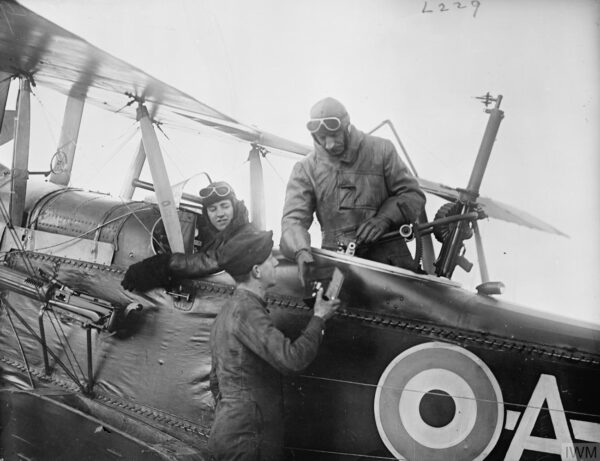
Four years of war would mature British aviation beyond recognition as the aeroplane evolved from a hand-built rich person’s toy into a mass-produced lethal weapon. Those Edwardian amateur sportsmen in their flying machines fledged into expertly trained pilots with specialties as fighters, bombers and night flyers. The aeroindustry mushroomed from a thinly financed cottage industry housed in ramshackle workshops into a national manufacturing sector with huge factories designed for mass production. Royal Air Force aircraft now achieved speeds, heights and ranges hard to conceive just four years before, equipped with instrumentation, bomb sights, radio communications and early parachutes while armed with weaponry and ordnance to harass, terrorise and kill the enemy, whether in uniform or not. Those cynics doubting the utility of military aviation had been silenced.
Alcock and Brown’s marvellous achievement in 1919 re-energised civilian ‘airmindedness’ in Great Britain. The UK government had finally lifted the wartime ban on non-military aviation that May, paving the way for the launch of civilian flights. Air Transport & Travel Limited, Britain’s first airline, established the world’s first scheduled daily international air service, between London and Paris using converted Great War bombers. For the price of fifteen guineas (roughly £700 in today’s money), a car collected the passengers from the Ritz Hotel on London’s Piccadilly and drove them to the temporary aerodrome at Hounslow Heath for immediate departure on the 10.30 a.m. flight. Having arrived, subject to the weather, two and a half hours later in Le Bourget, with every passenger travelling first class, another car ferried them to the Ritz in Paris in time for a late lunch. Modern passengers may reflect on whether the convenience, comfort and value-for-money have improved since then. The world’s first international airport opened at Croydon the next year and was soon handling more passengers, cargo and mail than any other. It was also the first to implement air traffic control and unsurprisingly, adopted English as the lingua franca for radio communications, soon and ever since the mandatory language of the air.
While the exigencies of war had certainly propelled aviation forward at a pace unimaginable in peacetime, it had been the wrong innovation for the practical flying of civilians. Progress towards British-built aeroplanes carrying a dozen or more passengers in safety and comfort, as demonstrated by Sikorsky before the war, was slow and painful. Following a short-lived economic revival in the wake of the Armistice, the Spanish flu epidemic exacerbated a severe post-war manufacturing slump. Thereafter the patchiness of British government and private investment in flying triggered a short-lived boom-and-bust stock market funding cycle echoing the ‘railway mania’ of eighty years before and the ‘dot-com bubble’ eighty years later. In 1924 Imperial Airways (precursor to British Airways) was formed to amalgamate four struggling airlines. By the mid-1930s it was running flights to Africa, Asia and Australia but in aircraft smaller and less reliable than its American rivals who were pulling ahead in civilian aviation. In 1939, 20 years after the first crossing, Pan American Airlines launched the first scheduled transatlantic service in the massive US-built Boeing 314 ‘Clipper’ flying boats, with wealthy passengers enjoying chef-prepared dinners served by liveried stewards in dining rooms and comfortable sleeping berths.
Meanwhile, the RAF struggled to maintain its independence, funding and raison d’etre in peacetime. The quest for aircraft with faster speeds, higher ceilings and greater manoeuvrability was nurtured by the world record-setting Schneider competitions. In 1929 R. J. Mitchell of Southampton-based Supermarine Aviation won the trophy for Great Britain, witnessed by Prime Minister Ramsay MacDonald, using engines built by Rolls-Royce to achieve an average speed of 328.6 miles per hour.
In response to an Air Ministry specification for a new fighter capable of at least 310 miles per hour, Mitchell started development of a new single seater designated ‘Type 300’. By using a novel, thin semi-elliptical metal wing, it delivered better lift and faster speeds, while still being thick enough to house a retractable undercarriage, eight guns and their ammunition. Mitchell paired this novel monoplane airframe concept with the latest Rolls-Royce aeroengine delivering over 1,000 horsepower – soon renamed the ‘Merlin.’ The Type 300 prototype K5054 undertook its successful eight-minute maiden flight on 5 March 1936, reaching a speed of around 330 miles per hour. At a time when most of the RAF were still flying biplanes, such as the Gloster Gladiator, this was the fastest fighter in the world, rechristened three months later, the ‘Spitfire.’
The contribution of the Spitfire, alongside other totemic British military aircraft such as the Hurricane and Lancaster (all powered by Rolls-Royce Merlin engines) to Britain’s Second World War is the subject of innumerable books, films and documentaries. But the efforts and sacrifices of those brave, often eccentric, men and women, from Charles Rolls onwards, who nursed the haphazard birth of British aviation, deserve to be better known and more widely celebrated. By taking to the skies before, during and after the Great War, they flew through adversity to take Great Britain’s aspirations aloft and thereby secure her success in flight through war and peace.
Charles Spicer is a Suffolk-based historian and the author of Flying Pianos: The Eccentric Birth of British Aviation, published by Oneworld Books.