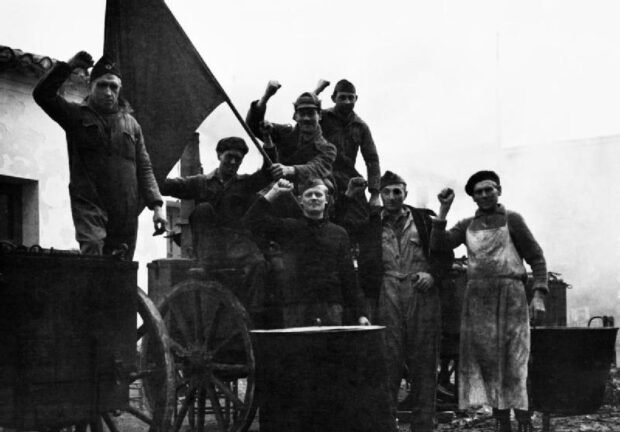
Nearly a century ago, people from around the world left their homes and everything dear to them to volunteer to fight against the rising tide of fascism.
After World War I, conditions in Europe were bleak. This helped fuel the rise of fascism, leading to Benito Mussolini and his Fascist Party becoming the rulers of Italy in 1922, followed by Adolph Hitler and his Nazi Party taking over the government in Germany in 1933.
The fascist movement had even spread to Britain, where the British Union of Fascists (BUF) had over 50,000 members in 1934 and garnered support in local newspapers. Other concerned citizens rallied against fascist movements at home in favour of a more socialist government where there were equal rights for everyone.
Meanwhile, in February 1936, Spain held an election that was close, but the left-wing coalition prevailed. They then formed a socialist government that instituted a program to take land and wealth from the rich and distribute it to ordinary people to promote equality. The right-wing army generals led by the fascist leader, General Franco, then staged a rebellion to overthrow the government. Spain soon became fragmented; some parts of the country supported Franco and the Nationalists while others supported the Republican government forces and their resistance to the fascist uprising. It was a Civil War.
To bolster his forces, Franco sought military support from Hitler and Mussolini, who gladly supplied arms and troops.
France and Britain took notice and feared the Civil War in Spain would escalate into the next world war. In August 1936, they drafted the Spanish Civil War Non-Intervention Agreement, which forbade foreign governments from supporting either side with weapons or troops, but Germany and Italy ignored it.
Things got worse for the Republicans in September. Britain and France did nothing but honour their Non-Intervention Agreement and their policy of appeasement. The Soviet Union then decided to send help to the Republicans and form the International Brigades, so people from other countries could volunteer to fight against Franco.
The world reacted quickly. Roughly 35,000 volunteers from 52 countries answered the call, including 2,500 from the UK. Their motivations were diverse.
Albert Charlesworth, an English volunteer, was interviewed in 1980 and said: “There is something in my nature that compels me to go to the help of anyone who is in distress. The German and Italian involvement made me feel strongly. I knew of that before I went to Spain, and that is what made it so unjust. Not just that, the whole thing was absolutely unjust, for a military man to try and overthrow the legal government, and especially when the legal government was a government of the people.”
Canute Frankson, a black African-American volunteer, wrote to a friend in 1937: “Why am I, a black man who has fought for the rights of my people, here in Spain today? Because if we crush fascism here, we’ll save our people in America, and in other parts of the world, from the vicious persecution, imprisonment, and slaughter which Jewish people are suffering under Hitler. We will crush the fascists. We will build us a new society, a society of peace and plenty. There will be no color line, no segregated trains, no lynching. That is why I am here in Spain.”
Maurice Levine, an English volunteer who was Jewish, explained in an interview his reasons for joining the International Brigades: “I should say the prime motive was the emergence of fascism and Mosley in Britain in persuading lots of people like myself to go to Spain. You see, Spain might not have had the attraction if there had not been alongside this great creeping wave of fascism taking place in Europe at that time. Hitler was ranting against the Jews, and here was a threat to our way of living.”
Annie Murray, a Scottish Nurse volunteer whose experiences are portrayed my book, The Heart Has Its Reasons, explained her motivation this way: “I went to Spain because I believed in the cause of the Spanish Republican Government. I didn’t believe in Fascism, and I had heard many stories of what happened to people who were under Fascist rule.”
In the end, General Franco, with help from Hitler and Mussolini, won the war. Still, the heroism and selflessness of those who served in the International Brigades will always be celebrated and remembered.
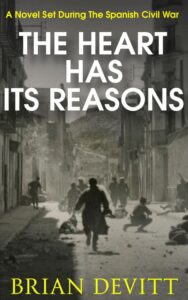
Brian Devitt is a retired US Navy officer and IT professional, and the author of The Heart Has Its Reasons, published by Holand Press.