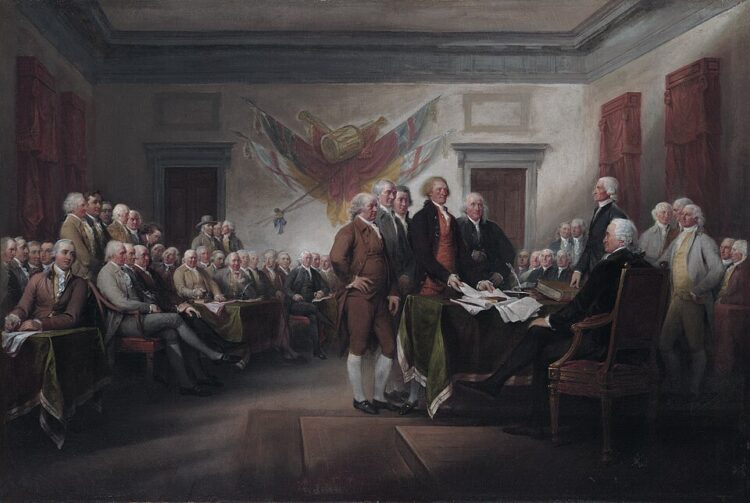
1776 is a year that has been on many people’s minds recently, and as the Semiquincentennial ebbs on, to partisan celebration, there now is an opportunity to discuss America’s relationship with power, tyranny and authoritarianism away from the heightened patriotism surrounding the 4th of July. The United States’ founding mythology is one that centralises ‘life, liberty and the pursuit of happiness’, but it also stresses the importance of this as one of the democratic moments of the 18th century. A democratic moment that not only shaped a continent, but also the world. However, despite this being positioned as one of America’s crowning achievements in what it perceives as its historic battle against tyranny, it also a highlights American attitudes toward tyranny, whilst also serving as the very beginning of its own authoritarian vein which flows through the entirety of the nation’s history.
‘Taxation without representation is tyranny’ was one of the central arguments that surrounded the colonies’ break from Britain, but very rarely do we question whom these men were seeking representation for. The founding fathers were seeking representation, and then freedom for themselves. Themselves meaning a small group of wealthy white men, excluding many of the men who fought for freedom, the women who supported them, the native people who lived among them, and the enslaved people who served them. Whilst this might seem like a tired, and possibly ‘woke’, argument to trot out, it is an important distinction to make as this crowning moment of democracy was an opportunity for these men to right the wrongs that they were seeing. Instead, they took the opportunity to entrench and perpetuate them. The Declaration of Independence and the US Constitution both discuss and mention men, explicitly and implicitly. Jefferson and other Founding Fathers considered ‘men’ to mean ‘mankind’; however, this was very quickly interpreted in a way as to not mean what it was intended. Furthermore, a contradiction can be found within Jefferson’s perspective, and many of the men who supported it. Despite initially arguing for the rights of all mankind, they still owned and maintained enslaved people, argued for policies that resembled ethnic cleansing toward Native Americans and African Americans, and did little to advance the rights of women.
Lewis Nicola, a Colonel in the American Revolutionary army writing on behalf of many within, even attempted to recreate some elements of the ‘tyrannical’ system he was fighting against by writing to George Washington to become King of America. Even though a constitutional monarchy was proposed, Washington’s power, prestige, and personal influence would have rendered that constitutional element useless, eventually leading America back into the doldrums of the hereditary, tyrannical monarchy they professed to hate. However, this wasn’t the only type of anti-democratic measure proposed within this new nation, the Electoral College being one anti-democratic body that was established. This body was created to act as a check on the electorate. If the politicians did not like their choice, they could change it… legally, and they did! This legal anti-democratic changing of the vote was made in 1824 where Congress banded together and chose John Quincy Adams as the President instead of the winner of the popular vote and the most electoral college votes, Andrew Jackson.
These actions, across the first 50 years of the United States laid a path away from democracy, a path that the nation has often strayed down and needed to be dragged back away from. However, throughout America’s history, the temptation to take it has often proven too strong to overcome.
Jackson van Uden is an award-winning historian and the podcaster behind History with Jackson. He is currently completing a PhD in History at Royal Holloway, University of London.