
Erica Stevenson is a YouTube sensation – and I wish she’d been operating back when I was teaching Classics because her book-by-book discussions of the Iliad, Odyssey and Aeneid are excellent, packed full of interest and accessible. She also interviews Classical big hitters, from novelists such as Elodie Harper to academics like Paul Cartledge, and it is well worth taking a look at her work on her channel @MoAnInc.
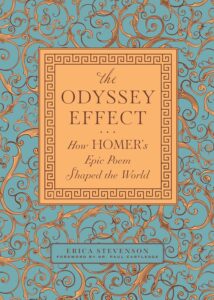
My initial reaction to The Odyssey Effect: How Homer’s Epic Poem Shaped the World was that it is a thing of beauty. It has been produced by publishers Epic Ink with love, resulting in illustrations, layout and graphic design that make you want to find someone with a birthday, just so you can give them this book. My only quibble was the background to the text that made me keep wanting to brush away biscuit crumbs which turned out to be a deliberate part of the page’s design.
After a foreword from Paul Cartledge, Stevenson introduces The Odyssey, emphasising the personal nature of each reader’s reaction to it, and the community we join when we have encountered the epic. It’s a community built up over hundreds of years and Stevenson’s aim is “to explore how and why the people of all periods have returned to The Odyssey”. She takes us from the ancient theatre of Classical Athens all the way through to Smurfs (the Smurfs did the Odyssey?) and is passionate, enthusiastic and witty, making this an easy and (with one caveat) an enjoyable read. At a time when I was beginning to feel jaded by the number of articles and podcasts in reaction to Christopher Nolan’s film, I found her subject matter interesting and welcome.
I particularly enjoyed the chapter on the early Medieval period, in which the Aeneid was the epic of choice in the Western world. Thank goodness Petrarch and the Renaissance rekindled an interest in Greek classics, which in turn resulted in wave of translations of The Iliad and The Odyssey. Stevenson takes us through the Enlightenment, the Victorian era and early 20th century with ease and a flair for keeping a narrative fresh. The book ends with two chapters covering modern films, theatre, fiction and video games. I was a little relieved to see that a very bad adventure game based on The Odyssey that I tried in the early 2000s didn’t make the grade, but it all reminded me of just how important Homer’s poem still is in our creative lives.
The caveat mentioned above is that it took time for me to get over the YouTube style of the narrative. I had expected that the tone of YouTube and the tone of a book are two different things but there was a chattiness, an informality, that I had to work to overcome, feeling as though I must be the oldest fogey on the planet as I did so. I am sure that the publisher wanted this YouTube voice. Her 55,000 followers make a good argument for it, and I suspect it has done me no harm to have my own assumptions challenged.
Fiona Forsyth is the author of Written in Blood, the third instalment in The Publius Ovidius Mysteries, published by Sharpe Books.