
“Her efforts did not produce definitive change or unqualified success, but in helping to shape the events of a pivotal century, she left legible traces of a consequential life.”
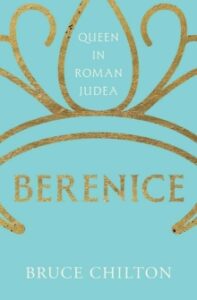
With typical precision, Bruce Chilton ends Berenice: Queen in Roman Judaea. Throughout this account, Chilton has skilfully guided the reader through a violent and disturbing era of history featuring rebellion in Judaea and Rome of the 1st century CE, and kept his narrative centred on the intriguing person that is Berenice, daughter of Herod Agrippa (the man who befriended the Emperor Claudius long before there was any chance of Claudius becoming Emperor).
Berenice, like nearly every woman in the ancient world, is never given her own voice in contemporary sources, and Chilton begins his story with an impressive essay discussing the task facing the biographer given this obstacle. Here is a woman who, Chilton feels, was “the most Herodian of her generation”, but who is regularly relegated to the gossip pages because the satirist Juvenal took a xenophobic sideswipe at her in the infamous Sixth Satire. Given that this poem consists of nearly 700 lines of misogyny, it is no surprise to find Berenice accused of incest; hundreds of years later, and just as unfairly, the 19th-century historian Mommsen labelled her “Kleopatra im kleinen” (“Cleopatra in miniature”). Chilton is determined to give some balance back to our thinking about Berenice, a woman whose likeness to Cleopatra is exaggerated and reliant on both having a long-lasting relationship with a Roman leader.
The accusation of incest seems to originate in our sources at least with the historian Josephus, himself a fascinating figure, once a Judaean rebel himself, later an admirer of the men who dealt with Judaean rebels, Vespasian and Titus, both later Emperors of Rome. Chilton affords Josephus a key part in his account but never lets the historian’s attitude towards Berenice escape examination. He observes that “awareness of how evidence is distorted cannot justify ignoring what it says”.
What results is an examination of Berenice’s era, family, allies and relationships; sources are rigorously examined, and eventually Chilton shows us the Berenice-shaped hole in the midst of the welter of information. He emphasises what he cannot tell us, what she intended, while showing us that the evidence can lead us towards an educated guess. Or, as he would put it far more elegantly, “… her intents become increasingly plain as the differing contexts of actions elucidate one another”.
There are many intriguing and enlightening moments in this biography. Chilton can reduce a huge amount of history into a few pages and keep it all intelligible, and I was particularly struck by the description of Berenice’s family, going back to Herod the Great and highlighting their relations with Rome. I also found Chilton’s discussion of the royal marriages within Berenice’s family interesting: the women of the Herodians often were the agents of their own marital alliances and they kept their family’s interest to the fore.
But, above all, I was struck by how Chilton maintains both a respect for his subject and integrity in his handling of the sources, all expressed in elegant and clear writing. Only once his main account is done does he allow himself to betray an admiration that is almost personal: “My intention,” he writes in the Acknowledgements, “is to offer both an illustration of how to infer a life from history as well as a substantial engagement with Berenice herself, a person it has become my privilege to know.”
Fiona Forsyth is the author of Written in Blood, the third instalment in The Publius Ovidius Mysteries.