The referee blows the starting whistle and Chile launches into action. The ball is driven forward by the footwork of Captain Francisco Valdés. Behind him is the team’s back line, led by Elías Figueroa. Orchestrating the attack in midfield is the best man among them, Carlos Caszely. His teammates keep looking for him, hoping to give him the honor of sliding the ball in the net, but he has another idea. He’d like the captain to do the job. And Valdés does, putting Chile up by 1. A mere seventeen seconds have elapsed and Chile is already ahead.
It’s a match like no other, that of November 21, 1973; what’s at stake is a berth at the following year’s World Cup. There’s hardly enough time to take a seat in the stands before Chile is up 1–0. How is that even possible? Did a great champion cast his spell? No, that’s not it. What has happened is that only one team has taken the pitch. The other team, the Soviet Union, has stayed home. In short, in Santiago that day, Chile is playing alone.
To understand the story behind the match, we need to turn back the clock. On September 11, seventy days before the match, General Augusto Pinochet led a coup and took control of Chile. The government of the socialist Salvador Allende, elected president of the Republic three years earlier in a free and fair election, collapsed at dawn when the air force shelled the Palacio de La Moneda, headquarters of the executive branch. The army finished the job with tanks and soldiers trundling through the streets to ferret out any adversaries. Many died during the coup, including Allende.
While Chile was swept up in a never-ending drama, its national team was, in the most striking of contrasts, about to fly to Moscow for a soccer match. FIFA’s qualification process stipulated that one of the sixteen slots in the following year’s World. Cup was reserved for the winner of a playoff between teams from different continents: in this case, Chile and the Soviet Union. One newly fascist country versus the leader of the Communist bloc.
The first part of the World Cup playoff was celebrated in Lenin Stadium, manned as never before by law enforcement. This, despite there not being a fan among them from Chile. Diplomatic relations between the two countries had frozen in the wake of Pinochet’s coup; tensions were at an all-time high. On Leonid Brezhnev’s orders, the match was not to be televised; the recap was entrusted to the few print journalists who managed to get accreditation.
The final score was 0–0. Everything was premised on the next match. In such cases, it is customary for the two teams to meet a couple of weeks later, but in this case as many as eight weeks passed. For starters, they had to decide where the match would be played. For the Chileans, it was a no-brainer: the Estadio Nacional, the facility that had always hosted the national team’s matches. It was the same stadium that hosted Brazil and Czechoslovakia for the 1962 World Cup final, when Pelé was sidelined with an injury and Garrincha put in a sublime performance.
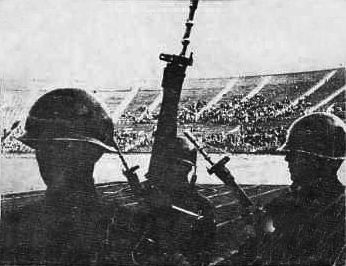
After September 11, 1973, the day Pinochet took power, the Estadio Nacional was completely transformed. It became a principal site where opponents of the regime were imprisoned, tortured, and killed. Like an open-air concentration camp. Would they hold the Chile–Soviet Union rematch at the Estadio Nacional? Any third party would have considered it madness. Between the pitch, the stands, and the underground rooms, there were thousands of prisoners who would have to be moved.
FIFA sent a small delegation composed of the Swiss secretary Helmut Käser and the Brazilian vice president Abilio d’Almeida to the capital. The pair arrived on October 23 and the following day visited the Estadio Nacional. A few days later, FIFA issued a statement: “Based on what they saw and heard in Santiago, Mr. d’Almeida and Dr. Käser have come to the conclusion that life in the Chilean capital has returned to normal and that the guarantees given by the government authorities are such that the match between Chile and the Soviet Union can be played as scheduled on November 21. The visiting delegation has been guaranteed maximum security and from now until the day of the event the risk of things escalating is inconceivable.”
That settled the matter for FIFA: the Chile–Soviet Union match would be played in Santiago. As for all those poor detainees, tortured and killed at the Estadio Nacional? It was, they said, fake news pushed by the pro-Communist press.
Meanwhile, there came a wave of protests from Moscow. Russia’s TASS news agency published a statement from the Soviet Football Federation that effectively closed off any possibility for maneuvering: “Following the fascist coup d’état, a climate of terror and repression has been established in Chile, and with it a campaign of provocation has been launched against the socialist countries and all democratic forces. At this time, we cannot play in a stadium stained with the blood of Chilean patriots.” Switzerland took note and prepared to apply Article 22 of the World Cup regulations, which states that if a team refuses to play a match, points will be awarded to the opposing team, and the refusing team shall be expelled from the tournament.
Wednesday, November 21, 6:00 p.m. There were just shy of twenty thousand people in the stands of the Estadio Nacional. To use a favorite term of soccer journalists, a massive turnover had taken place: the prisoners were swapped for ordinary people, who may have gone to the stadium harboring hopes of obtaining information on relatives or friends who had been missing since the day of the coup. Opponents of the regime had either been transferred elsewhere or taken underground, at a safe distance from prying eyes. Above the scoreboard were the words: Chile is united today by the youth and sports. What youth? Those whom a ruthless regime had wiped off the face of the earth?
Chile donned its traditional red jersey. Had the Soviet Union also been on the field, there would have been confusion, since their colors were the same, but the Soviets were not there. There was, however, a referee on the pitch, ready to start the most absurd match in the history of the sport.
Chile won the match 2–0 by forfeit and received a pass for the World Cup the following year, while the Soviet Union was fined by FIFA for not taking the field.
Augusto Pinochet remained in power for seventeen years, until 1990, perpetrating many more crimes against humanity.
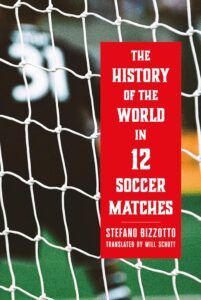
This is an extract taken from The History of the World in 12 Soccer Matches by the Italian sports journalist and commentator, Stefano Bizzotto, translated by Will Schutt.