
Welcome back to Aspects of History, Steve. How hard was it to dig through nearly a thousand years of myth building to get to the truth about what was really happening with the Assassins and the Templars?
Thanks Adam. Great question. There’s really two aspects to this.
Firstly, there’s the practical difficulties of dealing with two organisations that each have their own problems with regards to the primary sources. With the Templars we have a group which was effectively closed down and whose archives were destroyed at the end of the crusading period. So most of what we know about them has to come from other commentators – people who received letters from them and kept a copy, organisations who were suing them, and so on. So we’re often seeing half the picture (at most) and have to deduce a lot from that.
With the Assassins we have a different but equally demanding problem. They were genuinely a very secretive group, certainly at this time in their history, with some of the closed characteristics of a cult. Many of their primary sources were deliberately written or presented in a fairly esoteric form. And again, much of what we know about them comes from people who were outside the group.
Particularly in the case of the Assassins, as they were not popular amongst many other parts of the Islamic world, even the primary sources often present a rather jaundiced and prejudiced view that one must treat very carefully – even the name given to them ‘Hashashin’ was a calculated insult.
But even once we have the information, there is the bigger issue of how we clear out the clutter of so much of the modern nonsense that has been written about both groups. The Internet is a major culprit, of course, but equally a lot of our modern insecurities actively draw us into their stories and mythologies. We are willing victims of disinformation.
How much of the way we see the Assassins and the Templars today is a product of their own myth building and ‘branding’?
Good point. Some of the supporters of each group have argued, often with justification, that they have been misrepresented. But there are also many instances where they protest far too much. Both of the groups were tiny in number and were greatly outnumbered by their enemies. One of their main techniques for survival was the old Darwinistic trick of trying to appear larger and more intimidating than they actually were.
So time and again we find that they both actually play into their enemies’ propaganda and embrace it. It was in their interests to appear menacing, intimidating and capable of killing their opponents – they leaned into that as part of their ’core branding’. It was one of the secrets of their success, or at least survival.
Why do you think we remain so fascinated by these two organisations? And what is it about the Templars in particular that we find so intriguing compared to, say, the Hospitallers?
I think both groups speak to us because they led such extraordinary lives and achieved so much – and they did it against all the odds and with only the most slender of resources. As our societies have become safer and more comfortable, so there is a part of us that secretly admires those who lived dangerously and burn brightly. This basic grounding of grudging admiration has also been magnified by the mythology which has grown up around the Templars and the Assassins in later years. So they are scary – but they are also strangely, compellingly attractive.
And particularly when you look at how the two groups bounced off each other, largely in Lebanon during the period of the crusades, we’re very much looking at an ‘Aliens versus Predator’ situation. As the PR people for the film franchise said, ‘whoever wins we lose’.
The Hospitallers, who were a very similar group to the Templars, survived by being more ‘sensible’ and diversifying into hospitals and social care provision. This was, in the long term, far more successful as an approach. The Hospitallers (the Knights of Malta or St John Ambulance), are still with us today running hospitals, helping with first aid courses and handing out orange segments at football matches. Their origins are remarkably similar but the outcomes are almost diametrically opposed.
Through your research for the book, did your view of either group change significantly? Were you surprised by what you found?
Yes, my views changed a lot on the journey. I came to them with much of the mythological and conspiratorial baggage that anybody who owns a TV would bring with them. But as I delved into their history from the primary sources, I got a much more human, often much less impressive view – and their imperfections makes them all the more attractive.
So we have the Templars who are ostensibly James Bond-type characters, but you also get the odd bad apple who is incredibly stupid, or who commits fraud or murder, or theft. And with the Assassins, again they have an almost superhuman image, but there are also times when they are almost endearingly incompetent at killing their opponents.
In the book you deliberately take a non-Eurocentric view of the region, how much do you think this changes the overall picture of both groups from the narrative we normally get in the West?
I hope that taking a non-Eurocentric view allows us to get a more realistic and well-rounded view of them both. The Templars went out in a blaze of tabloid ignominy but at the time it is clear that they were actually one of the most mature and sophisticated diplomatic voices in the turbulent medieval Middle East. Likewise with the Assassins, we come to them expecting to find drugged-up bogeyman if we take a purely European view – but from their own perspective they were brave, highly committed religious devotees, trying to protect their own community, rather than mindless psychopaths.
I think if we take a look at our shared humanity, rather than coming at it from a purely mono-focused ethnic or cultural perspective, we get a better understanding of their motivations and their real strengths and flaws.
The picture of the Middle East in the book is of a dangerous and tumultuous place. Given the Middle East is in much the same state today, do you think there are lessons for us to take from the experiences of the Templars and Assassins that might inform what is happening, or should happen, now?
I always love these kinds of questions but in this case in particular I would be very nervous about trying to extrapolate the ostensible lessons of the past into a modern context. The temptation is always to assume (or pretend) that the circumstances and players are sufficiently similar to allow proper practical comparison, but that’s very rarely the case.
I think there are some very broad, basic lessons about regional strategy and demographics that would apply. For instance, the position taken by both groups speaks volumes about how smaller players in a crowded region can punch above their weight through the clever use of strategy. But beyond that the modern situation is so very different that only very glib and potentially misleading comparisons and lessons can be drawn.
And what can we expect in terms of upcoming titles or projects?
I loved writing Assassins and Templars and I hope some of that fun comes through in the book itself. My next project is a look at what the history of the Templars might have been if they had not taken the particular path they chose – alongside Dr Rory MacLellan, it’s a history of their arch-rivals, the Hospitallers, who were another military order focused on the defence of the Christian Middle East, due in 2027 under the title The Knights of Malta (also with Yale). We’re writing with a particular focus on how and why they adopted such different strategies. The Templars’ choices took them to the edge of destruction, while the Hospitallers’ decisions came to a such a divergent conclusion.
It’s a fascinating opportunity to play out a few grand-historical ‘what ifs’ in detail, and look at how these extraordinary individuals, in both orders, left their very different marks on history.

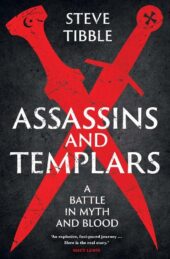
Steve Tibble is an historian and the author of Assassins and Templars: A Battle in Myth and Blood, published by Yale University Press.
Adam Staten is the author of Crusader, the most recent instalment of the Honour Bound series, published by Sharpe Books.