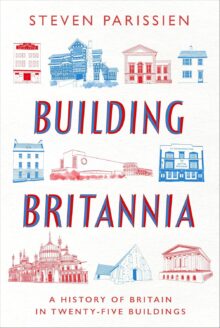
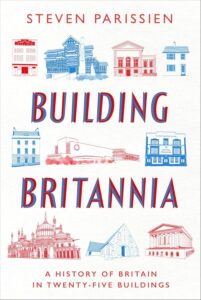
Dr. Steven Parissien’s latest retelling of history through architecture, Building Britannia: A History of Britain in Twenty-Five Buildings, begins with Maiden Castle in Dorset, which dates from around 600 BC. In the words of John Cooper Powys, this resembles ‘the shape of a huge dropping of super-mammoth dung’. This characterisation by the now largely forgotten sub-Hardian Powys is suitably obtuse. Parissien’s narrative now zig-zags through the philanderings of the 1950s celebrity archaeologist Sir Mortimer Wheeler, furious controversies over Ancient Roman involvement in the site, a former waitress at Veerswamy’s who hooked society millionaire Horace de Vere Cole, the 1920s composer John Ireland’s symphonic rhapsody Mai-Dun, as well as a satirical skewering by Stella Gibbons in her Cold Comfort Farm. As Parissien summarises: ‘The mystic and ghostly aura of the site which had been suggestively conjured by Hardy, Ireland and Powys, and which was so succesfully stoked by Mortimer Wheeler in 1940, formed the backdrop for John Schlesinger and Nicolas Roeg’s evocative 1967 film of Hardy’s 1874 novel Far from the Madding Crowd…’ and so on through ‘Sergeant Troy’s effective seduction of Bathsheba with a thrilling if frightening display of sword-play before Maiden Castle becomes a character in itself, the violence of Troy’s demonstration fuelled by the savagery of the site’s history’. And all this within the first ten pages of Parissien’s 500-page tome.
Such could easily be dismissed as an example of Dr Gradgrind’s convicion that history consists of nothing more than facts, facts and more facts. Such judgement would be highly unfair. Parissien has an uncanny gift for evocative narrative. His 25 buildings illustrate the history of Britain in a superbly original manner, the result of stakhanovite polymathic research. The narrative which he weaves around the Electric Cinema in Notting Hill where I have lived for many years contains facts and stories which were new to me. But Parissien is interested in more than just actual history in all its cultural forms. The string of tales and anecdotes he draws out of his discussion of Heriot’s Hospital in Edinburgh includes an ingenious counter-factual history where the empire on which the sun never set might have become French. And as one would come to expect – if one has made one’s way through the firework display of erudition – the endpoint is part consolingly predictable, part blindsidingly original.
The 24th building is 20 Forthlin Road, Liverpool, one of Atlee’s ‘homes for heroes’ built after the Second World War, where Paul McCartney lived ‘When I get home’. The 25th is 30 St Mary Axe, christened ‘the Gherkin’ even before it was completed. Did you know, or might you ever have guessed: its panoramic dome ‘the Lens’ recalled the glazed dome of the old Baltic Exchange of 1903, while at the same time enabling an expansive column-free interior enclosed by 500 flat triangular and diamond-shaped glass panels? This Gaudi Cathedral of a book will provide endless dipping for the architecturally curious in search of architectural curiosities far beyond the realms of curious architecture.
Paul Strathern is a historian and the author of Ten Cities that Led the World: From Ancient Foundations to Modern Powerhouses.