When studying Anglo-Saxon history at university, it often felt to me that (with apologies to East Anglia), Mercia was left holding the thin end of the wedge in terms of the big three kingdoms of the Heptarchy. With Northumbria to the north and Wessex to the south, it was the very thin piece of cheese between two doorstep slices of bread. What Bede did for the former in the 7th century, so too did King Alfred and his Anglo-Saxon Chronicle do for the latter from the 9th century.
Left in the literal and metaphorical middle was Mercia, a fact that is all the more surprising when you consider that for most of the 8th century the kingdom demonstrated great stability and dominance under the rule of just two men: AEthelbald (r.716-757) and Offa (r.757-796).
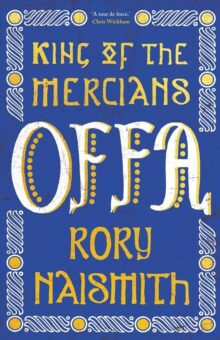
Which makes this new biography, Offa: King of the Mercians, by Rory Naismith all the more welcome in going some way to redress that existing imbalance (or to thicken the piece of cheese, if you’ll allow me to stretch that metaphor to breaking point).
But with the lack – or possibly non-survival – of a Mercian chronicle, the job of piecing together a comprehensive, rounded but – above all – accessible narrative becomes that much harder. Or, perhaps perversely, that fact rather helps guide the author to a different approach, one that is less constrained by primary sources that have praise of their subjects or sponsors at their core.
Either way, the result is stunning. Using a logical and structured approach, involving multiple sources both written and physical, Naismith has managed to combine the disparate pieces of several different jigsaws to produce a picture that is as close to a three-dimensional representation of an hitherto elusive monarch as could be hoped for (or indeed possible).
The book offers a linear chronology, but also delivers more horizontal analyses covering such diverse subjects as familial relationships, dealings with rivals and adversaries -ranging from the Emperor Charlemagne (where at least one of them saw the two men as equals) to the Wealas living to the west of his kingdom – as well as the development of Offa’s own unique model of kingship.
Given his noted expertise in numismatic matters, it is no surprise that Naismith also draws heavily on the evidence provided by Offa’s coinage. Multiple examples (with many fantastic supporting diagrams) help illustrate the changing nature of Offa’s reign as his strength and territorial dominion grew towards its apogee in the last decade or so of his reign. In this respect, he was every inch the equal of his great Frankish contemporary; there being some debate as to who was actually copying whom in terms of the design (and therefore cultural and political impact) of their coins.
Though Offa may not have ever envisioned a kingdom of the English (in the way that Alfred and his descendants later did), there is no doubting the man’s (undervalued) importance in the long sequence of what Bede would have referred to as overlords. In fact, Naismith shows how Offa bridges the gap between the old warrior kings ruling over smaller, splintered kingdoms and the future, unified state known as England that would emerge under King Aethelstan.
That is not to say that Offa was not a violent man, capable of decisive and ruthless action when necessary (e.g. the execution of King Aethelberht II of East Anglia in 794), but over a 40-year reign, we see armed force (in so far as it has been recorded for posterity) used sparingly and only with the furtherance of his political ambitions in mind. The classic rifled shot approach as opposed to the indiscriminate blast of a shotgun.
For me, the book’s biggest and best achievement, however, is to take a man best (and perhaps only) known for the earthwork that bears his name (the misunderstood significance of which risks further clouding his reputation), and to restore him to his rightful place among the pantheon of truly great Anglo-Saxon monarchs. It is one of history’s frequently occurring ironies that within six months of his death, his dynasty (for which he worked so hard and so long) was no more, ushering in the embryonic and inexorable dominance of the West Saxons over the next generation or so.
In short, a masterful work that is very much worthy of your time.
Paul Bernardi is the author of The Reckoning, the last volume in the Rebellion Trilogy, published by Sharpe Books.