As the clock ticked down to D-Day the atmosphere in the central London office of Britain’s Secret Intelligence Service, MI6, reached feverish anticipation. Years of carefully calibrated deception, casting spells over the German generals defending the landing grounds earmarked for Operation Overlord was to be finally tested in the largest amphibious invasion ever undertaken. For the men and women of British intelligence it was the culmination of everything they had been working towards.
Failure was unimaginable. If the Germans discovered the destination of the Allied armada, tens of thousands of British, American and Commonwealth troops would be slaughtered on the Normandy beaches and the war would drag on for years. The difference between defeat or victory depended on Hitler believing the Allies’ intended target was the Pas-de-Calais, 200 miles further down the coast.
Given such high stakes and such high drama, it seems incredible that one British intelligence officer, someone who had been involved in the deception campaign crucial to Operation Overlord, would walk out on the service before a single ship had set sail for France. Before a single bullet had been fired. And before victory had been assured.
On 2nd June 1944 three MI6 counter-intelligence officers arranged to have lunch in the Cafe Royal, central London.
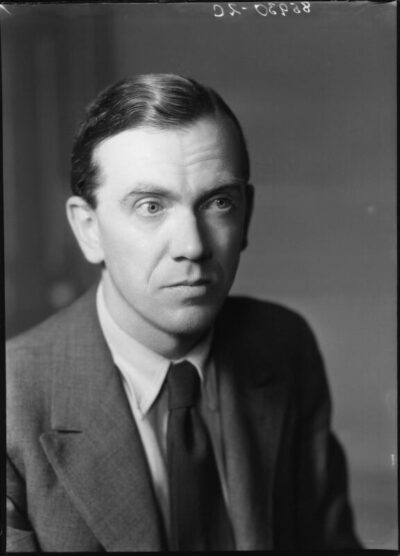
Two of them were old Westminster School friends: Kim Philby headed up MI6’s counter-intelligence section and Tim MiIne, nephew of Christopher Robin author A.A. Milne and Philby’s loyal number 2. The third officer was Graham Greene who was in charge of MI6’s Portuguese desk.
The three spies made a good team. Philby and Milne were proud and protective of their most famous recruit, the celebrated author, Greene. In turn, Greene was grateful for Philby’s loyal support during his troubled tour of duty in Sierra Leone and a damaging row with MI5 over an intelligence operation in the Portuguese-held Azores. Philby had also recently bailed out Greene after he was caught playing a prank on American intelligence officers who shared the office in Ryder Street.
When the three British intelligence officers gathered at the bar in the Cafe Royal, Greene told his MI6 colleagues that the lunch was his treat.
Perhaps he hoped this act of generosity would help sweeten the bitter news he was about to deliver.
While they tucked into their food Greene told his friends he intended to leave the service immediately. Greene made it plain his mind was made up and there was no budging him.
Philby and Milne were mystified and tried to persuade Greene to delay his decision until after D-Day. Greene refused to change his mind.
Greene’s explanation for leaving MI6 on the eve of its greatest triumph and with many agents run by Greene still in play in Portugal and the Azores, has perplexed spywriters and biographers for decades.
Graham Greene was recruited to MI6 in August 1941 through his sister’s Elisabeth’s MI6 contacts. He was initially posted to Sierra Leone but did so well that he was brought back to ‘the office’ in March 1943 where he began working for the Iberian section, under Philby. Greene was already an established literary figure while Philby had acquired mythical status as a war correspondent personally awarded a medal by General Franco after his jeep was blown up while reporting on the front line.
The two men hit it off and ran secret agents and operations that made a considerable contribution to the Allied war effort, including Operation Torch (the invasion of North Africa), the British occupation of the Azores and the degrading of the Abwehr spy machine on the Iberian peninsula.
Greene was fiercely proud of his service to his country as an MI6 officer but rarely spoke or wrote about it. He strictly observed the highest tenet of the Secret Intelligence Service, enforced by the Official Secrets Act – an intelligence officer must never talk about their work.
But did he really believe loyalty to his friend the traitor Philby trumped loyalty to Britain and MI6?
In the 1970s and 80s, MI6 would have loved to have brought Philby back in from the cold and scored a huge propaganda coup against the KGB.
Moscow had often considered the possibility that Kim Philby, Russia’s most successful penetration agent, had been a plant, working for SIS all along. As Greene approached his own death in 1991 the author wondered the same thing and questioned whether Philby had played the ultimate betrayal on Greene, secretly working for British Intelligence while setting up Greene as the innocent dupe. That would make Philby a triple agent. Greene is reported to have been so disturbed by this notion that he spent the last days of his life re-reading his correspondence with Philby, searching for clues as to where his friend’s true loyalties lay.
Robert Verkaik is an historian specialising in espionage, military history and social mobility and the author of The Writer and the Traitor.