

De Gaulle wrote of Churchill, and might well have written of himself, that he was an ‘artist of history.’ Both men were artists in how they wrote their history, but also lived their lives as thought they were constructing a work of art. They understood that every act of theirs would contribute to an image that would be passed down to posterity. When he went into battle in the Sudan at the age of 23, Churchill left a lancer riding behind the main body of troops so that someone would survive to record the incident if Churchill himself were killed. When, at the age of 71, de Gaulle stepped calmly from a car that had been riddled with the bullets of would-be assassins, he knew that his icy self-control would contribute to the mystical sense that his destiny was intertwined with that of France.
Artists need material to work with. De Gaulle and Churchill’s marble was the extraordinary time in which they lived. Their reputations are bound up with World War 2 and particularly perhaps with one day: 18 June 1940. This was the day on which de Gaulle, in London, broadcast his ‘call’ for the French people to resist and when Churchill delivered his ‘finest hour’ speech. Their roles were not, though, comparable. In June 1940, Churchill exercised more power than any Englishman since Cromwell. He was the single figure who most personified resistance to Nazi Germany. De Gaulle in 1940 was almost unknown outside a small circle of experts on tank warfare. He had been stripped of his nationality and would soon be sentenced to death in absentia. He only survived as leader of the Free French (an ambiguous title that did not make him head of a government in exile) because of his own extraordinary determination and, at first, the support of Churchill.
After the war, the balance of power between the two men changed. Churchill was evicted from power in the 1945 general election. He returned for a second term as prime minister in 1951 but no one, least of all Conservatives, believe that his government was successful. He neglected domestic issues and pursued the fantasy that he would be able to negotiate peace between the great powers. He was disappointed to be awarded the Nobel Prize in literature because he had hoped to be awarded it for peace.
De Gaulle, by contrast, flourished as a peacetime leader when, in 1958, the crisis triggered by the Algerian War brought him back to power. He once wrote of Albert Lebrun (the president during the French defeat of 1940) that ‘for a head of state, he lacked two things: being a head and having a state.’ The constitution of the newly created Fifth Republic made de Gaulle, as he would have put it, ‘a real head of a real state’.
Though he was nostalgic for the age of the ‘oil lamps and carriages’, De Gaulle understood the need for France to embrace a new world. He pulled her out of Algeria and devised a foreign policy that revolved around an ostentatious (and slightly contrived) French independence of both the USA and the Soviet Union. France, unlike Britain, found a role as it lost an empire. The rapid economic growth of the trente glorieuses conferred a new prestige on France – which de Gaulle exploited with a succession of brilliantly theatrical gestures. His sureness of touch only failed when confronted with the student demonstrations of 1968 – perhaps because the students had an even better grasp of political theatre.
De Gaulle and Churchill said things about empire and race that seem shocking to modern eyes – and that often seemed absurd to their most intelligent contemporaries. It is, though, hard not to admire Churchill who could joke at even the most desperate of times – he told the House of Commons in 1940 that they should take precautions against bombing because ‘three or four hundred by-elections’ would be inconvenient. It is even harder not to admire de Gaulle. The greatness of France meant everything to him, but he was oddly modest about his own person. When he realised that he had done all that he could, he resigned in 1969 and walked away from the presidency without a backward glance. He died a year later at his country house. There was no state funeral. He was buried in the village churchyard.
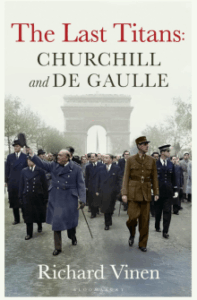
Richard Vinen is an academic, Wolfson Prize-winning historian and the author of The Last Titans: Churchill and de Gaulle.


