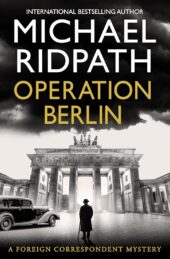

Congratulations on your new mystery novel Operation Berlin, Michael. I thoroughly enjoyed it. I have read several of your books. You started out with a series of financial thrillers, which I read and remember with pleasure, but I am less familiar with your more recent work prior to Operation Berlin. Does this new book represent a big change of direction for you?
Over my 30-year career, I have been obliged – and have enjoyed – changing directions. After my financial thrillers, I wrote a series of mysteries set in modern Iceland and some stand-alone thrillers, a few of which were set in Europe in the 1930s. So, I suppose that the Foreign Correspondent series, of which Operation Berlin is the first book, is a natural continuation, being detective stories set in 1930s Europe. I feel at home in the 1930s, for some reason, and I like to write about people living in countries which are not their own.
The novel is set in Berlin in 1930. What attracted you in particular to this period?
I studied history at university, and I was always fascinated by the 1930s. In particular, I am intrigued by the enormous gap between our perspective looking at the period backwards through the Second World War, and people at the time who had no idea what was about to happen. For many of them, peace was a top priority, and the communists were at least as scary as the Fascists. Also, there were no mobile phones to mess up plots, nor tedious police procedures. And they were so damned stylish.
Clearly you carried out a good deal of research before writing the book. What were your principal sources?
I consulted the classic sources to begin with: history books and biographies. At an early stage, Deborah Cohen’s Last Call at the Hotel Imperial, which describes the lives of 1930s foreign correspondents, was very useful. As I delved deeper there were some sources that were particularly interesting: editions of The Times newspaper for the months of August and September 1930; People on Sunday, a 1929 film written by Billy Wilder; the Babylon Berlin novels (not the TV series) by Volcker Kutscher; Trail Sinister by Sefton Delmer – the memoirs of a Daily Express journalist; and pre-war Baedecker guides to Northern Germany.
Archie Laverick and Esme Carmichael are your two main protagonists. Archie is a well-off amateur historian who has been severely affected by his experiences in WW1, while Esme is a young American woman with ambitions to become a foreign correspondent. They form an oddball but engaging detecting duo. What gave you the idea for them?
I started off with Esme. I had read about young American women who travelled to Europe with no money and no job, determined to become foreign correspondents. I liked the idea of writing about a woman like that, and thought she would be well placed to come across murders.
I then thought things would be more interesting if she had a foil – a partner in solving crime. Someone different – British, a man. Someone who lived in a small village in Yorkshire, as I had. I have long been fascinated by the idea that interwar Europe was full of men badly affected by PTSD who never talked about it. The result was Archie. The idea that he should be researching military biographies was a device to bring him and Esme together. He needs research help; she needs money.
Some real people mingle with Archie and Esme in the story. Have you used real people as models for any of the fictional characters?
I do use some real characters as models for my fictional characters. In two of my earlier thrillers set just before the Second World War, I made extensive use of real events and real characters. I found this boxed me in, preventing plot twists and so on. This would be even truer in a detective story where you want characters to be suspects in fiction where they might not have been in real life.
There were plenty of interesting foreign correspondents to use as models. So I took some of them and made small changes. Specifically, there are characters who resemble in some ways Dorothy Thompson, Vincent Sheehan (both American journalists), Adam von Trott (young German aristocrat) and Norman Ebbutt (of The Times).
The story in the book takes place against a background of major and tumultuous political events in Germany, notably the latter stages of the Nazi rise to power. Does your murder plot have any base in reality, or is it completely fictional?
The main murder plot is completely fictional. But I used political events, such as Russian spying, the rise of the Nazis and secret German-Russian military cooperation to provide credible motives for murder.
I understand this book is intended to be the first of a series. Can you give us any hints as to where you might take Archie and Esme in the future?
Yes. Right from the beginning, I decided Archie and Esme would solve murders in one European city after another. So they start in Berlin in 1930. Then it’s Vienna in 1931, Paris in 1932 and Moscow in 1933. Not sure yet where in 1934, but there are plenty of interesting places to choose from!
Which authors, past or present, do you regard as influences on your writing?
There are many. I suppose the most consistent through my career have been Dick Francis, William Boyd and Robert Goddard. A recent addition is the “Golden Age” detective writer Henry Wade, who was himself a much-decorated veteran of the trenches in the Great War and wrote very sympathetically about men mentally scarred by their experiences.
Why do you think historical crime fiction has become so popular?
If “the past is another country” people are fed up with the weather in this one and are looking for a trip abroad and some sunshine.
When can we expect to see the next in the Foreign Correspondent series?
I have just finished the second draft of Operation Vienna. It will be published in October 2026.
Michael Ridpath is the bestselling author of the Foreign Correspondent series, of which the first book, Operation Berlin, was published in April 2026.
Mark Ellis is a thriller writer from Swansea and a former barrister and entrepreneur. He is the author of The Embassy Murders.