‘Rumour is always more terrifying when it concerns the deaths of the powerful’, wrote the Roman senator and historian Cornelius Tacitus in the early 2nd century CE. His statement can be equally applied to monarchs and potentates, both dynastic and elected, who, by continuing to draw breath, are regarded as representing stability, continuity, and peace in their realms. Their deaths bring a combination of anxiety, tension, hope, and excitement, because they open up a world of possibilities for the future, ranging from the smooth succession of an heir to a long and bloody civil war.
In the Roman world, panic that an emperor might die could spread across the entire empire. When Caligula fell gravely ill in the autumn of 37 CE, the news was swiftly carried from Rome across the Mediterranean by sailors returning to their homes for the winter. Philo, a contemporary witness from Alexandria, wrote of the terror that set in among people in the eastern provinces:
“For they turned over in their minds the many terrible things which anarchy brings forth: famine, war, devastation, the destruction of properties, loss of goods and possessions, being carried off into captivity, desperate fears of enslavement and death, for which there was no physician, the only treatment being Caligula’s restoration to health.”
Philo’s account reminds us that civil war had the potential to envelop all levels of Roman society in a tragic tale of human and economic ruin: senators forced to pick sides, young men marched off to war, families divided, and women and children sold into slavery.
The level of potential anxiety about an emperor’s death meant that the imperial state tried to control the flow of information so that the news could be released at a time and manner that suited the regime. The is what the eastern emperor Theodosius II did precisely when his uncle, the western emperor Honorius, died without issue in 423 CE. He suppressed the news of Honorius’ death until he had secretly sent a military force to Salonae on the Adriatic coast to protect his territory in case of usurpations from the West.
But the government’s efforts to manage the flow of information when emperors were diseased, dying, or dead clashed with the intense public interest in the leader’s health, the circumstances of his death, and the possibilities for the succession. The gulf between the demand for reliable, official news and the availability and believability of that information was filled by rumour. We have more surviving evidence for rumours about deaths and the succession than for any other topic concerning emperors, because it was something that had ramifications for people from all walks of life.
The emperor was a figure of stability and continuity, his existence reassuring the popular that the grain ships would continue to sail, and his subjects would continue to be fed. When the emperor Justinian returned to Constantinople from a visit to Thrace in September 560 CE, he decided not to hold any audiences. A rumour promptly swept through the city that he had died, leading the populace to rush to the marketplaces and buy up all the bread. Order was only restored when the senate asked for lights to be lit to show the emperor was still alive. Justinian had no son or designated heir, so if he had died, there was a real possibility that civil war might have broken out and cut off supply lines to Constantinople.
If an emperor died in suspicious circumstances, rumours emerged to explain how had passed away. When the great conqueror Trajan suffered a stroke and passed away in the province of Cilicia in August 117 CE, he left no designated heir. Formal letters were soon distributed to announce that on Trajan, on his death bed, had adopted Hadrian, who was married to the emperor’s great-niece. But not everyone trusted this official story, especially when Hadrian had several other generals who had also been potential candidates to succeed Trajan executed shortly after he came to power.
Cassius Apronianus, who was governor of Cilicia several decades later, set out to investigate the truth of the matter. Apronianus talked about his discoveries to many friends and associates, including his own son, the historian Cassius Dio, who later recorded his father’s theories in his Roman History. The whole affair – so Apronianus claimed – was a sham. The adoption had been engineered by the praetorian prefect Attianus and Trajan’s wife Plotina, because she was in love with Hadrian. They allegedly kept the news of Trajan’s death secret for many days to ensure that the announcement of Hadrian’s adoption would be revealed first. Plotina had reportedly even signed the letters sent by Trajan to the senate herself.
This tale – despite Apronianus’ claim to have researched it thoroughly – was a rumour, which reflected widespread distrust of the administration’s own version, a scepticism which persisted for decades after Trajan’s demise. The Roman imperial government might have tried to control the official narratives about imperial deaths, but rumours reveal whether or not people believed them.
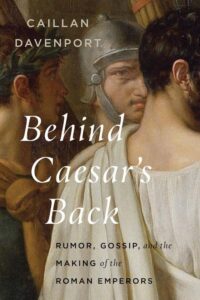
Caillan Davenport is a professor at the Australian National University. This is an edited extract from his book Behind Caesar’s Back: Rumor, Gossip, and the Making of the Roman Emperors, published by Yale University Press.