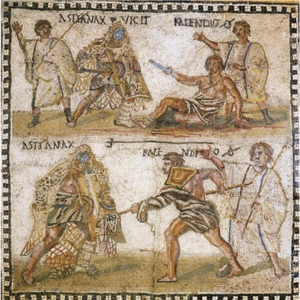
It is telling just how few mainstream films have tackled ancient Rome in the 21st century, with two notable exceptions… you know the ones I mean. Gladiators and the arches of the Colosseum are two of the most iconic images we have of the Romans and the Eternal City’s skyline, while combat in the arena is both a concept so foreign to our sensitivities and yet so ubiquitous to anyone pondering life in antiquity. Do gladiators grip our contemporary imaginations because of the Ridley Scott films, or is it the other way around? Despite swiftly puncturing the Russell Crowe ‘myth’, Harry Sidebottom, author of Those Who Are About To Die: Gladiators and the Roman Mind, bears no grudge: ‘So many modern ideas about gladiators just come from Hollywood, really. And again and again, they turn out to be completely wrong.’
It was not merely entertainment or bloodlust – one of the predominant misconceptions. Just as these modern on-screen depictions have informed the way in which we now envision and understand the ancient world, the munera (games) were also how the Romans explained themselves to themselves: ‘It’s a theatrical staging of the concept of virtus, courage, especially physical courage. The gladiators play out this central self-image of the Romans to themselves.’
But this becomes all the more contradictory when considering how onlookers viewed those on the sands of the arena: ‘They’re socially the lowest of the low – prisoners of war, condemned criminals, slaves. At the same time, they’re doing something really glamorous. That’s where the paradox comes in. They’re idealised but reviled.’ A ‘merciful’ (or not) condemnation for the unfortunates of ancient society, then, but inexplicably to us, free men would volunteer too, driven to such a choice more likely on account of poverty than heroism.
The choice to order his account across 24 hours, beginning with the cena libera (free supper) the night before and ending at dusk in the aftermath, is key to examining the strange existence lived by the combatants at close quarters. This narrative anatomy segues instinctively into food, sleep, spectacle, violence and psychology, the author noting:
‘I suddenly realised that this structure can carry so much more. You could almost do an entire cultural history of Rome through the eyes of the gladiator. It ended up being far less about what do I put in, and much more about what on earth do I leave out.’
Some of the most eyebrow-raising insights arrive early in our conversation. Far from being Adonises, the typical gladiator’s diet of barley, beans and ash-wine was designed to enhance the visual spectacle: ‘These are really chunky, hefty guys. The more subcutaneous fat they had, the more likely they were to bleed satisfyingly without puncturing vital organs. Far from being sex symbols, the average gladiator was a fat boy with bad teeth and bad breath.’
What would a Roman spectator actually see during a full day at the games? The spectacle itself would have been lengthy and drawn out – ‘a whole package of entertainment,’ says Sidebottom. There was the parade from the ludi (gladiatorial schools) at dawn; the morning taken up by wild beast hunts, including animals from all over the empire; executions – mythological re-enactments or otherwise – and circus-like entertainment at lunchtime, before the gladiatorial pairs faced off in the afternoon: ‘It’s basically saying: we rule the world.’
Social order is essential to understanding the arena as a space for holding gladiatorial games. Not only was imperial achievement projected onto the sand alongside the ideals of virtus that Rome held dear, but the architecture itself revealed the workings of hierarchy, even during leisure. Sidebottom explains: ‘It’s society stratified in stone. I nicked that from the late Keith Hopkins of Cambridge. It’s a great phrase. The social pyramid is flipped upside down, so the nearer the sand you are, the more important you are.’ Like so much that lies behind gladiatorial combat, seating in the arena was also a form of ideology: visibility among the onlookers denoted power.
One assumes that a combination of horror, shock and concern over overt bloodshed and violence is how many of us today would view such bouts and contests. So how could the Romans justify the games for over 500 years? ‘If even those scum show courage close to the steel, how much more courage will the citizens watching them derive from this!’ is Sidebottom’s rationale when placing himself in the position of a citizen or an emperor hosting such an event. It appears that the argument centred on the need for moral education, with the gladiators serving as tools and objects through which this lesson could be imparted, while cruelty played a secondary role in Roman reasoning.
Herein lies one of the most jarring dissonances – the lack of meaningful (to our eyes at least!) opposition to the games at the time, and just how alien the moral priorities of the Romans feel to a modern reader: ‘The opposition is not founded on sympathy for the guys out in the middle. The problem isn’t the suffering – it’s the bad moral effect on the audience.’ Even among Stoic writers such as Seneca the Younger, and later Christian authors decrying gladiatorial combat, it is fear of a loss of self-control that animates the critical voices: ‘The games are so exciting, you might lose your self-control. And for the Roman elite, self-control was everything. It’s what distinguishes them from the non-elite, it distinguishes them from barbarians.’
To bring up the Gladiator films and not mention Commodus, the villainous emperor played by Joaquin Phoenix, would be the ultimate transgression, one only matched by the profound shock of Rome’s leader actually fighting publicly in the arena.
‘Commodus is unique because he’s the only one who fights in the Colosseum. We have a lot of anecdotal evidence of members of the elite training as gladiators in private. It’s kind of a sliding scale of moral badness. Hanging out in a gladiatorial school, a bit bad. Training in a gladiatorial school, much worse. Actually fighting in private, getting worse still. This is the nadir, the absolute pits.’
These public performances seem to have triggered the ire of the literati, but Sidebottom notes that it is harder to know how this breaking of norms would have been received by the plebs:
‘Cassius Dio, the elite writer, says they stayed away from the games out of sheer disgust at this degrading behaviour of the emperor. But he then gives another reason: that Commodus was insane and fancied acting out a myth of Hercules and the Stymphalian birds – he was planning on getting a bow and arrow and shooting some of the audience, which would be quite a good reason not to go, really, wouldn’t it?’
Mythological re-enactment and the potential for spectator fatalities aside, the question remains: why did gladiatorial combat finally die its own death? The answer likely lies in a gradual cultural shift rather than any moral awakening:
‘Cold hard economics probably plays a role. The empire isn’t what it once was, and the emperors don’t have the disposable wealth to lavish on these shows. Ultimately, Christianity kills gladiatorial combat too – not directly, but by changing how elites display their status. They are still going to spend vast sums of money, building churches, giving alms to the poor – actions which are acceptable within a Christian frame of mind.’
2,000 years later, is it sensible to consider this entertainment unique to the Romans? Could one draw parallels with bullfighting, combat sports like boxing, or even rugby?
‘I think it was Courtney Lawes, the former England rugby forward, who was talking about how we have to take care of rugby players when it comes to head injuries, but we also have to accept, in his words, that it’s ‘a gladiatorial contest’ and that it is about physical violence. I don’t think gladiatorial combat is totally unique, but it is different. It reinforced so many Roman ideas about themselves – through courage, hierarchy and domination.’
Whether we like it or not, that vocabulary still resonates in discussions of sport today. As long as contemporary interest in physical contest remains and Hollywood keeps producing, people will continue to look back at the gladiatorial games with a strange fascination: ‘They’re hardwired into the Roman psyche, and somehow they’re still hardwired into ours.’
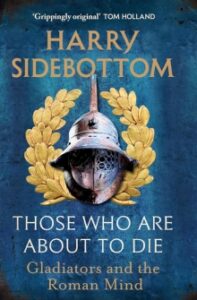
Harry Sidebottom is an academic and the best-selling author of Those Who Are About To Die: Gladiators and the Roman Mind, which was published in August 2025. You can listen to a full conversation with Harry here on the Aspects of History podcast feed.
Zeb Baker-Smith is a Classics teacher based in Malawi, a freelance journalist and Editor at Aspects of History.