
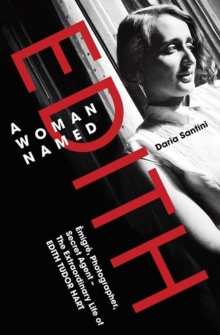
There is something fitting in the idea of a photographer spy. Both espionage and photography require close attention to detail, an awareness of perspective, and an ability to manipulate reality. Sometimes, usefully, the activities overlap. Perhaps the most influential photographer-spy of the 20th century was Edith Tudor Hart, an idealistic Austrian, whose recruiting of Kim Philby secured her a footnote in espionage history. Yet while the Cambridge spies have gone into legend, the woman at the heart of the Britain’s most treacherous spy ring has stayed largely unknown. Daria Santini’s absorbing new biography brings her back into the light.
Edith Suschitzky grew up in the tumult of post-World War One Vienna which the Social Democratic authorities were attempting to transform into a paragon of social inclusivity; focusing on women’s health, housing and child psychology. As the daughter of a well-known bookseller, Wilhelm Suschitzky, she mixed in an intellectual, left-wing crowd and attended summer retreats with lessons from the likes of Arnold Schoenberg, Oscar Kokoschka and Adolf Loos. It was when she visited England to train as a Montessori teacher that she fell in love with a doctor and keen Communist, Alexander Tudor Hart.
Back in Vienna, Edith trained in photography at the Bauhaus and it was there she discovered that photography could be a political weapon – a key medium for disseminating revolutionary views. She excelled at portraying her subjects – children, workers and the poor – as individuals rather than a faceless Proletariat.
Her main activity, however, was as a Communist courier, and, after being arrested for executing a dead letter drop in a Viennese bookshop in 1933, she fled to England, joining a bohemian crowd in Hampstead, surrounded by other European refugees. Her idealistic but unworldly husband failed to provide for her and their son Tommy, so she needed to sustain herself as a photographer. She began work at The Listener, specialising in photographing children, urban deprivation and the dismal condition of the London poor. An exception to this was her portrayal of the fascinating Lawn Road Flats, the modernist icon whose inhabitants included Walter Gropius, the Bauhaus founder, Arnold Deutsch and later, Agatha Christie, who may have had a fit to know that she had landed amid a nest of spies.
Arnold Deutsch, a Czech Jew, Communist agent runner and sometime lover, came back into Edith’s life in 1934. Deutsch, code name Otto, was a senior Soviet agent, whose plan to infiltrate British society focused on recruiting ‘disaffected bourgeois highflyers with promising careers’. By chance Edith’s Viennese friend, Lizzy, had married just such a character, Kim Philby, so on a roundabout voyage to Regent’s Park, switching taxis, tubes and trains to ensure they were not followed, Edith went about introducing the 22-year-old Philby to Deutsch. The park bench encounter went into espionage history and Santini notes that when Kim Philby was serving out his exile in Moscow, he kept a photograph of himself on the mantelpiece taken by Edith when they first met.
To her disappointment, Edith never visited the socialist paradise of the Soviet Union, instead living a rootless life, shadowed by MI5, and engaging in a series of doomed relationships, including with the influential child psychologist Donald Winnicott. A dangerous moment for her came in 1964, when Anthony Blunt confessed to the authorities, naming her as Philby’s recruiter and describing her as ‘the grandmother of us all’. Mentally fragile and at odds with the Communist party, Edith’s idealism never dimmed and Santini’s portrait is a sympathetic, one of a passionate individual who ultimately found purpose not in agent recruitment but in her photographic art.
A Woman Named Edith reads like a thriller and is superbly researched (though n.b. the Rosenbergs were electrocuted not hanged). With distinct shades of Le Carré, Edith retired to Brighton and lived a seemingly quiet life running an antique shop. Yet behind the mild façade, the significance of Edith Suschitzky in the catastrophic Soviet penetration of British society cannot be overstated.

Jane Thynne is a bestselling writer and the author of Appointment in Paris.