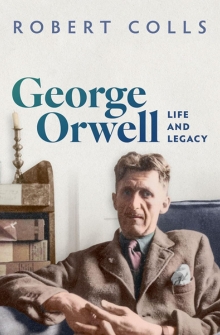
At times, this biography strays into the polemical, and for those who prefer a biographer’s voice to remain largely in the background, look away now. However, Colls does manage to successfully ‘get under the skin’ of this towering figure, even if some of his conclusions rest on personal opinion.
Colls traces Orwell’s evolution mostly – but not always – chronologically. We begin with the “King’s Scholar” and “Burma Sergeant,” where the young Blair served as a colonial policeman, an experience that forged his lifelong hatred of imperialism. Colls argues that while Orwell eventually rejected the Empire, he retained a deep and complicated sense of patriotism, viewing the English as a “family with the wrong members in control”. This theme of Englishness is central to Colls’ analysis; he presents Orwell not as a Marxist theoretician, but as a “documentarist” who believed in the “known rules of ancient liberty” found in the common people.
The biography moves briskly through Orwell’s “tramping” years, where he sought to expiate his class guilt by exploring the poverty of the working class. Colls is critical yet sympathetic regarding Orwell’s time in Wigan and Spain. He notes that while Orwell’s socialist theories were often simplistic, his moral clarity never dimmed. In Spain, Orwell witnessed the revolution being betrayed by Stalinists, a trauma that led indirectly to his two masterpieces, Animal Farm and Nineteen Eighty-Four.
Colls also touches on the influence of the two most important women in Orwell’s life, Eileen O’Shaughnessy and Sonia Brownell. He credits Eileen with being a stabilising force who saved his life in Spain, and likely a big influence on Animal Farm. Her tragic death in 1945 left Orwell to face his final years as an invalid, racing against tuberculosis to finish Nineteen Eighty-Four. Colls argues that the book was neither a prophecy nor a literal prediction of the future, but a “boot stamping on the human imagination”, and a warning against the destruction of objective truth.
Ultimately, Colls concludes that Orwell’s legacy is not just literary but institutional; he has become a statue and a meme, invoked by everyone from the BBC to the far Left. He strips away the “Saint George” mythology to reveal a man who was often wrong, occasionally prejudiced, and frequently contradictory. Yet, he remained a writer who “never wavered in his belief that the point of being George Orwell was to catch the eye and shake the hand”.
James Dunford Wood is the author of The Big Little War: The Incredible Story of How 39 Pilots From an RAF Flying School Changed the Course of WW2.