
First of all, Nicholas, congratulations on the publication of this endlessly fascinating and absorbing work. In the introduction, you describe the book as a fresh look at the subject rather than a rehash of your earlier work, Rome, Britain and the Anglo-Saxons, some 30 years ago. Without giving too much away, can you summarise what you feel to be the main developments in thinking over that period in respect of this period of Late Roman Britain and early Anglo-Saxon England?
What is most striking about how the subject developed since 1991 is the range of new techniques now embedded in scholarship. When I wrote Rome, Britain and the Anglo-Saxons, scholars depended on different blood groups to try to map movements of peoples. Now, geneticists can track population changes across tens of thousands of years. Examining modern and ancient DNA provides information regarding the patterns of migration, colonisation and intermarriage underpinning archaeological changes. It is now even possible to identify what people ate and even where they spent their childhood, using isotope analysis, alongside identifying well-being and illnesses from skeletal evidence. And in very general terms, archaeology has benefited from improved techniques of both excavation and recording, with ever more detailed analysis of the results, using computers. This has led to complete excavation and publication for the first time of one of the very large, cremation-dominated, Anglo-Saxon cemeteries in eastern England like Spong Hill in Norfolk, and a vast flow of new information from excavations powered by the statutory requirement that archaeological assessment be part of project designs. Alongside, environmental research has developed important new skills, enabling far better studies of the agrarian backdrop, for example, to life in the first millennium AD.
What advice would you have for anyone planning to write about this era? What are the main challenges they will face?
There seem to me to be two problems facing anyone attempting to wrestle with this period. The first is the wide range of different disciplines which input. Rapid increases in the quantity and quality of archaeological and scientific data have encouraged these areas to dominate studies of the period, but it is important for those entering the field to look as widely as possible across earlier approaches and techniques, as well. Secondly, the period is marginal to two period specialisms. So it is seen as an add-on by Romanists, but a prequel from the point of view of medievalists. This means few focus on it, and the few that do have to be expert in what comes before and after.
In a period famously short on contemporary writings, what does that mean for the relative importance of archaeology and what has been your approach to achieving an effective balance between the two disciplines?
This is the Dark Ages, certainly, but there is more written evidence than is often recognised, both within Britain and without, and it is something of a mistake to look for all the answers in a few short time-scale, in the fifth century. If we recognise that important aspects of the Anglo-Saxon/British interface occurred as late as the seventh and eighth centuries, far more written evidence is drawn into the discussion. Even so, archaeological evidence is increasing in both quantity and quality, making that central to any discussion of the period.
Following on that, the writings of Gildas seem to shine like a sputtering candle (rather than a beacon of light) in an otherwise darkened room – begging more questions than he perhaps answers. What’s your view of his oeuvre? Invaluable? Infuriating? Indecipherable?
Gildas’s only complete work, The Ruin of Britain, is an extraordinarily difficult text to read, let alone understand, not just because it was written in lengthy, complex sentences but also because it is a letter, part of a wider correspondence. Since several letters had already circulated, Gildas had no need to spell out his purposes or the immediate context of his work. Those earlier works are now lost, though (beyond brief references in ‘The Ruin), leaving us having to establish exactly who he was writing for and what were his intentions. There have been many hypotheses, many encouraged by the uses made of his work by later authors, particularly that of the ‘History of the Britons’. There are, though, many points of scholarly agreement, regarding Gildas’s level of education, for example, and his theory of history, which identifies Britons as the insular equivalent of God’s Old-Testament Israelites. Gildas interpreted the barbarian takeover of large parts of Britain as divine punishment of the Britons for their sins, which could be remedied only by penance and a return to the Lord. Of course, there are all sorts of issues regarding when and where he wrote, and we would have welcomed far more information regarding the world in which Gildas lived, but the argument he set out has enormous value to the historian, since it reveals something of the thought-world of Britain’s sixth-century Christian elite. As infuriating as it is invaluable, therefore.
It’s the classic question that is doubtless asked of all historians of this period… and forgive me for you must have been confronted with it multiple times in the past… what evidence is there for an historical Arthur (king, dux or whatever)?
Yes, good old King Arthur, whose name and stories resonate throughout books about this period, particularly their titles. The ‘historical’ Arthur derives from an attempt, in ninth-century North Wales, to fill out and up-date Gildas’s The Ruin. It has no contemporary value, therefore. The resulting History of the Britons developed several British hero-figures who supposedly fought foreign invaders. The first is Dolabellum, depicted as a British general combatting Caesar’s invasion. The name (Dolabella) comes from Orosius’s Seven Histories against the Pagans, wherein it denoted a Roman contemporary, not a Briton. Arthur’s role was similar, to spearhead British resistance to the Saxons. The story is rooted in Gildas’s laconic mention of a succession of conflicts in which success was divided. The History of the Britons gives names to twelve battles and claims Arthur’s success throughout. Only one, Badon, came from Gildas, the remainder were ‘borrowed’ from other texts, including Saxon victories and Briton on Briton battles. Arthur’s battle list was put together for this purpose. It has no historical reality. His name, though, is likely to have been sourced in some earlier text. There are various Arthurs known to history, in Ireland, Scotland and Wales. It is unclear which was used, perhaps an amalgam. His kingship came later, probably due to the pan-British role given him in History of the Britons.
In the book you cite newer analytical tools such as strontium analysis which can be used to help determine the whereabouts of an individual’s upbringing. Do you think we will see major new developments in the study of this era in the next thirty years and whence will they come if so?
Science marches on, advances come quicker than ever, so it seems likely that new applications will arrive soon, providing ever-better-quality information regarding what occurred in the Dark Ages. That said, the results will only ever be as good as the data sets on which scientific techniques can be applied. The difficulty will always be how to examine more archaeologically opaque sections of society, particularly the indigenous majority.
Finally, Nicholas, are you at liberty to tell us what you are working on at the moment? Just so I can start saving my pennies.
This is my last academic book, I am afraid. I retired (a little early) in 2011 to try to complete my academic work. 15 years, four books and various articles later, I am now about done.
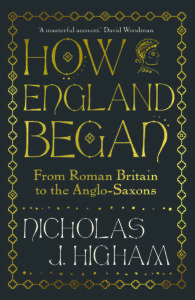
Nicholas Higham is an archaeologist, academic and the author of How England Began: From Roman Britain to the Anglo-Saxons, published by Yale University Press. You can read more by Nicholas in the forthcoming April 2026 issue of the Aspects of History magazine.
Paul Bernardi is the author of The Reckoning, the last volume in the Rebellion Trilogy, published in February 2026 by Sharpe Books.