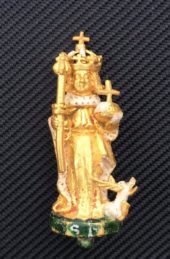

When Elizabeth I lay dying in March 1603, England held its breath.
Later generations would remember the Tudor succession as smooth, almost serene. But that is hindsight. At the time, many feared – and some expected – civil war.
Elizabeth had refused to name her successor. It was a political strategy she had long maintained: to name an heir was to weaken herself. Yet the result was that when she died at Richmond Palace there was no public proclamation of intent, no settled script. The queen who had embodied the state for forty-five years left no written instruction for what came next.
The leading councillors moved quickly. Robert Cecil had for years maintained a cautious correspondence with James VI and I, preparing the ground in secret. Within hours of Elizabeth’s death James was proclaimed king in London. But speed does not mean calm. It means urgency.
The political nation remembered the Wars of the Roses. It remembered the rebellions of the 16th century. It knew how quickly disputed succession could turn to bloodshed. England had not forgotten that Mary, Queen of Scots had once been regarded by many as Elizabeth’s rightful heir — nor that Elizabeth had executed her.
James was her son.
He was also a foreign king, raised in a fractious Scottish court. Rumour travelled faster than official proclamations. Would Catholic powers intervene? Would an alternative claimant emerge? Would London erupt?
The uncertainty was real. It shaped behaviour. Nobles raised men quietly. Letters flew across the Channel. Courtiers calculated.
After Elizabeth argues that 1603 was not the peaceful epilogue of a Golden Age, but a moment of profound instability — a hinge in English history. What followed Elizabeth’s death did not merely preserve the state; it transformed it.
Within months the new reign had already claimed casualties. The most spectacular was Sir Walter Raleigh. Once a dazzling favourite of Elizabeth, Raleigh found himself accused of treason in the so-called “Main Plot”. His trial and imprisonment signalled that the new regime would not be gentle. The hero of the Elizabethan imagination was sacrificed in the interests of security.
Nor was Raleigh alone. 1603 saw the “Bye Plot”, whispered conspiracies, arrests and executions. Hopes rose and collapsed with bewildering speed. English Catholics, who had dared to believe that the son of Mary Stuart might grant toleration, were swiftly disappointed. Puritans, who hoped for deeper reform, were equally disillusioned.
Disappointment curdled into radicalism. Within two years the Gunpowder Plot would attempt to annihilate king and parliament in a single explosion. Its origins lie in the atmosphere of frustrated expectation and tightening repression that followed the accession.
Meanwhile, the court itself was transformed. Elizabeth’s regime had been controlled, performative, hieratic. James’s was expansive, argumentative and — to many English observers — unruly. Scots arrived in numbers. Patronage shifted. The culture of access changed. What had seemed stable under Elizabeth now felt volatile.
The myth of the “Golden Age” was in large part constructed after her death. Under James, Elizabeth was polished into Gloriana, the perfect Protestant queen whose reign had been unified and triumphant. That myth served political purposes. It stabilised the new dynasty by sanctifying the old.
But myth is retrospective. The reality of 1603 was fear.
In writing After Elizabeth, I wanted to recover that sense of contingency — of roads not taken, of outcomes not yet known. We know that the Stuart century would end in civil war and regicide. The men and women of 1603 did not. They were navigating risk in real time.
It is perhaps no surprise that this moment has inspired historical thrillers. The ingredients are all there: secret correspondence, coded loyalties, faction, betrayal, religious extremism, the fall of great men. The death of a monarch creates a vacuum, and vacuums attract danger.
England avoided immediate civil war in 1603. But it did so by stepping into a new and uncertain political world. Treason trials, executions and plots were not aberrations of the early Jacobean reign — they were symptoms of a regime securing itself.
The spring of 1603 was not serene.
It was dangerous.

Leanda de Lisle is an historian and the author of After Elizabeth: The Rise of James of Scotland and the Struggle for the Throne of England.