When he was killed at the battle of Bosworth in 1485, Richard III was venerated by some contemporaries and vilified by others. Even now, five hundred and forty years later, this monarch divides opinion more than Marmite. Not many medieval kings can boast legions of followers many centuries after they died. But, for every ‘supporter’, there’s a ‘hater’. So, writing a book about Richard III is not for the faint-hearted.
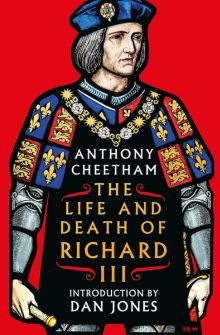
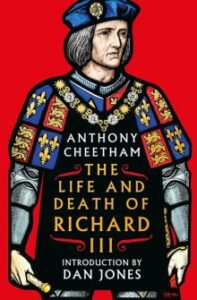
It is over fifty years since Anthony Cheetham first published his The Life and Death of Richard III, as part of a series of books on English monarchs. Yet, despite the passage of so much time, Cheetham’s analysis of Richard, as both a man and a king, still seems as even-handed and valid now as it was then. In the meantime, though many thousands of pages have been written, much ink deployed and endless online threads unravelled, very little new has been discovered. No bright-eyed young historian has had a eureka moment to solve the riddle of Richard III: how was it that a man famed for his sense of justice came to depose his nephew, young Edward V?
In this new edition of The Life and Death of Richard III, an introduction by historian, Dan Jones, helps to put the author’s book in its own historical and literary context. Against the myriad biographies and fictional representations of Richard over the centuries, Anthony Cheetham’s account still stands pretty tall.
Jones also adds a chapter to update readers about the discovery of Richard III’s skeleton in 2012, long after the book was first published. Whilst the investigation and excavation only added a limited amount about what was already known about Richard, it did excite an enormous, world-wide interest in the life of the man.
As someone who has studied, taught and written about Richard III for many years, I think that the author has got the balance about right. I very much like his approach: analyse what Richard did and then try to work out why. Cheetham is even-handed, consigning the ‘monster’ argument to the rubbish bin where it belongs and instead, attempting to construct a more realistic assessment of this fascinating character by careful examination of the evidence.
Though I would like to have seen a closer analysis of Richard’s motivation in the spring and summer of 1483, Cheetham’s assessment seems to me to hit all the right notes. He stresses that Richard lacked the charisma to forge good relationships with his nobles and that his essential belief that he was right was not shared by many contemporaries. Cheetham presents a Richard who is no Machiavelli, but a man whose political errors of judgement set him on a course which he was then obliged to follow to the bitter end.
For those interested in King Richard and the Wars of the Roses period, this new edition of Anthony Cheetham’s book is a timely reminder that the work of a good historian is always worth reading.
Derek Birks is a novelist and author of A Guide to the Wars of the Roses and a nine-book fiction series period.